
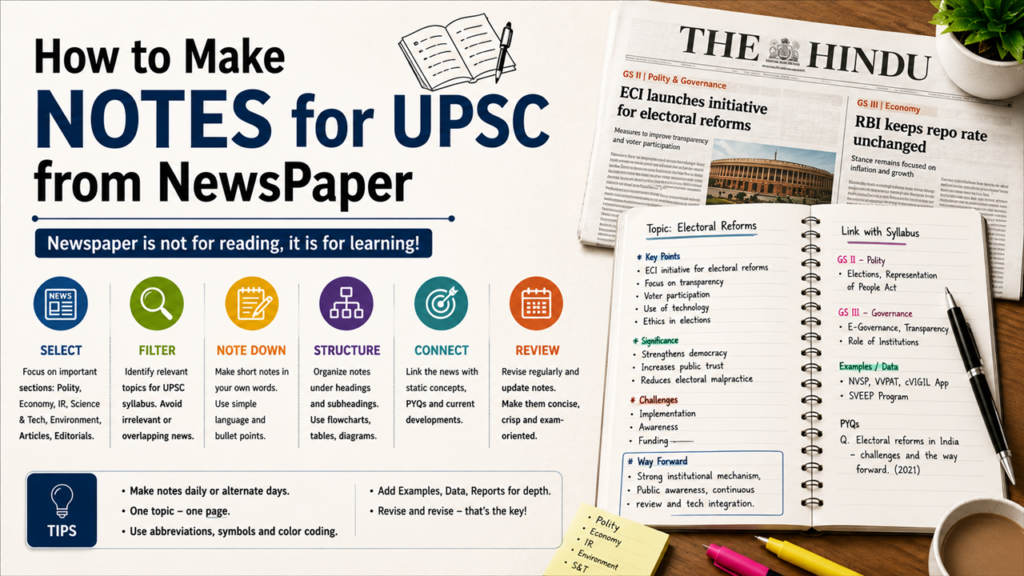
Every UPSC topper will tell you the same thing: reading the newspaper is not enough. You must make notes from it. But most students read the newspaper for one or two hours every day and still feel they are not learning anything. Why? Because they are reading, but not organising.
This guide will teach you exactly how to read a newspaper like The Hindu or Indian Express and turn it into useful, exam-ready notes for UPSC. We will explain everything in simple steps that even a beginner can follow.
Whether you are just starting your UPSC preparation or you have been studying for some time, this guide will help you save time and study smarter.
Why Newspaper Reading is Important for UPSC
1 What UPSC Expects from Current Affairs
UPSC is not just a test of your memory. It tests whether you understand the world around you. The Preliminary exam (Prelims), the Main exam (Mains), and the Interview (Personality Test) all test your awareness of current events.
UPSC asks questions like:
- What is the government doing about climate change?
- What happened at the recent G20 summit?
- What is the significance of a new law that was passed?
- How does a new policy affect common people?
These questions cannot be answered by reading only textbooks. You need current affairs, and the best source for current affairs is the newspaper.
2. The Link Between Newspaper and UPSC Syllabus
The UPSC syllabus covers many topics like History, Geography, Polity, Economy, Science and Technology, Environment, and International Relations. Almost every day, newspaper articles connect to one or more of these topics.
For example:
- An article about a new river project connects to Geography and Environment.
- An article about a Supreme Court judgement connects to Polity.
- An article about India’s trade with another country connects to Economy and International Relations.
This is why making newspaper notes is not separate from studying the syllabus. It is a part of studying the syllabus.
3. How Much Time Should You Spend?
Many students make the mistake of spending three to four hours on the newspaper every day. This is too much. You should spend one to one and a half hours on reading and noting from the newspaper. Here is a good time split:
- Reading the newspaper quickly: 30 to 40 minutes
- Making notes from important articles: 30 to 40 minutes
- Reviewing and organising your notes: 10 to 15 minutes
Pro Tip: Do not try to read every article. Skim the headlines first, then read only those articles that are related to the UPSC syllabus.
Which Newspaper to Read for UPSC
1. Best Newspapers for UPSC in 2026
There are many newspapers in India, but not all of them are equally useful for UPSC. Here are the best options:
The Hindu
This is the most recommended newspaper for UPSC. It covers national and international news with good depth. It is written in formal English and focuses on important policy and political issues. Most UPSC toppers recommend The Hindu as their primary newspaper.
Indian Express
This is the second most popular choice for UPSC preparation. It has very good editorials and opinion pieces that help you understand different sides of an issue. The ‘Explained’ section in Indian Express is very useful for UPSC.
Business Standard or Financial Express (Optional)
If you want to strengthen your Economy section, reading Business Standard or Financial Express once or twice a week can be helpful. You do not need to read these every day.
2. Which Sections to Read
You do not need to read the entire newspaper. Focus on these sections:
- Front Page: Important national and international news
- Editorial Page: Opinion pieces on current issues
- National News: Government policies, schemes, laws
- International News: India’s foreign policy, global events
- Economy Section: Budget, trade, inflation, government schemes
- Science and Technology: New discoveries, ISRO, DRDO, health
- Environment: Climate change, wildlife, pollution, international agreements
You can skip: Sports (except if a major event happened), Crime news (unless it involves policy or a court judgement), Entertainment, and most local city news.
How to Read the Newspaper for UPSC
1. The Three-Level Reading Method
Most students read the newspaper like they are reading a story. This is wrong for UPSC. You should use the three-level reading method:
Level 1: Skim (5 seconds per article)
Go through all headlines quickly. Ask yourself: ‘Is this related to the UPSC syllabus?’ If yes, mark it. If no, skip it. This takes about 10 minutes for the whole newspaper.
Level 2: Read (2 to 5 minutes per selected article)
Read only the articles you marked. As you read, think about:
- What is the main point of this article?
- Which UPSC topic does it connect to?
- Are there any important facts, dates, or terms?
- Is there a government policy or scheme mentioned?
Level 3: Note (1 to 2 minutes per article)
After reading, write down only the important points. Do not copy the article. Use your own words. This is the most important step.
2. The Five Questions Technique
When reading any article, ask yourself these five questions:
- WHAT happened? (The main event or news)
- WHO is involved? (Government, countries, organisations, people)
- WHY did it happen? (Background and reasons)
- HOW does it connect to the UPSC syllabus? (Which topic or paper?)
- SO WHAT? (What is the impact or significance?)
If you can answer these five questions, you have understood the article properly and are ready to make notes.
Important: The ‘So What?’ question is the most important one for UPSC. UPSC always asks about significance and impact, not just facts.
How to Make Notes from the Newspaper
1. Choosing Your Note-Making Method
There are two main ways to make notes: physical notebooks and digital notes. Both have advantages. Here is a comparison:
| Feature | Physical Notebook | Digital Notes |
| Remembering | Better | Depends on app |
| Editing | Difficult | Easy |
| Organisation | Manual | Automatic search |
| Speed | Slower | Faster |
| Revision | Easy to flip | Use search or tags |
| Cost | Low | Free to premium |
Our recommendation: Use a physical notebook if you are a beginner. When you are more experienced, you can switch to digital tools like Notion or OneNote.
2. The Notebook Method: Organising Your Physical Notes
If you use a physical notebook, do not just write notes randomly. Organise your notebook by topics. Here is the best way:
- Keep separate notebooks or sections for each major topic: Polity, Economy, Environment, Science and Technology, International Relations, etc.
- When you read an article, write it under the correct topic.
- Use a date at the top of each note so you know when it was published.
- Use short headings to make it easy to find the note later.
Example: If you read an article about the Digital Personal Data Protection Act in 2026, write it under ‘Polity and Governance’ and add the subheading ‘Data Protection Laws’.
3. The Note Format: What to Write
Here is a simple format you can follow for every note:
- Heading: The topic name (e.g., ‘RBI Monetary Policy 2026’)
- Source and Date: (e.g., ‘The Hindu, June 2026’)
- Key Facts: Important numbers, names, dates (3 to 5 points maximum)
- UPSC Relevance: Which paper and topic it connects to
- Background (if needed): 2 to 3 lines of context
- Significance/Impact: Why is this important?
- Keywords: Important terms or names to remember
Do not write more than one page for any single article. If you are writing more than one page, you are writing too much.
4. The Digital Method: Using Notion or OneNote
If you prefer digital notes, here are some good tools:
Notion
Notion is a free app that lets you organise notes like a database. You can create pages for each topic, add tags, and search easily. Many UPSC students use Notion in 2026 for current affairs notes.
OneNote
OneNote is part of Microsoft Office. It works like a digital notebook with sections and pages. It is simple to use and very good for organising notes.
Google Docs or Google Keep
Google Docs is good for longer, detailed notes. Google Keep is good for quick one-line notes that you can review later.
Tip for Digital Notes: Create a folder structure that mirrors your UPSC subjects. For example: Current Affairs > Polity > Supreme Court Judgements. This makes it easy to find notes during revision.
Subject-Wise Newspaper Note-Making Tips
1. Polity and Governance
Polity is one of the most important subjects for UPSC Prelims and Mains. When reading newspaper articles related to Polity, look for:
- New laws and amendments passed by Parliament
- Supreme Court and High Court judgements
- Government schemes and policies
- Constitutional issues and debates
- Elections and electoral reforms
- RTI, anti-corruption laws, vigilance
Note: For Polity articles, always note the name of the law or act, what it changes, and why it was introduced. Connect it to the relevant article of the Constitution if possible.
2. Economy
Economy questions in UPSC can be tricky. Newspaper reading helps you understand how the economy works in real life. When reading Economy articles, look for:
- Budget announcements and their impact
- RBI decisions on interest rates (Monetary Policy)
- Inflation and GDP data
- New government schemes for farmers, MSMEs, or exports
- International trade agreements
- Banking and financial sector news
Note: For Economy articles, always note the numbers. For example, if the GDP growth rate is 7.2%, write that down. UPSC often asks about such data.
3. International Relations
International Relations covers India’s relationship with other countries and global organisations. When reading these articles, look for:
- India’s visits to or from foreign leaders
- New agreements, treaties, or MoUs signed
- India’s role in global organisations like UN, WTO, IMF, G20
- Border issues and geopolitical developments
- India’s foreign aid and development projects
Note: For IR articles, always note which countries are involved, what agreement was signed, and why it is important for India.
4. Environment and Ecology
Environment questions have become very common in UPSC in recent years. Look for these in the newspaper:
- International climate conferences and agreements (like COP)
- Government policies on pollution, waste, renewable energy
- New protected areas, national parks, or wildlife news
- India’s targets for clean energy or carbon reduction
- Reports from organisations like IPCC, WWF, or UNEP
Note: For environment articles, always note the name of the report or agreement, the organisation that published it, and India’s position.
5. Science and Technology
Science and Technology is becoming more important in UPSC every year. Look for:
- ISRO missions and space developments
- Defence technology and new weapons or systems
- Artificial Intelligence, cybersecurity, digital India news
- Health news: new vaccines, diseases, WHO guidelines
- Agricultural technology: new seeds, irrigation methods
Note: For Science articles, note the name of the technology or mission, what it does, and India’s achievement or goal related to it.
6. Social Issues
Social Issues are important for UPSC Mains Essay and GS Paper 2. Look for:
- Education policy changes
- Women’s rights and gender equality news
- Health and nutrition data
- Poverty and inequality reports
- Tribal rights and minority issues
- Child labour, human trafficking, bonded labour
The Editorial Page – A Gold Mine for UPSC
1. Why Editorials Are So Important
The editorial page is the most important page in the newspaper for UPSC. Here is why:
- Editorials give you arguments and analysis, not just facts.
- They teach you how to think about an issue from multiple angles.
- UPSC Mains and Essay papers require you to write balanced views.
- Reading editorials improves your answer writing quality.
2. How to Read and Note an Editorial
Reading an editorial is different from reading a news article. Here is how to do it:
- Read the headline and introduction to understand the topic.
- Identify the main argument: What is the author saying?
- Find the supporting points: What reasons does the author give?
- Look for the counterargument: Does the author mention any problems?
- Note the conclusion: What solution does the author suggest?
When making notes from an editorial, write:
- The topic and date
- The main argument (1 to 2 sentences)
- 3 to 5 key points or arguments made
- Any important data or facts mentioned
- The conclusion or solution suggested
Golden Rule: Never copy the editorial word for word. Write the ideas in your own simple words. This will help you remember better and write better in the exam.
3. Best Editorials to Read in 2026
In The Hindu, focus on the ‘Lead’ article and the regular editorial column. In Indian Express, the ‘Explained’ section and the editorials by senior journalists on governance and economy are very useful. Look for authors who write regularly on themes that match the UPSC syllabus.
Making Monthly Compilations
1. Why Monthly Compilation is Important
Reading the newspaper daily is important, but if you do not revise your notes, you will forget most of what you read. This is why you should make a monthly compilation of your notes.
At the end of every month, go through all your daily notes and:
- Remove notes that are no longer relevant (the topic is over)
- Update notes if new information has come on the same topic
- Organise all notes topic-wise into one place
- Make a short one-page summary of the most important topics of that month
2. How to Make a Monthly Summary
Follow these steps at the end of every month:
- Open all your current affairs notes for that month.
- Sort them by topic: Polity, Economy, Environment, IR, Science, Social Issues.
- For each topic, write a short summary of the most important events.
- Make a ‘Keywords List’ with all important terms, schemes, acts, and names.
- Mark topics that are likely to appear in UPSC as ‘High Priority’.
3. The 3-Month Revision Cycle
UPSC exams test events from the last one to two years. So you should not only revise last month’s notes, but also notes from 2 to 3 months ago. Here is a simple revision cycle:
- Every Sunday: Revise notes from the past week
- End of month: Make monthly compilation
- Every 3 months: Revise the last 3 monthly compilations together
- Before Prelims: Revise all monthly compilations from the last 12 months
Common Mistakes to Avoid
1. Reading Without Making Notes
This is the most common mistake. Students read the newspaper for 2 hours and make no notes at all. After a few days, they remember almost nothing. Always make notes as you read.
2. Writing Too Much
Some students write pages and pages of notes for every article. This is also wrong. If your notes are too long, you will never revise them. Keep each note short. Maximum one page for any article. Maximum 5 to 7 bullet points.
3. Not Connecting to the Syllabus
Making notes without thinking about which part of the UPSC syllabus they connect to is a waste of time. Before writing any note, ask yourself: ‘Which GS paper does this belong to?’ If you cannot answer this, the article may not be important enough to note.
4. Reading Too Many Newspapers
Some students read three or four newspapers every day. This is a mistake. Stick to one main newspaper (The Hindu or Indian Express). Reading more than one newspaper means you will spend all your time on current affairs and have no time for other subjects.
5. Ignoring Old News
UPSC often connects current events to historical background. If you only read today’s news without understanding why something happened, your notes will not be useful for Mains answers. Always note the background of an issue.
6. Not Revising Notes
The biggest mistake of all: making notes and never reading them again. Notes are only useful if you revise them. Make a schedule to revise your notes regularly. Without revision, even the best notes are useless.
Sample Note – A Practical Example
1. Sample Article Topic: India Signs New Trade Agreement
Let us say you read this article in the newspaper: ‘India and the European Union signed a Free Trade Agreement (FTA) in June 2026 to boost bilateral trade. The agreement covers goods, services, investments, and intellectual property. Trade between India and EU currently stands at 120 billion dollars annually.’
2. How Your Note Should Look
Here is how you should note this article:
Topic: India-EU Free Trade Agreement (FTA) 2026
Source: The Hindu | Date: June 2026
UPSC Paper: GS Paper 2 (International Relations) + GS Paper 3 (Economy)
Key Facts:
- India and EU signed FTA in June 2026
- Covers: goods, services, investments, intellectual property
- Current bilateral trade: USD 120 billion per year
Significance: Largest trade deal India has signed with a bloc; will increase exports, create jobs, and improve diplomatic ties.
Keywords: FTA, bilateral trade, EU, intellectual property, goods and services trade
See how the note is short, clear, and organised. It has the source, UPSC relevance, key facts, significance, and keywords. This is the format you should follow every time.
Using Newspaper Notes in the Exam
1. For UPSC Prelims
Prelims is an objective exam. Current affairs questions in Prelims usually ask:
- Which organisation published a particular report?
- What is a particular scheme or act about?
- When was an agreement signed or what does it cover?
Your newspaper notes help you remember these facts quickly. During revision before Prelims, go through your monthly compilations and memorise key data points, names, and schemes.
2. For UPSC Mains
Mains is a written exam where you write long answers. Current affairs from your newspaper notes help you:
- Give current examples to support your points
- Quote recent government policies or court decisions
- Show the examiner that you understand real-world applications
When writing a Mains answer, try to include at least one or two current examples from your newspaper notes. This makes your answer stand out.
3. For the Interview
The UPSC Interview tests your awareness about current events and your opinions on them. Reading editorials regularly and noting different viewpoints will help you answer interview questions confidently. You will be able to give balanced, well-reasoned answers.
A Recommended Daily Routine
1. Sample Daily Schedule for Newspaper and Notes
Here is a simple daily routine that balances newspaper reading with other subjects:
- 6:00 AM to 6:40 AM: Read the newspaper (skim headlines, then read selected articles)
- 6:40 AM to 7:20 AM: Make notes from today’s newspaper
- 7:20 AM to 7:30 AM: Quick review of yesterday’s notes
- Rest of the day: Study other subjects as per your schedule
- Every Sunday morning (extra 30 minutes): Review and organise the week’s notes
This routine takes about one and a half hours in the morning and keeps your current affairs always fresh.
2. What to Do If You Miss a Day
Life happens. Sometimes you cannot read the newspaper for a day or two. Do not panic. Here is what to do:
- Do not try to cover all missed days at once. This will waste too much time.
- Go back only one day and read the most important articles.
- For older missed days, rely on current affairs apps or summaries to catch up quickly.
- Never spend more than 2 hours on catching up. Move on and stay consistent from the next day.
Helpful Tools and Resources for 2026
1. Current Affairs Supplements and Apps
Along with daily newspaper reading, these resources can help you:
- Yojana and Kurukshetra magazines: Published by the Government of India. Very useful for Mains.
- PIB (Press Information Bureau): Official government press releases. Good for government schemes.
- PRS India (PRS Legislative Research): Tracks bills and laws passed in Parliament.
- Current affairs apps: Apps like Unacademy, BYJU’s, or Testbook provide daily current affairs summaries. Useful for quick revision, but should not replace newspaper reading.
2. Using YouTube for Current Affairs
Many educators on YouTube provide good explanations of important news topics for UPSC. Watching a 10 to 15 minute video on a complex topic can help you understand it better before making notes. However, YouTube should supplement your reading, not replace it.
3. Peer Discussion
Discussing current affairs with a study partner or a group is one of the best ways to remember what you have read. After you make your notes, try explaining the topic to someone else in simple words. If you can explain it, you understand it well enough for the exam.
Conclusion
Making notes from the newspaper for UPSC is not about doing something special once. It is about doing something simple every single day. The students who succeed in UPSC are not always the smartest ones. They are the most consistent ones.
Start small. Read one or two articles today and make short notes. Tomorrow, read two or three. In a few weeks, you will have a good daily habit. In a few months, you will have a strong collection of notes that will help you in Prelims, Mains, and the Interview.
Remember these key points:
- Read The Hindu or Indian Express every day for 30 to 40 minutes
- Make short, organised notes using the simple format given in this guide
- Connect every note to the UPSC syllabus
- Make monthly compilations and revise them regularly
- Read editorials to improve your thinking and writing
- Stay consistent. Even 20 minutes a day is better than 3 hours once a week

StudentsTalk.in, is an education-focused platform dedicated to helping students stay informed about the latest academic updates, scholarships, entrance exams, career opportunities, government schemes, and study resources. With a passion for education and student success, she creates informative, easy-to-understand content.