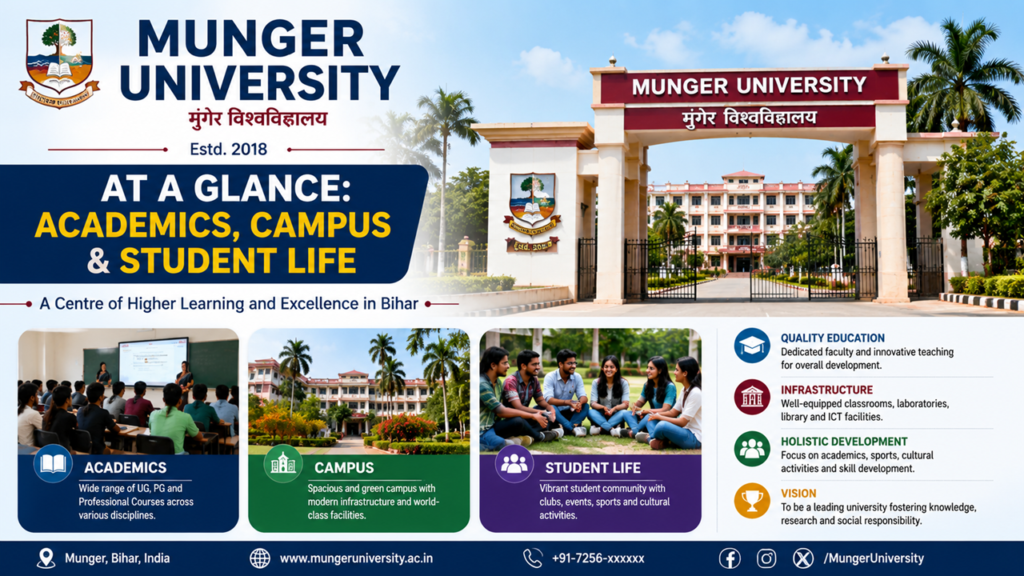
If you are thinking about joining a university in Bihar, Munger University is a name you must know. Whether you are a student fresh out of Class 12, a parent looking for a good and affordable college, or someone who just wants to learn more about higher education in eastern Bihar — this blog is for you.
In this blog, we will tell you everything about Munger University — its history, courses, campus, facilities, student life, admissions, fees, scholarships, and much more. We have written this in simple language so every student can understand it easily.
So, let us begin.
What is Munger University?
Munger University is a public state university located in Munger, Bihar. It is a government university, which means it is run by the state government of Bihar. The university was officially established on 18 March 2018. It came into existence when the Bihar government decided to split Tilka Manjhi Bhagalpur University into two parts. One part continued as Tilka Manjhi Bhagalpur University, and the new part became Munger University.
The idea to create this university was first thought of by Bihar Chief Minister Nitish Kumar on 16 August 2016, during one of his visits to the Munger region. The goal was simple — to bring better higher education closer to the students of this area, so they do not have to travel far to cities like Bhagalpur, which is about 70 kilometres away.
The university is recognised by the University Grants Commission (UGC) and is also a member of the Association of Indian Universities (AIU). This means that the degrees given by Munger University are valid and accepted all over India.
Currently, the university operates from the Science Block of R.D. & D.J. College in Munger, Bihar (PIN: 811201). This is the temporary headquarters of the university while a permanent campus is being developed.
Where is Munger University Located?
Munger University is located in Munger, a city in eastern Bihar. Munger is a very historic city — it sits on the banks of the holy river Ganga and has a rich cultural heritage. The city is also surrounded by natural beauty, with hills, forests, and rivers nearby.
What makes the location of Munger University even more special is that it sits between two of India’s most ancient centres of learning — Nalanda and Vikramshila. These were world-famous universities thousands of years ago. So, Munger has always been a land of learning, and this new university continues that great tradition.
The university’s jurisdiction covers five districts in the Munger Division:
- Munger
- Lakhisarai
- Sheikhpura
- Jamui
- Khagaria
This means that students from all these five districts can study under Munger University, either in its constituent colleges or in its affiliated colleges spread across the region.
A Brief History of Munger University
Before Munger University existed, the colleges in the Munger Division were all affiliated with Tilka Manjhi Bhagalpur University in Bhagalpur. Students and college staff had to travel all the way to Bhagalpur for university-related work — examinations, admissions, document verification, and more. This was very inconvenient, especially for students from rural areas.
Bihar has long faced challenges in education. Many rural districts, including those in the Munger Division, had low literacy rates and limited access to quality higher education. The Bihar government took a big step by creating Munger University to directly serve the educational needs of this region.
The university was created under the Bihar State Universities (Amendment) Act, 2016 (Bihar Act 1/2017). It formally began its academic operations in the 2018–19 academic year. Since then, it has grown steadily, adding more colleges under its wing and offering more programs to students every year.
Today, the university is led by Vice-Chancellor Prof. (Dr.) Sanjoy Kumar, who was appointed in January 2025. Under his leadership, the university is focusing on modern education, research, and skill development to make students ready for today’s competitive world.
Courses Offered at Munger University
Munger University offers a wide range of courses for students at every level. Whether you want to study after Class 12 or want to continue after graduation, there is a course for you here. The university offers over 100 courses in total across different streams and levels.
1. Undergraduate Courses (After Class 12)
These are three-year degree programs for students who have completed Class 12 (Intermediate). Some popular UG courses at Munger University are:
- A. (Bachelor of Arts) — in subjects like History, Geography, Political Science, Economics, Hindi, English, Sociology, and more
- Sc. (Bachelor of Science) — in Physics, Chemistry, Mathematics, Biology, Botany, Zoology, etc.
- Com. (Bachelor of Commerce) — for students interested in business and accounting
- C.A. (Bachelor of Computer Applications) — for students interested in computers and technology
- B.A. (Bachelor of Business Administration) — for students who want a career in management
- Ed. (Bachelor of Education) — for students who want to become teachers
- Tech (Bachelor of Technology) — engineering programs
- Sc. Nursing — for students interested in the healthcare sector
2. Postgraduate Courses (After Graduation)
These are two-year programs for students who have completed their graduation. Some popular PG courses are:
- A. (Master of Arts) — in subjects like History, Economics, Hindi, Political Science, Sociology, etc.
- Sc. (Master of Science) — in various science subjects
- Com. (Master of Commerce)
- C.A. (Master of Computer Applications)
- B.A. (Master of Business Administration)
- Tech (Master of Technology)
- MBBS (through affiliated medical institutions)
3. Doctoral Programs (PhD)
Munger University also offers PhD programs for students who wish to do advanced research. Admission to the PhD program is done through the PhD Admission Test (PAT). Students who clear this test and have a postgraduate degree can join the PhD program in their chosen subject.
4. Vocational and Skill-Based Courses
In addition to the regular degree programs, Munger University also offers vocational courses in areas like Bio-Technology and Bio-Informatics. These courses are designed to give students practical, job-oriented skills that are useful in the real world. The university is also working on aligning its programs with the National Education Policy (NEP) 2020 to introduce more skill-based and interdisciplinary education.
Admission Process at Munger University
Getting admission to Munger University is not very difficult, but you need to know the right process. Here is a simple explanation of how admission works.
1. Merit-Based Admission (Most Courses)
For most undergraduate courses like B.A., B.Sc., and B.Com., admission is done on a merit basis. This means your marks in Class 12 (Intermediate exam) will decide whether you get admission. There is no separate entrance exam. The better your Class 12 marks, the better your chances.
The basic eligibility for undergraduate admission is that you must have passed Class 12 with at least 50% marks. For postgraduate programs, you need to have a bachelor’s degree with at least 55% marks.
2. Entrance Exam-Based Admission (Some Courses)
Some courses require you to give an entrance exam. For example:
- Ed.: You need to appear for the Bihar B.Ed. CET (Common Entrance Test).
- PhD: You need to appear for the PhD Admission Test (PAT).
- Some professional courses may also have their own entrance requirements.
How to Apply
The admission process for Munger University is done online. Merit lists for every college are published on the official website of the university at mungeruniversity.ac.in. Students can check the merit lists, complete their application, and get updates about their admission status on this website.
It is always a good idea to keep checking the university’s official website for the latest admission dates and notifications, as these can change every year.
Fees at Munger University
One of the best things about Munger University is that it is very affordable. Since it is a government university, the fees are kept very low compared to private colleges. Students from all economic backgrounds can afford to study here without taking big loans.
The fee structure varies depending on the course and the college. In general, the annual fees for undergraduate courses like B.A., B.Sc., and B.Com. are very low — often just a few thousand rupees per year. The university also has a policy of no unnecessary fee hikes, which means students and parents do not have to worry about sudden increases in fees.
For the exact and latest fee details for each course and college, it is best to check the official website at mungeruniversity.ac.in or contact the specific college directly.
Scholarships Available at Munger University
Munger University believes that every deserving student should get the chance to study, regardless of their financial situation. That is why the university and the Bihar government offer several scholarships to help students. Here are the main ones:
SC/ST Full Tuition Fee Waiver
Students who belong to Scheduled Castes (SC) or Scheduled Tribes (ST) and whose family income from all sources is less than Rs 2.5 lakh per year can get a 100% scholarship on tuition fees. This means they do not have to pay any tuition fee at all. This is a huge help for students from economically weaker backgrounds.
OBC and Minority Scholarships
Students from OBC (Other Backward Classes) and minority communities can also apply for government-funded scholarships. These scholarships are given based on economic need and academic performance.
EWS Scholarship
Students from Economically Weaker Sections (EWS) — the general category students who have low income — can also apply for special scholarships under the EWS category.
Merit-Based Scholarships
In addition to income-based scholarships, there are also scholarships for meritorious students who perform exceptionally well in their exams. These scholarships encourage students to study hard and do their best.
Constituent and Affiliated Colleges
Munger University does not have just one campus. It is like a family of colleges spread across five districts. When you study at any of the colleges under Munger University, your degree is given by Munger University — so it is a valid and recognised university degree.
Here is a quick look at the number of colleges under the university:
- 17 Constituent Colleges — these are colleges directly run by the university
- 17 Affiliated Colleges — these are private colleges affiliated with the university
- 5 B.Ed. Affiliated Colleges — colleges that specifically offer B.Ed. programs for aspiring teachers
- 1 Affiliated Law College — for students who want to study law
- 61 General Affiliated Degree Colleges — spread across the five districts
- 16 Professional Affiliated Colleges — offering professional courses
These colleges are spread across Munger, Lakhisarai, Sheikhpura, Jamui, and Khagaria districts. This wide network means that students from even the most remote villages in these districts do not have to go far to get a university education.
The Munger University Campus
Currently, Munger University operates from the Science Block of R.D. & D.J. College in Munger city. The campus spans over 25 acres and is situated in Shastrinagar, Munger. It is a pleasant environment to study in, with a mix of academic buildings, open spaces, and facilities for students.
1. Library
The central library at Munger University has a large collection of books, reference materials, and academic resources. Students can use the library for studying, research, and finding information for their assignments. The library is a favourite place for serious students who want to go beyond their textbooks.
2. Computer Labs and IT Infrastructure
The university has computer laboratories equipped with modern systems for students who are studying computer applications, technology, and related subjects. The campus also has Wi-Fi connectivity and internet access, which is very useful for students doing research and online learning.
3. Examination and Administrative Halls
Munger University has well-organised examination halls where semester and annual examinations are held. The administrative offices are also located at the main campus, where students can go for issues related to admissions, results, certificate verification, and other official matters.
4. Sports Ground
The university has an open ground where sports activities take place. Events like javelin throw and other field sports are popular among students. While the sports infrastructure is still growing, students have access to an open space where they can play and be physically active.
5. Hostels and Accommodation
Accommodation is available for students at the university. Hostel facilities are provided for both male and female students. The accommodation has been rated well by students in reviews, with a score of 4.2 out of 5, which shows that students are generally satisfied with where they live during their studies.
Student Life at Munger University
Life as a student at Munger University is about much more than just attending classes and giving exams. The university believes in the overall development of every student — academically, socially, and personally. Here is what student life looks like at Munger University.
1. Annual Festivals and Events
The university organises various annual festivals and events throughout the year. The months from October to February are especially festive, with cultural programs, sports competitions, and other celebrations happening on campus. These events are a great way for students to come together, have fun, and make memories.
2. Student Clubs and Social Groups
There are student-run social groups and clubs at Munger University that help students connect with each other and engage in meaningful activities. These groups are a good way to make friends, develop leadership skills, and work as part of a team. Students have noted that these clubs also help them in their academic journey.
3. Social Work and Community Service
Munger University encourages students to give back to society. The university organises various social activities like blood donation camps, awareness campaigns, and community service programs. Students who participate in these activities not only help their community but also develop a sense of responsibility and compassion.
4. Sports and Physical Activities
Sports events are very popular at Munger University. Field sports like javelin throw, athletics, and other outdoor games are organised on campus. While the university is still building its sports infrastructure, students have access to the open ground and can participate in competitions and sports activities throughout the year.
What Students Say
Based on reviews from students who have studied here, Munger University has received an overall rating of 4 out of 5. Students have praised the faculty for being helpful and cooperative. The social life on campus has also been rated highly. Students say the campus life is enjoyable and memorable — a place where they have learned, grown, and made lifelong friends.
As one student put it: “I spent three years in this college and experienced many types of activities. I also participated in social work, which was a great experience.” Another student mentioned: “It was a good experience. There were good social aspects and club involvement was okay. Overall, the college was good.”
Faculty and Teaching Quality
The faculty at Munger University has been consistently praised by students. In reviews, teachers have been described as “very good and cooperative in nature.” The faculty rating among students stands at 4.1 out of 5, which is a very good score.
The teachers at Munger University are qualified professionals who are committed to helping students learn. They are available to answer questions, guide students through difficult topics, and support them in their academic journey. The student-teacher relationship at Munger University is known to be friendly and respectful.
The university is also working on bringing in the Choice Based Credit System (CBCS), which gives students more flexibility in choosing their subjects. This system allows students to pick elective subjects based on their interests, rather than being stuck with a fixed set of subjects. This is a modern approach to education that helps students explore different fields.
University Governance and Leadership
Munger University follows the standard governance structure of state universities in Bihar. Here is a simple breakdown of who runs the university:
- Chancellor: The Governor of Bihar serves as the ex-officio Chancellor of the university. The Chancellor is the ceremonial head and has the power to appoint the Vice-Chancellor.
- Vice-Chancellor: The Vice-Chancellor is the actual head of the university who manages its day-to-day operations. Currently, Prof. (Dr.) Sanjoy Kumar serves as the Vice-Chancellor (appointed January 2025).
- Academic Council: This council oversees all academic matters, including curriculum design, examination policies, and academic standards.
- Executive Council: This body handles the administrative and financial decisions of the university.
The university is governed under the Bihar State Universities Act, 1976, as amended in 2016. This legal framework ensures that the university operates according to the rules and standards set for all state universities in Bihar.
Placements and Career Opportunities
Munger University is still a young university — it started in 2018. So, its placement infrastructure is still developing. However, the university is actively working on building bridges between students and the corporate world.
Students who study professional courses like BBA, MBA, BCA, MCA, and B.Tech at affiliated colleges have better chances of campus placements. The university is working on connecting students with industries and companies in Bihar and beyond.
For students who study arts, science, and commerce, careers in teaching, government jobs, banking, civil services, and other public sector roles are very common. Many students go on to appear in competitive exams like BPSC, SSC, Banking exams, and UPSC after completing their degrees from Munger University.
The placement rating given by students stands at 3.8 out of 5, which reflects that while the university is doing well, there is still room to grow in this area. As the university matures and builds more industry connections, placements are expected to improve significantly.
Why Should You Choose Munger University?
There are many reasons why Munger University is a good choice for students in eastern Bihar. Here are the most important ones:
1. Affordable Education
As a government university, Munger University charges very low fees. Students from low-income families can get a university degree without spending a lot of money. Combined with scholarships, many students pay almost nothing for their education.
2. Wide Range of Courses
With over 100 courses in arts, science, commerce, management, technology, law, education, and more, there is something for every student at Munger University. No matter what career you want to build, you can find the right course here.
3. UGC Recognised Degree
Since Munger University is recognised by the UGC, the degrees you earn here are valid and accepted all over India. You can use your degree for jobs, higher studies, and government exams without any problem.
4. Close to Home
For students from Munger, Lakhisarai, Sheikhpura, Jamui, and Khagaria, studying at Munger University means they do not have to go far from home. They can stay with their families and still get a good university education. This saves money on rent and food as well.
5. Holistic Development
Munger University is not just about books and exams. It cares about the complete development of every student. Through festivals, sports, clubs, social work, and various activities, students grow as individuals — not just as scholars.
6. Scholarship Support
The university offers excellent scholarship support for SC/ST students, OBC and minority students, EWS students, and meritorious students. Financial difficulties should not stop a student from getting educated, and Munger University stands firmly by this belief.
7. Friendly and Cooperative Faculty
Students consistently rate the faculty at Munger University highly. Teachers here are not just instructors — they are mentors who guide students through their academic and personal challenges. A good teacher can make a huge difference in a student’s life, and Munger University understands that well.
Tips for New Students Joining Munger University
If you are about to join Munger University or are planning to apply, here are some helpful tips to make the most of your time there:
- Stay updated with the official website (mungeruniversity.ac.in) for all admission dates, merit lists, and important notifications.
- Apply early — do not wait until the last day. Admission seats can fill up fast, especially in popular courses.
- Make use of the library. It is one of the best resources on campus and can help you go beyond your textbook knowledge.
- Join student clubs and social groups. They are a great way to make friends and develop skills that will help you in your career.
- Participate in sports and cultural events. University life is short, and these memories will stay with you forever.
- Apply for scholarships as soon as you are eligible. These are free money for your education — do not miss out on them.
- Talk to your teachers. They are there to help you. Do not be shy about asking questions or seeking guidance.
- Prepare for competitive exams like BPSC, SSC, and banking exams alongside your degree. Many students from government universities in Bihar go on to crack these exams and get good government jobs.
- Respect the campus environment. Keep the campus clean and be a responsible student.
- Enjoy every moment. These university years are some of the best years of your life — make the most of them!
Important Contact Information
If you want to know more about Munger University, reach out to them directly. Here is the contact information:
- Official Website: mungeruniversity.ac.in
- Address: Munger University, Shastrinagar, R.D. & D.J. College Campus, Munger, Bihar — 811201
- Nearest Bus Stand: Munger Bus Stand (approximately 2.2 km from the campus)
For questions about specific colleges under the university, merit lists, or affiliated colleges, you can also visit the individual college’s office or check their information on the Munger University website.
Final Thoughts
Munger University may be a young institution, but it is growing fast and playing a very important role in transforming higher education in eastern Bihar. With affordable fees, a wide range of courses, dedicated teachers, scholarship support, and a growing campus network, it is giving thousands of students from rural and semi-urban backgrounds a real chance at a bright future.
Its location in the historic city of Munger — sitting between the ancient knowledge hubs of Nalanda and Vikramshila — is symbolic. Just as those ancient universities once attracted scholars from all over the world, Munger University today is becoming a centre of learning for students across the Munger Division.
If you are a student from Munger, Lakhisarai, Sheikhpura, Jamui, or Khagaria — or even from other parts of Bihar — Munger University is absolutely worth considering. It offers a solid foundation for your academic and professional life, at a cost that will not burden your family.

StudentsTalk.in, is an education-focused platform dedicated to helping students stay informed about the latest academic updates, scholarships, entrance exams, career opportunities, government schemes, and study resources. With a passion for education and student success, she creates informative, easy-to-understand content.