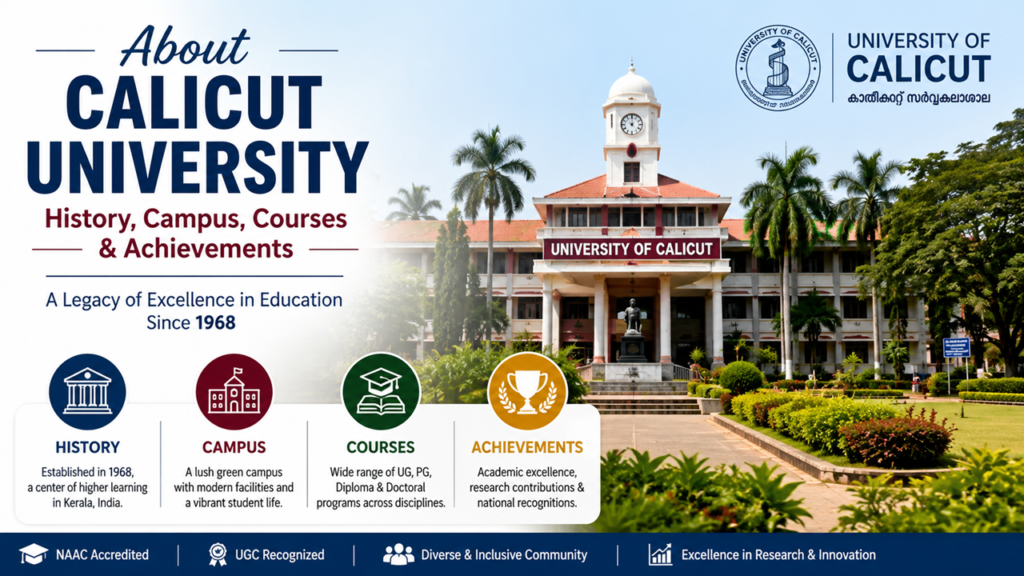
Have you ever wondered which university in Kerala serves the most students? The answer is the University of Calicut — also known simply as Calicut University. It is the largest university in Kerala and one of the most important universities in South India.
Whether you are a Class 12 student thinking about where to study, a parent trying to understand your child’s options, or someone who just wants to know more about this famous institution — this blog is written just for you. We have used simple, everyday language so that everyone can understand.
In this blog, you will learn about:
- When and how the university started
- Where the campus is and what it looks like
- What courses are available and how to apply
- Great achievements and rankings of the university
- Famous people who studied here
So let us begin!
History of Calicut University — How It All Started
The Beginning: 1968
The University of Calicut was established in the year 1968. Before this, there was only one university in Kerala — the University of Kerala, located in Thiruvananthapuram (the capital city in south Kerala). The people in northern Kerala had to travel very far to study at a university level.
The government decided to split Kerala University into two parts to serve students better. The new university was set up to serve the northern districts of Kerala — places like Kozhikode (Calicut), Malappuram, Palakkad, Thrissur, Wayanad, and Kannur. This is how the University of Calicut was born.
In simple words: The government saw that students in north Kerala had no easy access to a university. So they created one specifically for them.
The Calicut University Act 1975
The university started in 1968, but its rules and structure were officially set by the Calicut University Act of 1975, which was passed by the Kerala Legislative Assembly. This Act made the university a proper legal institution with clear rules about how it should be run, who should lead it, and how it should help students.
The First Vice-Chancellor
The first Vice-Chancellor of Calicut University was M. M. Gani, who served from 1969 to 1975. He was responsible for setting up all the early systems, departments, and structures of the university from scratch. It was a huge and challenging job, but thanks to his leadership, the university grew rapidly.
The Name — Why ‘Calicut’?
You might wonder — the university is located in Tenhipalam, Malappuram district, not in the city of Calicut (now called Kozhikode). So why is it called Calicut University?
The answer is simple. Calicut (Kozhikode) is the most famous city in north Kerala. It was a major trading port in ancient and medieval times — Vasco da Gama, the famous Portuguese explorer, landed here in 1498. The city was known all over the world by the name ‘Calicut’. When the university was named, ‘Calicut’ was chosen because it represented the identity and pride of the entire northern Kerala region.
Growth Over the Decades
When the university started, it was small. Over the decades, it grew into one of the largest affiliating universities in India. Let’s look at this growth in a simple timeline:
- 1968: University established. First departments created.
- 1969–1975: M. M. Gani serves as first Vice-Chancellor. Core academic structure is built.
- 1975: Calicut University Act passed, giving the university a strong legal foundation.
- 1980s–1990s: More affiliated colleges added. New departments in science, management, and law introduced.
- 2000s: Distance education expanded. School of Distance Education (SDE) grows significantly.
- 2014–15: Engineering colleges move to APJ Abdul Kalam Technological University (KTU).
- 2019: NAAC re-accreditation with ‘A+’ Grade — a top honour in Indian higher education.
- 2026: Over 406 affiliated colleges, 34 departments, nearly 1 lakh (100,000) students annually.
The University’s Motto
The motto of Calicut University is “Nirmaya Karmana Sri” — a Sanskrit phrase that means “Prosperity will be Produced by Pure Action.” This motto reflects the core values of the university: work hard, work honestly, and good things will follow.
This is a beautiful thought for students — it means that if you put in sincere effort in your studies and life, success will naturally come to you.
The Campus — What It Looks Like and Where It Is
Where Exactly Is the University?
The main campus of the University of Calicut is located at Tenhipalam (also spelled Thenjipalam) in Malappuram district, Kerala. It is about 24 km from Kozhikode city and about 30 km from Malappuram town.
The area is green, hilly, and peaceful — like a hill station. If you visit, you will feel like you are in the middle of nature. The campus is surrounded by trees, and the air is fresh. This calm environment is perfect for studying.
How Big Is the Campus?
The campus spreads over approximately 520 acres of land. That is a very large area — roughly equal to 400 football fields put together! Walking from one end to the other would take quite a long time.
Main Buildings and Facilities
Let’s look at the important buildings and facilities on campus:
- Administration Block: This is the main building where the university offices are located. All important university work — admissions, examinations, results — is managed from here.
- Teaching Departments (34 Departments): Each subject has its own department building where classes, labs, and research take place. There are 34 teaching departments on the main campus covering subjects from Arabic to Zoology.
- University Library: The central library is huge and one of the best in Kerala. It has thousands of books, journals, research papers, and e-resources. Students can spend hours here studying and exploring.
- School of Distance Education (SDE): A separate building for students who cannot attend regular classes. SDE allows lakhs of students across Kerala and India to study through correspondence and online methods.
- Pareeksha Bhavan (Examination Hall): This is the central examination building where major university exams are conducted and results are processed.
- UGC-HRD Centre: A training centre for teachers and faculty where workshops and development programs are held, funded by the University Grants Commission (UGC).
- Smart Classrooms: Modern classrooms with projectors, computers, and audio-visual systems to make learning more interactive and interesting.
- Laboratories: Dedicated science, computer, and research labs for students to do practical work.
- Hostels: Separate hostels for boys and girls so that students from far-away places can stay on campus comfortably and safely.
- Sports Facilities: Grounds for football, cricket, basketball, and other sports. There are also facilities for indoor games.
- Cafeterias and Canteens: Several canteens serve affordable and nutritious food to students and staff throughout the day.
- Health Centre: An on-campus health centre where students can get basic medical help without leaving campus.
- Guest House: Accommodation for visiting professors, researchers, and guests who come to the university for conferences or work.
How to Reach the Campus
Getting to the campus is fairly easy:
- By Train: The nearest railway station is Tirur or Kozhikode. From there, buses or auto-rickshaws go to the campus.
- By Bus: Regular KSRTC (government) and private buses run from Kozhikode and Malappuram to the campus.
- By Air: The nearest airport is Calicut International Airport (CCJ), about 35 km away.
- By Road: The campus is well-connected to the National Highway network.
Courses Offered — What Can You Study Here?
Calicut University offers a very wide range of programmes. Whether you love science, arts, business, law, or technology — there is something here for everyone. The university has 34 departments on its main campus and 406 affiliated colleges offering many more programmes.
Undergraduate (UG) Programmes — For Class 12 Passouts
These are 3-year or 4-year programmes that you can join after completing your Class 12 (Plus Two). From 2024, a new Four-Year Undergraduate Programme (FYUGP) has been introduced under the National Education Policy (NEP), giving students more flexibility in choosing subjects.
- Sc. (Bachelor of Science): Physics, Chemistry, Mathematics, Zoology, Botany, Biotechnology, Statistics, Biochemistry, Electronics, Geology, Computer Science, Environmental Science, Nanoscience and Technology, Applied Physics, and more.
- A. (Bachelor of Arts): English, Malayalam, Hindi, Arabic, Sanskrit, History, Economics, Political Science, Sociology, Psychology, Philosophy, Folklore Studies, Russian and Comparative Literature, and more.
- Com. (Bachelor of Commerce): Regular B.Com and B.Com with Computer Application.
- BBA (Bachelor of Business Administration): Business and management fundamentals.
- BCA (Bachelor of Computer Applications): Computer programming and IT basics.
- Ed. (Bachelor of Education): For students who want to become school teachers.
- LLB (Bachelor of Law): A 3-year law degree for graduates.
- Hotel Management / Catering Science: For students interested in the hospitality and tourism industry.
Postgraduate (PG) Programmes — For Graduates
These are mostly 2-year programmes that you can join after completing your Bachelor’s degree. Many PG programmes require you to clear the Calicut University Centralized Entrance Test (CU-CET).
- Sc.: Mathematics, Physics, Chemistry, Zoology, Botany, Statistics, Biotechnology, Food Science and Technology, Health and Yoga Therapy, Environmental Science, Nanoscience, and more.
- A.: Economics, History, Political Science, Sociology, Psychology, Malayalam, English, Hindi, Arabic, Folklore, Islamic History, Urdu, and more.
- Com.: Advanced commerce and accountancy.
- MBA (Master of Business Administration): Business management with various specialisations.
- MCA (Master of Computer Applications): Advanced computer science and IT.
- Ed.: Advanced teacher training and education.
- LLM (Master of Laws): Advanced study of law.
- MJMC (Master of Journalism and Mass Communication): Media, journalism, digital content, and public relations.
- Tourism and Hospitality Management: For students wanting careers in travel and hotels.
PhD and Research Programmes
For students who want to do deep research and become experts in their field, Calicut University offers PhD (Doctor of Philosophy) programmes in almost all disciplines. As of recent NIRF data, the university has over 581 full-time doctoral students pursuing research. The university encourages innovation and research across science, humanities, and social sciences.
Distance Education — Study From Home
One of the most important features of Calicut University is its School of Distance Education (SDE). Through SDE, students who cannot attend regular classes — because of work, family, or distance — can still earn a UG or PG degree.
Key points about SDE:
- UGC has approved new online MA programmes in Sociology, History, Political Science, and Economics starting February 2026.
- Students get study materials sent to their homes.
- Examinations are conducted at centres across Kerala and India.
- SDE has been ranked separately — ranked 214 in QS Asian University Rankings (Southern Asia) 2026.
- Very affordable fees compared to regular programmes.
Certificate Courses
Apart from degree courses, Calicut University also offers short certificate courses. These are great for learning new skills quickly. Some examples include Certificate Course in Commercial and Spoken Hindi, and various vocational and skill-based courses designed to make students job-ready.
How Do You Apply?
Applying to Calicut University is done online through the official admission portal. Here is a simple step-by-step:
- Visit the official admission website: admission.uoc.ac.in
- Register with your name, email, and phone number.
- Fill in the application form for your chosen course.
- Upload your mark sheets, photo, and other documents.
- Pay the application fee online.
- For PG courses, check if you need to appear for CU-CET (the university entrance exam).
- Check the merit list or allotment list on the website.
- If selected, confirm your admission by paying the fee.
Fees — Is It Affordable?
Yes! Calicut University is a government university and one of the most affordable options for higher education in Kerala. Here is a general idea of fees:
- UG courses (per semester): Approximately INR 10,080 to INR 26,880
- PG courses: Moderate fees, depending on the programme
- Total BA degree cost (3 years): Approximately INR 49,520 to INR 1,91,000 (including hostel)
- Distance Education: Very low fees — accessible to all
Compared to private universities where fees can be in lakhs per year, Calicut University is a very cost-effective choice for quality education.
Departments — The Heart of the University
Calicut University has 34 teaching departments on its main campus. Each department has expert professors, research scholars, and modern facilities. Here is a full list of the departments:
- Arabic
- Botany
- Biotechnology
- Women’s Studies
- Chemistry
- Commerce and Management Studies
- Computer Science
- Education
- English
- Hindi
- History
- Political Science
- Mass Communication and Journalism
- Life Science
- Library and Information Science
- Malayalam and Kerala Studies
- Mathematics
- Nanoscience and Technology
- Philosophy
- Physics
- Physical Education
- Psychology
- Russian and Comparative Literature
- Sanskrit
- Folklore Studies
- Statistics
- Zoology
- Environmental Science
- Geology
- Sociology
- Law
- Economics
- Islamic History
- Urdu
This list shows the enormous diversity of the university. You can study anything from the latest science of Nanoscience and Technology to ancient languages like Arabic and Sanskrit. This variety is one of the greatest strengths of Calicut University.
Affiliated Colleges — A Family of 406 Institutions
One of the most remarkable things about Calicut University is the number of colleges affiliated to it. As of 2026, there are over 406 affiliated colleges under Calicut University. These colleges are spread across the districts of north Kerala — Kozhikode, Malappuram, Palakkad, Thrissur, Wayanad, and Kannur.
What Does ‘Affiliated’ Mean?
When we say a college is ‘affiliated’ to Calicut University, it means that the college teaches courses approved by the university, uses syllabi designed by the university, and the degrees are awarded in the name of Calicut University. So if you study at an affiliated college, your degree certificate will say ‘University of Calicut’ on it.
Types of Affiliated Colleges
- Government Colleges: These are run by the Kerala State Government. Fees are very low and seats are limited.
- Aided Colleges: These are private colleges that receive salary grants from the government. Fees are moderate.
- Self-Financing Colleges: These are fully private colleges. Fees are higher, but they offer more seats and sometimes better infrastructure.
With 406 colleges and nearly 1 lakh (100,000) students joining each year, Calicut University is truly the ‘University of the People’ in north Kerala.
Achievements — What Makes Calicut University Special
NAAC ‘A+’ Grade — Top Accreditation
The National Assessment and Accreditation Council (NAAC) evaluates universities and colleges across India on their quality of education, research, infrastructure, and student support. NAAC grades go from B to A to A+.
Calicut University has been re-accredited with the ‘A+’ Grade by NAAC. This is one of the highest honours a university can receive in India. It means that Calicut University meets excellent standards in teaching, research, and overall management.
For students, this matters a lot: An ‘A+’ grade means your degree is recognised and respected everywhere — by employers, other universities, and government services.
NIRF Rankings 2025 — Among Top 101–150 Universities
The National Institutional Ranking Framework (NIRF) is India’s official university ranking system run by the Ministry of Education. In the NIRF Rankings 2025, Calicut University is ranked in the 101–150 band under the University category — placing it among the top 150 universities in all of India.
Under the State Public Universities category, it is ranked 38th in India. These rankings are based on teaching quality, research output, placements, and student diversity.
QS World Rankings 2026 — Globally Recognised
The QS World University Rankings is one of the most prestigious and well-known university ranking systems in the world. In the QS Asian University Rankings — Southern Asia 2026, Calicut University’s School of Distance Education (SDE) is ranked 214th. This means Calicut University is not just a regional or national institution — it is recognised on the global stage.
UGC Recognition and Approval
The University Grants Commission (UGC) is the government body that controls and approves universities in India. Calicut University is fully recognised by the UGC. In January 2026, UGC approved new online MA programmes (in Sociology, History, Political Science, and Economics) under the School of Distance Education — showing that the university continues to grow and innovate.
Memberships and Affiliations
Calicut University is a member of several important national and international organisations:
- UGC (University Grants Commission): India’s apex body for university education
- AIU (Association of Indian Universities): The national body connecting all Indian universities
- ACU (Association of Commonwealth Universities): An international body connecting universities across Commonwealth countries
- NAAC: The national accreditation and quality assurance body
Research and Innovation
Calicut University has several research centres and special academic chairs. The university has 11 academic chairs where distinguished scholars hold special positions to advance knowledge in areas like Malayalam Studies, Islamic Studies, and History. There are also 41 self-financing centres that offer specialised courses in various fields.
The university regularly publishes research journals, organises national and international conferences, and collaborates with research institutions across India and abroad. Students who want to do serious research will find excellent mentors and facilities at Calicut University.
Four-Year Undergraduate Programme (FYUGP) — NEP 2020
Following India’s National Education Policy (NEP) 2020, Calicut University introduced the Four-Year Undergraduate Programme (FYUGP). This new system gives students more choice and flexibility:
- Students can exit after 1 year (Certificate), 2 years (Diploma), or 3 years (Degree) if needed.
- Students who complete all 4 years get a Honours or Honours with Research degree.
- The programme allows students to choose subjects from different disciplines — called a multidisciplinary approach.
- This is a major modern improvement that aligns Calicut University with the best universities worldwide.
Famous Alumni — People Who Studied Here
One of the best ways to understand the quality of a university is to see who its alumni (former students) are and what they achieved. Calicut University has produced many remarkable people in sports, arts, politics, science, and literature.
- Anju Bobby George: India’s most celebrated female track and field athlete. She was the first Indian to win a World Athletics Championship medal (Long Jump, Paris 2003). She also won silver at the 2002 Asian Games and won multiple national and international titles. Anju is one of the greatest sports icons India has ever produced.
- Bobby Aloysius: Indian athlete and another sporting legend from Kerala, representing the excellence of sports at Calicut University.
- Ayyappanpillai Ajayaghosh: A world-class organic chemist and winner of the prestigious Shanti Swarup Bhatnagar Prize — India’s highest science award. He is known internationally for his research in supramolecular chemistry and functional materials.
- K. N. Kurup: A renowned historian who specialised in the history of the Malabar region. He also served as Vice-Chancellor of Calicut University, proving that a student can one day lead the same institution where they studied.
- N. Karassery: A beloved Malayalam writer, thinker, and cultural critic. He is known for his powerful essays on politics, literature, and social issues. He holds a distinguished chair in Malayalam studies at the university itself.
- Shyamaprasad: A respected Indian film director known for thoughtful Malayalam films that have won national and international recognition.
- V. Chandran: An acclaimed Malayalam film director, screenwriter, and actor known for creating meaningful cinema.
- T. Balram: A prominent politician and former member of the Kerala Legislative Assembly.
- John Abraham: A highly successful Bollywood actor and film producer known for blockbuster Hindi films. A National Film Award winner who has been featured in Forbes India’s Celebrity 100 list since 2017.
- Ranjith Balakrishnan: Acclaimed Malayalam film director who has won three National Film Awards. Known for directing socially impactful films.
This diverse list — including an Olympic-level athlete, a world-class chemist, celebrated filmmakers, and a prominent politician — shows that Calicut University produces well-rounded, ambitious, and successful people across every field.
Student Life at Calicut University
Studying at Calicut University is not just about attending classes and writing exams. It is a full life experience. Here is what life on campus looks like:
Cultural Activities
Calicut University has a vibrant cultural life. Every year, inter-collegiate cultural festivals (arts festivals called ‘Kalolsavam’) are held where students from affiliated colleges compete in music, dance, drama, debate, and art. These festivals are among the most exciting events in Kerala’s academic calendar.
Sports
Given that great athletes like Anju Bobby George studied here, it is no surprise that sports are taken very seriously at Calicut University. The university has excellent sports facilities and regularly produces athletes who compete at state, national, and international levels.
Student Unions and Organisations
Student unions are very active at Calicut University. Students get to elect their own representatives who voice their concerns and organise events. This democratic tradition helps students develop leadership skills, confidence, and an understanding of civic life.
Research Clubs and Academic Societies
Many departments have their own academic clubs and societies where students can discuss new ideas, present research, attend guest lectures by experts, and collaborate on projects. These are great for students who want to go beyond the textbook.
Diversity on Campus
One beautiful aspect of Calicut University is its diversity. Students come from different districts of Kerala, different religious backgrounds, and different economic backgrounds. The university motto of ‘Pure Action for Prosperity’ encourages students to judge each other only by their work and character, not by their background.
Why Should You Choose Calicut University?
You might be asking: ‘With so many universities and colleges in India, why should I choose Calicut University?’ Here are the most important reasons:
- Affordable Education: As a government university, fees are very reasonable. You can get a world-class education without spending a fortune.
- NAAC ‘A+’ Accreditation: Your degree will be recognised and respected by employers and other universities across India and the world.
- Wide Range of Courses: With 34 departments and 406 affiliated colleges, you can find almost any subject you want to study.
- Global Recognition: QS ranked and internationally networked through ACU membership.
- Excellent Alumni Network: Being from Calicut University connects you to a huge network of successful people in sports, science, arts, business, and politics.
- Peaceful, Natural Campus: The green, hilly campus is perfect for focused study and personal growth.
- Modern Academic Reforms: The FYUGP under NEP 2020 gives you flexibility in choosing your academic path.
- Distance Education Option: If you cannot attend regularly, SDE gives you the chance to earn a degree from home.
- Strong Research Culture: Excellent PhD programmes and research centres for those who want to advance knowledge.
- Cultural Richness: You will experience the rich culture of north Kerala and be part of a diverse, lively student community.
Quick Facts About Calicut University (2026)
Here is a quick summary of the most important facts about Calicut University, perfect for revision or sharing with friends:
- Official Name: University of Calicut
- Commonly Known As: Calicut University
- Established: 1968
- Location: Tenhipalam, Malappuram District, Kerala, India
- Type: Government (Public State University)
- Campus Area: Approximately 520 acres
- NAAC Grade: A+ (re-accredited)
- NIRF Ranking 2025: 101–150 (University category); 38th among State Public Universities
- QS Ranking 2026: 214th in South Asia (SDE)
- of Teaching Departments: 34
- of Affiliated Colleges: Over 406
- Annual Student Intake: Nearly 1 lakh (100,000) students
- Distance Education: School of Distance Education (SDE) — one of the largest in Kerala
- Motto: Nirmaya Karmana Sri (Prosperity will be Produced by Pure Action)
- Chancellor: Governor of Kerala
- Website: ac.in
- Affiliations: UGC, NAAC, AIU, ACU
- Notable Alumni: Anju Bobby George, John Abraham, Ajayaghosh, K.K.N. Kurup, and many more
- New in 2026: UGC-approved online MA programmes in 4 subjects; FYUGP under NEP 2020 running
Conclusion
The University of Calicut has come a very long way since 1968. What started as a new university created to serve the educational needs of north Kerala has grown into one of the largest, most respected, and most beloved institutions of higher learning in India.
Today, with over 406 affiliated colleges, 34 teaching departments, an NAAC ‘A+’ grade, global rankings, and nearly one lakh students joining each year, Calicut University stands as a symbol of hope and opportunity for the people of Kerala and beyond.
Whether you want to study science or arts, get a job quickly or do deep research, study regularly on campus or from the comfort of your home — Calicut University has something for you. And if you ever doubt whether your efforts will pay off, remember the motto:
“Nirmaya Karmana Sri” — Prosperity will be Produced by Pure Action.

StudentsTalk.in, is an education-focused platform dedicated to helping students stay informed about the latest academic updates, scholarships, entrance exams, career opportunities, government schemes, and study resources. With a passion for education and student success, she creates informative, easy-to-understand content.