India is home to one of the largest networks of Industrial Training Institutes (ITIs) in the world, with more than 14,600 ITIs spread across every state and union territory. These institutes are supposed to give young people the technical skills they need to get good jobs. But for many years, ITIs have faced serious problems — outdated courses, poor infrastructure, low enrolment, and weak links with industry. Students often finish their training but still struggle to find work because what they learned does not match what employers actually need.
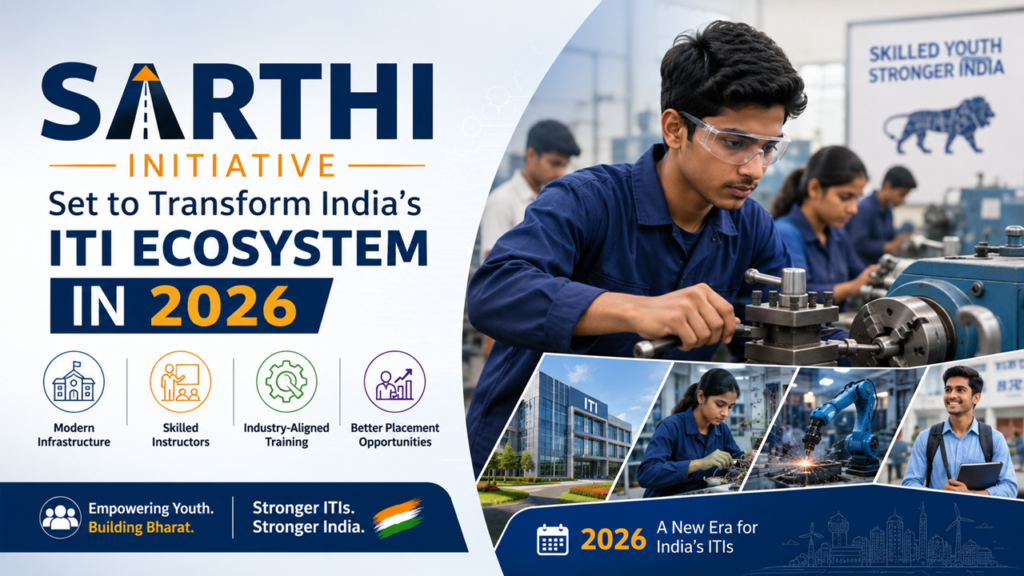
In June 2026, the Ministry of Skill Development and Entrepreneurship (MSDE) announced that it would convene the first meeting of a new body called SARTHI to drive the holistic transformation of India’s ITI ecosystem. This is a major step in the government’s plan to fix what is broken in India’s vocational training system and build something much better for the future. This blog explains everything you need to know about SARTHI — what it is, why it was created, what it aims to do, and what it means for students, trainers, and the country.
What Is SARTHI? Understanding the New ITI Reform Body
SARTHI is the name given to a new advisory and oversight body set up by the Ministry of Skill Development and Entrepreneurship (MSDE) under the Government of India. The name reflects the idea of a ‘sarthi’ in Hindi — a charioteer or guide — someone who helps steer in the right direction. Just as a charioteer guides a chariot safely to its destination, SARTHI is meant to guide India’s ITI system toward better quality, stronger outcomes, and real-world relevance.
The MSDE announced in June 2026 that it would hold the first formal meeting of SARTHI to begin its work of driving holistic transformation of India’s ITI ecosystem. This is not just a minor policy tweak. It is a structural effort to rethink how ITIs are run, governed, funded, and connected to industry. The government understands that for India to become the skill capital of the world, the ITI system needs a complete overhaul — and SARTHI is a key part of that plan.
SARTHI works in close coordination with the Directorate General of Training (DGT), which is the apex body under MSDE that manages ITIs and National Skill Training Institutes (NSTIs) across India. You can learn more about the DGT and its role at dgt.gov.in.
Why Does India’s ITI System Need Transformation?
Before understanding what SARTHI is trying to do, it is important to understand the problems it is trying to solve. India’s ITI system has been around for decades. The idea was always good — train young people in technical trades like electrician, fitter, welder, plumber, mechanic, and many others so they can get skilled jobs. But over the years, several deep problems developed.
Falling Enrolment and Empty Seats
One of the biggest warning signs is that many ITIs, especially private ones, are losing students every year. By March 2026, the MSDE had disaffiliated 614 ITIs because they had 100% vacant seats in the academic years between 2022 and 2024. This means that in those institutes, not a single student enrolled. That is a very serious problem. It tells us that students and their families do not see enough value in ITI training to sign up for it.
Outdated Courses and Obsolete Skills
Many ITIs are still teaching skills that were relevant twenty or thirty years ago. The world has changed. Industries now need people who know about automation, electronics, artificial intelligence (AI), robotics, green energy, and digital systems. But most ITI classrooms still look the same as they did in the 1990s. Equipment is old. Teachers have not been retrained. Courses have not been updated. This gap between what is being taught and what industries actually need means that ITI graduates often cannot find jobs in modern factories and workshops.
Weak Industry Connection
Good vocational training should be built around what industry actually needs. But India’s ITIs have historically had very weak connections with local and national industry. Companies rarely come to ITIs to help design courses, provide equipment, or hire graduates. This disconnect is a major reason why so many ITI students find it hard to get jobs after finishing their training. Employers do not trust that ITI certificates mean a student is genuinely job-ready.
Poor Quality in Private ITIs
India’s ITI network includes around 3,345 government ITIs and over 11,337 private ITIs. The rapid growth of private ITIs was supposed to expand access to training. But many private institutes opened mainly to take advantage of government grants and subsidies, without investing in proper infrastructure, qualified trainers, or quality training. Experts have pointed out that many private ITIs are failing on quality assurance and accreditation standards. This has hurt the overall reputation of ITI training in India.
Governance and Accountability Gaps
ITIs are under the administrative and financial control of state governments and Union Territory administrations. This means there is a lot of variation in quality and management from state to state. Some states run their ITIs very well; others do not. There has been a lack of a strong, unified national framework for governance, accountability, and performance tracking. SARTHI and the broader reform agenda aim to fix exactly this.
The PM-SETU Scheme: The Big Plan Behind SARTHI
SARTHI does not exist in isolation. It is part of a much larger government initiative called PM-SETU — Pradhan Mantri Skilling and Employability Transformation through Upgraded ITIs. The Union Cabinet approved PM-SETU on May 7, 2025, and it is now in active implementation across the country. PM-SETU is one of the most ambitious vocational education reform programmes India has ever launched.
The total outlay of PM-SETU is Rs. 60,000 crore over five years. This includes Rs. 30,000 crore from the central government, Rs. 20,000 crore from state governments, and Rs. 10,000 crore from industry partners. The scheme is also co-financed by international development partners — specifically the World Bank and the Asian Development Bank (ADB) — which will cover up to 50% of the central government’s share through loans. This international backing shows how seriously the world is watching India’s skill development reforms.
The Hub-and-Spoke Model
The core idea of PM-SETU is to upgrade 1,000 government ITIs using a hub-and-spoke model. Here is how it works. Around 200 ITIs will be selected as Hub ITIs — these will be the most advanced, best-equipped institutes in their regions. Each Hub ITI will function as a Centre of Excellence. Around it, approximately 800 ITIs will work as Spoke ITIs. Each Hub will support about four Spoke ITIs, giving them access to advanced machinery, modern courses, trained faculty, and industry connections that the smaller institutes cannot afford on their own.
In addition, five National Skill Training Institutes (NSTIs) located in Bhubaneswar, Chennai, Hyderabad, Kanpur, and Ludhiana will be upgraded into global Centres of Excellence. These will be world-class institutions that set the highest standard for vocational training in India.
Industry-Led Governance Through SPVs
One of the most important and unique features of PM-SETU is its industry-led governance model. Each upgraded ITI will be managed through a Special Purpose Vehicle (SPV). In this SPV, industry partners will hold 51% of the stake and the government will hold 49%. This is a major shift. It means companies will not just be advisors or donors — they will be actual managers of the institute. They will have real decision-making power over how the ITI is run, what courses are offered, and how students are trained and placed.
In June 2026, a landmark moment happened under PM-SETU. ArcelorMittal Nippon Steel India (AM/NS India), along with its academic partner New Age Makers Institute of Technology (NAMTECH), became the first company to get a Strategic Investment Plan approved for the Visakhapatnam ITI Cluster in Andhra Pradesh. This made Andhra Pradesh the first state to operationalise an industry partnership under PM-SETU. This was approved at the 3rd National Steering Committee meeting held at Kaushal Bhawan, New Delhi, chaired by Smt. Debashree Mukherjee, Secretary, MSDE.
States like Karnataka, Gujarat, Assam, and Chandigarh have also already issued Expressions of Interest inviting industry participation. Companies can contribute in multiple ways — providing managerial support, hiring trainers, donating advanced equipment, designing new courses, and even making CSR contributions. Learn more about PM-SETU at www.msde.gov.in.
The Role of SARTHI in India’s ITI Transformation
While PM-SETU provides the financial and structural framework for upgrading ITIs, SARTHI is meant to provide the governance backbone — the advisory guidance, strategic direction, and ongoing oversight that ensures the transformation actually happens on the ground. The very name SARTHI suggests its function: to guide and steer the process carefully so that the right goals are reached.
The first meeting of SARTHI, announced by MSDE in June 2026, marks the formal beginning of this guiding role. The purpose of convening this body is to bring together key stakeholders — government officials, industry leaders, training experts, state representatives, and development partners — under one platform to jointly drive the holistic transformation of the ITI ecosystem.
What ‘Holistic Transformation’ Really Means
When MSDE says ‘holistic transformation,’ it is not just talking about building new classrooms or buying new machines. The word ‘holistic’ means looking at everything together — the whole picture. The transformation SARTHI is pushing for covers several connected areas:
- Curriculum reform: Updating courses so they are aligned with what industry needs today and in the future — including AI, robotics, green skills, and advanced manufacturing.
- Infrastructure upgrade: Replacing old machines and tools with modern equipment so students get hands-on training with real industry tools.
- Trainer development: Upskilling and reskilling ITI instructors so they can teach modern, industry-relevant content with confidence.
- Industry integration: Creating deep, lasting partnerships between ITIs and companies so that training, apprenticeships, and placements happen smoothly.
- Digital learning: Introducing digital and blended learning methods, including online modules, simulation tools, and digital labs alongside classroom training.
- Governance improvement: Setting up clear accountability structures at the national, state, and institute level so there is transparency and continuous improvement.
- Soft skills and employability: Making sure students develop communication skills, teamwork, problem-solving ability, and workplace readiness — not just technical knowledge.
- Placement focus: Ensuring that training leads directly to jobs, through stronger placement cells, employer engagement, and industry connect programmes.
National and State Governance Structure Supporting SARTHI
SARTHI works within a broader governance structure that has been set up to oversee the transformation of the ITI ecosystem at every level — from the national government down to individual institutes. This structure has two main tiers:
National Steering Committee (NSC)
At the top is the National Steering Committee (NSC), chaired by the Secretary of MSDE. The NSC is the highest policy body for the ITI upgrade scheme. It sets the overall vision, finalises operational guidelines, approves Strategic Investment Plans from industry partners, monitors progress, and makes course corrections when needed. The NSC includes senior officials from the DGT, representatives from various ministries and departments, state governments, major industry players like Hindustan Aeronautics Limited, Hero MotoCorp, Bajaj Auto, and ITC Limited, as well as development partners like the World Bank and the Asian Development Bank.
State Steering Committees (SSC)
At the state level, State Steering Committees (SSCs) are led by the Chief Secretary of each state or union territory. Their job is to guide and oversee the implementation of the reform scheme within their state. They work with local industry, identify which ITIs are ready for upgrade, float Expression of Interest (EOI) documents to bring in industry partners, and ensure that the transformation aligns with the state’s specific economic and skill needs. As of early 2026, 25 States and Union Territories had already constituted their State Steering Committees, and 10 states had floated proposals inviting industry participation.
What Is Happening on the Ground in 2026?
2026 is a year of active and accelerating action for India’s ITI reform programme. Several important things are happening right now across the country.
Industry Consultations Across States
MSDE has been holding industry interaction meetings in different states to bring companies on board. In June 2026, for example, MSDE organised an industry consultation for the Rajasthan skill cluster in the Bhiwadi industrial hub — one of North India’s fastest-growing manufacturing regions, with strong automotive, engineering, electronics, logistics, and green industry presence. These meetings help identify what skills local industries need and find companies willing to partner with ITIs in that region.
First Industry Partnership Approved in Andhra Pradesh
As mentioned earlier, the approval of the Strategic Investment Plan for the Visakhapatnam ITI Cluster marks a historic first. AM/NS India and NAMTECH’s plan will transform the Visakhapatnam cluster into an industry-managed, outcome-oriented hub designed specifically to prepare students for careers in advanced manufacturing. This is the blueprint that other states and industries will now follow.
Admissions Reopening in Delhi ITIs
For students in Delhi, registration for admission in Delhi Government ITIs for the academic session 2026-27 started from June 8, 2026. Interested students can visit the official admission portal at itidelhi.admissions.nic.in for the latest updates and application details. This is a good example of how states are actively running their ITI admission cycles alongside the reform process.
AI and Digital Skills Being Added to ITIs
One of the most exciting developments is the integration of technology into ITI training. MSDE has already rolled out a 7.5-hour foundational AI module across over 14,600 ITIs, giving students early exposure to how artificial intelligence is changing the workforce. Partnerships with companies like Microsoft, Meta, Cisco, and Adobe are also helping add digital skills into ITI curricula. Meta is helping establish five Centres of Excellence in virtual and mixed reality to deliver specialised training across NSTIs.
World Economic Forum Partnership
In January 2026, MSDE signed a Memorandum of Understanding (MoU) with the World Economic Forum (WEF) to launch and implement a Skills Accelerator in India. Through this partnership, India’s skill training will be aligned with emerging global domains including artificial intelligence, green energy, robotics, and advanced manufacturing. This international collaboration adds another layer of credibility and global relevance to the ITI transformation programme.
Challenges the SARTHI Initiative Must Overcome
It would not be honest to write about SARTHI and PM-SETU without also discussing the real challenges this initiative faces. These are big reforms, and big reforms are always hard to implement.
Getting Industry to Commit
One of the biggest challenges reported so far is getting companies to actually step up and become Anchor Industry Partners. While large companies like AM/NS India have come forward, many smaller and medium-sized companies are hesitant. Running an ITI is a serious commitment that involves managing staff, ensuring training quality, and meeting government requirements. Some state officials have admitted that getting industry on board has not been easy. The government will need to make the partnership model simpler and more attractive for a wider range of businesses.
Dealing With the Scale of the Problem
India has over 14,600 ITIs. PM-SETU targets 1,000 of them for upgrade in the first phase. That leaves more than 13,600 ITIs that will not be directly upgraded under this scheme. What happens to them? The hope is that the hub-and-spoke model will help — the Spoke ITIs connected to Hub ITIs will benefit even if they are not being directly upgraded. But ensuring that quality improvements trickle down to all ITIs across the country is a challenge that will take many years of sustained effort.
State-Level Execution Varies Widely
Since ITIs are managed by state governments, the quality and pace of reform will vary significantly from state to state. States that are proactive, well-governed, and have strong industrial bases will move faster. States with weaker administrative capacity or less industry presence may lag behind. The national bodies like SARTHI and the NSC will need to provide extra support and monitoring to ensure that no state is left too far behind.
Trainer Shortage and Training Quality
Even if a new curriculum is written and new machines are bought, the quality of training depends entirely on the trainers — the teachers inside the ITIs. There is a significant shortage of well-qualified, industry-experienced trainers in India’s ITI system. Many existing trainers have not been retrained in years. MSDE has been working on a comprehensive Trainer Development Strategy, developed in collaboration with organisations like Accenture, Cisco, JP Morgan, and SAP through the Future Right Skills Network (FRSN). But retraining tens of thousands of ITI instructors takes time, money, and strong institutional support.
What Students Can Expect From the New ITI System
If you are a student who is thinking about joining an ITI, or if you are already enrolled in one, here is what the SARTHI initiative and PM-SETU reforms could mean for you in the coming years.
- Better courses: The trades and skills you learn will be updated to match what today’s industries need. You will learn about modern tools, digital systems, and new technologies as part of your training.
- Better facilities: Hub ITIs will have new and modern equipment, better classrooms, digital labs, and workshop spaces. You will get to practice on the kind of machines that real factories and workshops actually use.
- More internship and apprenticeship opportunities: Because industry partners are deeply involved in running upgraded ITIs, there will be better pathways for students to do on-the-job training, apprenticeships, and eventually get hired.
- Stronger placement support: Upgraded ITIs will have active placement cells and direct links with companies. Students who train in these institutes will have better chances of getting job offers before they even graduate.
- Soft skills training: You will not just learn how to do technical work. You will also be trained in communication, teamwork, punctuality, and professional behaviour — skills that make you a better employee and a more confident person.
- Digital and AI literacy: Even if you are training to be an electrician or a mechanic, you will have access to modules on digital tools and artificial intelligence so that you are not left behind in a technology-driven world.
- Recognition and certification: Your ITI certificate will carry more weight with employers because the whole certification system is being standardised under the National Council for Vocational Education and Training (NCVET).
There is also a PMIS portal where ITI pass-out trainees can register for internships with leading companies. This is another practical tool that current and recent ITI graduates can use right now. You can explore this at the DGT website: dgt.gov.in.
SARTHI Within the Bigger Picture of Skill India Mission
SARTHI and PM-SETU are not isolated programmes. They are part of a much larger national vision — the Skill India Mission, which was launched in 2015 and has been significantly upgraded. The mission’s overarching goal is to make India the skill capital of the world. By 2047, India aims to be a fully developed nation — what the government calls Viksit Bharat 2047. A skilled, productive, and employed workforce is absolutely central to reaching that goal.
MSDE operates through several key arms to make all of this work. The Directorate General of Training (DGT) manages ITIs and NSTIs. The National Council for Vocational Education and Training (NCVET) standardises skill certifications. The National Skill Development Corporation (NSDC) works with over 187 training partners. Sector Skill Councils (SSCs) align training with industry needs across 37 different sectors. And the National Skill Development Fund (NSDF) provides financial support for skilling initiatives.
Over the past decade, the percentage of skilled individuals in India has grown from approximately 34% to 51.3%. That is real progress. But India needs to go much further and much faster to give its young people the skills they need for jobs in a changing economy. By 2026, the Skill India Mission has shifted its focus from simply counting how many people were trained to measuring actual outcomes — did people get jobs? Did productivity improve? Is the training making a real difference?
ITI training reforms have also introduced 150 hours of mandatory on-the-job training and project work as part of the curriculum. This practical, real-world training is designed to make ITI graduates genuinely job-ready — not just certified on paper but actually able to do the work industry expects of them.
India’s Global Ambitions: Skills for International Jobs
One of the most exciting aspects of India’s skill development reform — and something that directly relates to what ITI students can look forward to — is the government’s ambition to place Indian skilled workers in jobs abroad. The government has a goal of placing 100,000 skilled workers internationally, positioning India as a key player in meeting global labour demands across diverse sectors.
MSDE has already signed 11 government-to-government (G2G) MoUs with various countries to create pathways for Indian skilled workers to take up jobs abroad. Countries in the Gulf, Europe, and Southeast Asia are looking for skilled tradespeople — exactly the kind of workers that well-trained ITI graduates can become. If the SARTHI reforms work and the quality of ITI training improves to international standards, it could open entirely new horizons for young people from villages and small towns across India.
The recently signed MoU with the World Economic Forum is another step in this direction. It ensures that India’s training programmes are aligned not just with domestic industry needs but with global standards in AI, green energy, and advanced manufacturing. This global relevance is what will allow India’s ITI graduates to compete not just at home but on the international stage.
A Note on Other ‘Sarthi’ Programmes in India
It is worth knowing that the word ‘Sarthi’ is used in the names of several other government initiatives in India, each with its own purpose. Understanding this will help you avoid confusion when you read about these programmes in the news.
In April 2026, NITI Aayog and the Atal Innovation Mission launched a programme called ATL Sarthi and Mentor India Academy in Telangana. This programme is focused on school-level innovation. It supports 379 Atal Tinkering Labs (ATLs) in Telangana, connecting them to local institutions for mentorship, teacher training, and startup support pathways. This programme clusters ATLs regionally and provides structured support to help school students turn their ideas into real innovations. It is different from the MSDE’s SARTHI for ITI transformation, but both share the same spirit of guiding students and institutions toward better outcomes.
There is also SARTHI Maharashtra — the Chhatrapati Shahu Maharaj Research, Training and Human Development Institute, a non-profit set up by the Government of Maharashtra for skill development and social empowerment of specific communities. And at the RBI, there is a portal called ‘Sarthi’ that is used for regulatory applications and tracking.
The common thread across all these programmes is the metaphor of a charioteer — a guide who helps navigate complex terrain to reach a destination safely. In the context of this blog, when we talk about SARTHI, we are specifically referring to the MSDE’s new advisory body for driving the holistic transformation of India’s 15,000+ ITIs.
What Will India’s ITI Ecosystem Look Like After the Transformation?
If SARTHI does its job well and the reforms deliver on their promise, India’s ITI ecosystem in 2030 could look very different from what it looks like today. Here is a vision of where things could go.
The 200 Hub ITIs will be functioning as world-class vocational training centres, each linked to specific industries in their region. A Hub ITI near an automotive manufacturing cluster will train students in EV (electric vehicle) assembly, battery technology, and smart manufacturing. A Hub ITI in a coastal state will train students in marine engineering, fishing technology, and port operations. The training will be directly aligned with what local companies need.
The five upgraded NSTIs will be globally recognised centres of excellence, setting standards for trainer quality, curriculum design, and technology-integrated learning. They will be producing a new generation of master trainers who then spread best practices to ITIs across the country.
Students who train in upgraded ITIs will have access to digital labs, simulation environments, AI-powered learning tools, and real factory floor experiences through mandatory on-the-job training. They will graduate with not just a certificate but a verified, industry-recognised skills credential. Employers will trust these credentials because they helped design the curriculum and know exactly what a graduate has been trained to do.
Placement rates will improve significantly. Not just because more companies are involved, but because the training itself will be more relevant. Students will not have to spend months after graduation looking for work because companies will already be lined up at the institute to hire them.
For the economy, the impact will be enormous. A workforce that is genuinely skilled reduces costs for industry, increases productivity, and helps India compete in global manufacturing and services. It also reduces poverty — because a skilled job pays better than an unskilled one, and a well-paying job pulls entire families out of poverty.
What Should Students Do Right Now?
If you are a student or a young person thinking about your future, here is some practical advice based on everything this blog has covered.
- Stay informed: Follow news from the Ministry of Skill Development and Entrepreneurship at msde.gov.in and the Directorate General of Training at dgt.gov.in. Policies and schemes are changing rapidly, and knowing what is available is the first step to taking advantage of them.
- Check admission portals in your state: ITI admissions are run by state governments. If you are in Delhi, check itidelhi.admissions.nic.in. Other states have their own portals. Do not miss deadlines.
- Look for PM-SETU upgraded ITIs: Once the hub ITIs are identified and operational in your state, try to apply to those institutes. They will have better equipment, better trainers, and better industry connections.
- Register on the PMIS portal: If you have already completed your ITI training, register on the PMIS portal through dgt.gov.in to find internship opportunities with companies.
- Consider apprenticeships: The Apprenticeship Training Program under MSDE is another powerful pathway to getting industry experience and a job. As of 2024, 7.46 lakh apprentices were in training across 47,311 establishments. This is a huge opportunity.
- Do not just focus on technical skills: The new ITI system places a lot of importance on soft skills, communication, digital literacy, and professional behaviour. Take these seriously. They are what will make the difference in a job interview and in your career.
- Think about international opportunities: As India signs more G2G MoUs and places skilled workers abroad, there may be real opportunities for well-trained ITI graduates to work internationally. A high-quality ITI certificate from an upgraded institute could open doors in the Gulf, Germany, Japan, and other countries that are looking for skilled tradespeople.
Conclusion: SARTHI Is a Step Toward a Better Future for Millions
India’s Industrial Training Institutes have always had potential. They are present in nearly every district of the country. They serve young people from rural areas, small towns, and working-class families who cannot afford expensive private colleges but who desperately want a good job and a better life. For decades, the system failed many of these students — not because they lacked talent or ambition, but because the system did not give them what they needed.
The SARTHI initiative, backed by PM-SETU and the full force of the Ministry of Skill Development and Entrepreneurship, represents one of the most serious and well-funded attempts to change this in India’s history. The Rs. 60,000 crore commitment, the industry-led governance model, the hub-and-spoke structure, the international partnerships, and the digital transformation of curricula all point toward a genuine effort to fix what is broken.
The first meeting of SARTHI in June 2026 is not just an administrative event. It is a signal — to students, to trainers, to industry, and to the world — that India is serious about transforming its vocational training system. The work ahead is massive and the challenges are real. But the direction is clear: better training, stronger industry links, more relevant skills, and real jobs for real people.
As a student, the best thing you can do is stay informed, stay engaged, and take advantage of every opportunity that this transformation creates. The ITI of tomorrow is being built today — and if you are willing to put in the effort, there is a real place for you in the skilled India that is being built.

StudentsTalk.in, is an education-focused platform dedicated to helping students stay informed about the latest academic updates, scholarships, entrance exams, career opportunities, government schemes, and study resources. With a passion for education and student success, she creates informative, easy-to-understand content.