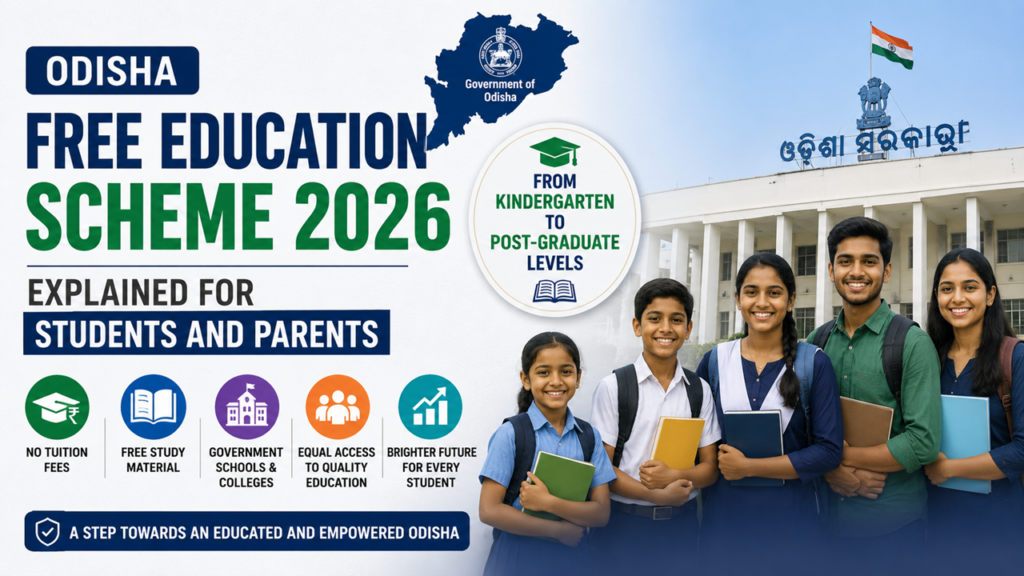
Education is one of the most important things a child can get. But for many families in Odisha, the cost of schooling is still a big worry. Paying for books, uniforms, fees, and other expenses can be hard — especially for families with low income. That is why the Odisha Free Education Scheme 2026 is such important news for students and parents across the state.
This scheme is the government’s promise to make quality education available to every child — without putting a financial burden on families. Whether your child is in a government primary school or studying in a higher class, this scheme covers many important benefits.
In this blog, we will explain everything about the Odisha Free Education Scheme 2026 in very simple language. We will cover who can benefit, what is offered, how to apply, and how this scheme can change the future of children in Odisha. Let us start from the beginning.
What Is the Odisha Free Education Scheme 2026?
The Odisha Free Education Scheme 2026 is a government initiative by the Government of Odisha to provide free and quality education to children across the state. The scheme focuses on removing financial barriers so that every child — no matter how rich or poor their family is — gets a chance to go to school and learn.
The scheme works under the broader framework of India’s Right to Education Act (RTE), which guarantees free and compulsory education to all children between 6 and 14 years of age. The Odisha government has taken this further by expanding benefits to cover more age groups and adding more services like free meals, uniforms, and books.
The main idea is simple: no child in Odisha should stay out of school just because their family cannot afford it.
Quick Overview
| Detail | Information |
| Scheme Name | Odisha Free Education Scheme 2026 |
| Launched By | Government of Odisha |
| Target Beneficiaries | Students from Class 1 to Class 12 |
| Main Benefits | Free books, uniforms, meals, scholarships |
| Eligibility | Students enrolled in government schools |
| Official Website | odisha.gov.in |
Why Did the Odisha Government Start This Scheme?
Many people ask — why was this scheme needed? The answer lies in the ground reality of Odisha. Even though a lot of progress has been made in recent years, there are still many challenges in the education sector in the state:
- High dropout rates: Many children drop out of school in middle grades because families cannot afford the expenses.
- Rural poverty: In tribal and rural areas of Odisha, income levels are very low. For such families, school expenses can feel like a luxury.
- Gender gap: Girl children in some districts are still not sent to school regularly because of financial pressures and social reasons.
- Lack of resources: Many students go to school without proper books, shoes, or uniforms — which makes it hard for them to focus on learning.
The Odisha Free Education Scheme 2026 directly addresses all these problems. By providing free essentials, the government encourages families to send their children to school — and keep them there until they complete their education.
According to data from the Ministry of Education, Government of India, school enrollment in Odisha has been improving steadily, and schemes like this play a major role in that improvement.
Who Can Benefit from the Odisha Free Education Scheme 2026?
This is one of the most important questions parents ask. Let us look at who is eligible:
Primary Beneficiaries
- Students studying in government primary schools (Class 1 to Class 5)
- Students in government upper primary schools (Class 6 to Class 8)
- Students in government high schools and higher secondary schools (Class 9 to Class 12)
- Children belonging to Scheduled Castes (SC), Scheduled Tribes (ST), and Other Backward Classes (OBC)
- Children from Below Poverty Line (BPL) families
- Girl students across all classes
- Children with disabilities who are enrolled in government schools
Basic Eligibility Criteria
- The student must be a resident of Odisha
- The student must be enrolled in a government or government-aided school
- The family must meet the income or category criteria set by the scheme
- Students must have regular attendance as per school norms
Parents who are unsure about eligibility can visit the Official Odisha Government Portal or their nearest Block Education Office (BEO) for guidance.
What Does the Odisha Free Education Scheme 2026 Offer?
This is the heart of the scheme. Let us go through each benefit one by one in simple language:
1. Free Textbooks
All students enrolled in government schools from Class 1 to Class 12 get free textbooks at the start of the academic year. These books are published by the Odisha School Education Programme Authority (OSEPA) and the State Council of Educational Research and Training (SCERT). The books are provided before classes begin so that no student has to sit without study material.
2. Free School Uniforms
Every eligible student gets two sets of school uniforms every year for free. Uniforms help students feel equal and create a sense of belonging. For girl students, special attention is given to ensure the uniforms are culturally appropriate and comfortable. Footwear is also provided in many districts under this scheme.
3. Mid-Day Meal (Free School Lunch)
The PM POSHAN Scheme (formerly known as the Mid-Day Meal Scheme) is implemented in Odisha’s government schools. Under this, every student gets a free cooked meal on every school day. This serves two important purposes: it ensures that children are well-nourished and it encourages parents to send their kids to school daily. You can read more about the national program at the PM POSHAN official website.
4. Free Stationery and Study Materials
Students in primary classes also get free notebooks, pencils, erasers, and other stationery items. This ensures that children from poor families do not fall behind because they could not afford basic writing materials.
5. Scholarships and Financial Assistance
Several scholarship programs run alongside the free education scheme. These include:
- Pre-Matric Scholarship: For SC/ST students from Class 1 to Class 10
- Post-Matric Scholarship: For SC/ST students studying after Class 10
- PRERANA Scholarship: For meritorious students from disadvantaged backgrounds
- Madhu Babu Pension Scheme related benefits: For children of disabled parents
Students can apply for scholarships through the National Scholarship Portal (NSP), which lists all central and state scholarships in one place.
6. Free Admission (No School Fees)
Government schools in Odisha do not charge any admission or tuition fees. This applies from Class 1 to Class 12. The government covers all operational costs of these schools so that no parent has to pay fees for their child’s basic education.
7. Free Transportation (Select Districts)
In tribal-dominated and hilly districts where schools are far from villages, free bus or cycle transportation is provided to students. Bicycles are distributed to girl students in higher classes under the Odisha government’s cycle distribution scheme to help them travel safely to school.
8. Residential Facilities (Hostels and Ashram Schools)
For students living in remote areas, especially from tribal communities (ST students), the government runs Ashram Schools and residential hostel facilities. In these schools, students get free accommodation, food, clothing, and education. The Odisha Tribal Welfare Department manages these for tribal students.
9. Digital Learning and Smart Classrooms
Under the Odisha Free Education Scheme 2026, many government schools are being equipped with smart boards, computers, and internet connectivity. This is part of the government’s mission to bring digital education to every student. E-learning apps and platforms are also being provided to students to help them study at home. This is especially important after the lessons learned from the COVID-19 pandemic, when offline schooling stopped.
How to Apply for the Odisha Free Education Scheme 2026?
Good news for parents — applying for this scheme is not complicated. Here is a step-by-step guide:
Step 1: Enroll Your Child in a Government School
The first and most important step is to get your child admitted to a government or government-aided school in your area. Most benefits under this scheme are automatically given to enrolled students. You do not need to apply separately for books, uniforms, or mid-day meals — these are given to all eligible students automatically.
Step 2: Submit Required Documents
During admission, you will need to submit these documents:
- Child’s birth certificate or age proof
- Aadhaar Card of the child and parent
- Caste certificate (for SC/ST/OBC students)
- Income certificate (for BPL category families)
- Residential proof (any document showing Odisha address)
- Previous class marksheet (for students enrolling from Class 2 onwards)
Step 3: Apply for Scholarships Separately
If you want your child to get a scholarship, you need to apply online through the National Scholarship Portal. The school teacher or headmaster can help you with this process. Applications are usually open between July and October every year.
Step 4: Contact Your School or BEO for Help
If you have any doubt, visit your child’s school or go to the Block Education Office (BEO) in your area. The staff there will guide you about which benefits your child can get and how to claim them. Do not hesitate to ask for help — these schemes are made for you.
Special Focus on Girl Child Education in Odisha
The Odisha government gives special attention to girl child education. Several programs specifically help girl students to stay in school and reach higher education levels. These include:
- Kanya Ratna Scheme: Financial incentive for families who have girl children enrolled in schools
- SAKSHAM Scheme: Provides financial support to girl students at the secondary and higher secondary level
- Free Sanitary Napkin Distribution: To address hygiene needs and reduce school absenteeism among teenage girls
- KALIA Scheme benefits for girl students: Related agricultural and livelihood support for girl students in farming families
- Free bicycle distribution: For girl students from Class 6 onwards in rural areas, helping them travel to distant schools safely
These initiatives are designed to remove every possible reason why a girl child might be kept home instead of being sent to school. Odisha has been recognized nationally for its efforts in improving girl enrollment and retention rates. You can read about national girl education initiatives at Beti Bachao Beti Padhao.
How This Scheme Helps Tribal and Rural Students
Odisha has a very significant tribal population. Districts like Koraput, Rayagada, Malkangiri, Kandhamal, Sundargarh, and Nabarangpur have large concentrations of Scheduled Tribe communities. For children in these areas, getting an education has traditionally been harder due to distance, language barriers, poverty, and cultural factors.
The Odisha Free Education Scheme 2026 addresses these challenges through:
- Mother Tongue Based Multilingual Education (MTB-MLE): Teaching children in their mother tongue in early classes makes it easier for them to understand lessons and stay in school
- Eklavya Model Residential Schools (EMRS): Central government-funded residential schools for ST students with quality education and free facilities
- Tribal Language Teachers: Special teachers who can communicate in local tribal languages to bridge the gap between home and school
- Community engagement programs: Village-level awareness campaigns to encourage tribal parents to enroll their children
- Ashram Schools with free boarding: Students live at the school so that distance is no longer a barrier to learning
The Odisha Scheduled Tribe and Scheduled Caste Development Department plays a key role in implementing these programs specifically for tribal students.
Important Schemes Running Along with Free Education in Odisha
Several other government programs work together with the Odisha Free Education Scheme 2026. Understanding these helps parents access all the help available:
1. Mukhyamantri Medhabruti Scholarship
This scholarship is given to meritorious students who score high marks in board examinations. It provides monthly financial support for higher studies so that bright students from poor families can continue their education beyond Class 10 and Class 12.
2. PRERANA Scheme
The PRERANA scheme gives incentive payments to children and families who send their kids to school regularly and pass each class. It works as a reward for continuing education — the longer you stay in school, the more financial benefit your family gets.
3. SMILE (Strengthening Monitoring and Improving Learning Effectiveness)
This is an Odisha government initiative to improve the quality of education in schools. Under SMILE, teachers are trained regularly, learning outcomes are tracked, and weak students are given extra support through remedial classes.
4. PM SHRI Schools in Odisha
The central government’s PM SHRI scheme is upgrading selected government schools across India, including Odisha, into model schools with modern facilities, smart classrooms, libraries, labs, and sports infrastructure — all for free for government school students.
5. National Means-Cum-Merit Scholarship (NMMS)
This central government scholarship gives Rs. 12,000 per year to meritorious students from economically weaker sections. Students in Class 8 can apply and if selected, they get this scholarship for four years (Class 9 to Class 12). Apply at the National Scholarship Portal.
How Parents Can Make the Most of This Scheme
Just knowing about the Odisha Free Education Scheme 2026 is not enough. Here is how parents can ensure their children get all the benefits:
- Enroll on time: New academic year admissions usually start in April-May. Make sure your child is enrolled before the deadline so they do not miss any benefits.
- Keep documents ready: Always have a copy of Aadhaar, birth certificate, caste certificate, and income certificate. These are needed for scholarship and other applications.
- Stay in touch with the school: Visit the school at least once a month. Talk to the teacher about your child’s progress and ask about any new scheme or benefit that has been announced.
- Use the NSP portal: Log in to scholarships.gov.in every August to check which scholarships your child qualifies for. Apply before the deadline.
- Report problems: If your child is not getting free books or uniforms on time, report it to the headmaster or Block Education Officer. You can also call the Odisha government’s helpline.
- Encourage attendance: Many schemes require minimum attendance. Make sure your child attends school regularly to remain eligible for all benefits.
- Join Parent-Teacher Meetings: Schools hold PTMs regularly. Attend these to understand your child’s learning level and get updates about schemes directly from teachers.
Challenges and What the Government Is Doing to Fix Them
Like any large scheme, the Odisha Free Education Scheme 2026 also faces some challenges. Being honest about these helps parents understand what is happening on the ground:
Challenge 1: Delays in Distribution
Sometimes, free books or uniforms reach schools late, causing disruption at the start of the year. The government is working on digitizing the supply chain so that materials are dispatched and tracked in real time, avoiding delays.
Challenge 2: Teacher Vacancies
Some government schools have fewer teachers than required. The Odisha government is addressing this through the Odisha Teacher Recruitment 2025-26 drive, which aims to fill thousands of vacant teacher posts across primary and secondary schools.
Challenge 3: Infrastructure Gaps
Some schools in remote areas still lack proper classrooms, toilets, and drinking water. Under the Samagra Shiksha Abhiyan program (the national school improvement initiative), funds are being released to upgrade school infrastructure across Odisha. You can learn more at the Samagra Shiksha portal.
Challenge 4: Awareness Gaps
Many families, especially in rural and tribal areas, do not know about all the benefits they are entitled to. The government is running Jan Jagran campaigns through gram panchayats, anganwadi workers, and Asha workers to spread awareness about free education benefits.
Impact of the Odisha Free Education Scheme: Real Numbers
Let us look at some data that shows how the Odisha Free Education Scheme 2026 and its predecessor programs have made a real difference:
- Odisha’s Gross Enrollment Ratio (GER) at the primary level is now close to 100%, meaning almost every eligible child is in school.
- The gender gap in enrollment has narrowed significantly in the last five years, with girl enrollment increasing faster than boy enrollment in many districts.
- Tribal districts like Malkangiri and Nabarangpur have seen 30-40% improvement in enrollment over the past decade due to residential school programs.
- Over 60 lakh students across Odisha benefit from the mid-day meal program every school day.
- Scholarship disbursement through the National Scholarship Portal has helped over 10 lakh students in Odisha receive direct financial support in recent years.
These numbers reflect the positive impact of sustained government investment in free education. While there is still work to be done, the trend is clearly moving in the right direction.
Final Thoughts
The Odisha Free Education Scheme 2026 is not just a policy paper — it is a promise from the government to the children of Odisha. It says: you deserve to learn, you deserve to grow, and money should never be the reason you stay home instead of going to school.
For parents, this scheme is a sign that help is available. You do not have to carry the burden of education costs alone. The government wants to partner with you to give your child the best possible start in life.
For students, this scheme is an opportunity. Take advantage of the free books, the free meals, the scholarships, and the digital tools being provided to you. Work hard in school, because a good education can change not just your life — but your entire family’s future.
Odisha has come a long way in education, and schemes like this one will take it even further. Stay informed, stay enrolled, and make the most of everything that is being offered to you.
Frequently Asked Questions (FAQs)
Q1. Is the Odisha Free Education Scheme 2026 only for BPL families?
No. Many benefits like free textbooks, uniforms, and mid-day meals are available to all students enrolled in government schools, regardless of income. However, some specific scholarships and extra benefits are targeted at BPL families, SC/ST students, and other disadvantaged groups.
Q2. Can students in private schools also benefit?
Students in private schools can benefit under the Right to Education (RTE) Act, Section 12(1)(c), which reserves 25% seats for economically weaker section children in private unaided schools. These students get free education up to Class 8. For other benefits like uniforms and meals, generally only government school students qualify.
Q3. What is the last date to apply for scholarships?
Scholarship deadlines vary by scheme. Generally, applications open between August and October every year on the National Scholarship Portal. It is best to check the portal regularly and not wait until the last minute.
Q4. How will I know if my child is getting all benefits?
Ask the school headmaster for a list of all schemes your child is enrolled in. You can also check the Odisha government’s education portal for information on available benefits for students in your area.
Q5. What should I do if there is corruption or my child is not getting what they are entitled to?
You can report issues to the Block Education Officer (BEO), District Education Officer (DEO), or use the Odisha government’s grievance portal at grievance.odisha.gov.in. You can also call the state education helpline to file a complaint.

StudentsTalk.in, is an education-focused platform dedicated to helping students stay informed about the latest academic updates, scholarships, entrance exams, career opportunities, government schemes, and study resources. With a passion for education and student success, she creates informative, easy-to-understand content.