
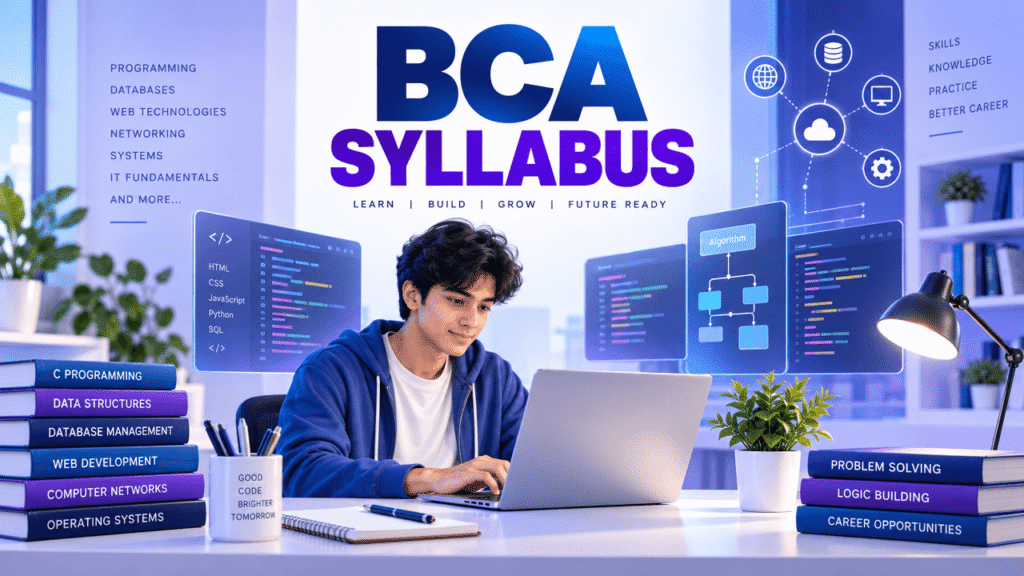
If you are planning to study BCA, you may have many questions. What subjects will you learn? Is coding difficult? Will mathematics be part of the course? What can you do after graduation?
BCA stands for Bachelor of Computer Applications. It is an undergraduate course that introduces students to programming, computer systems, software, databases and other areas of information technology. This guide explains the usual BCA syllabus in simple English.
One important thing to know is that there is no single semester-wise list used by every university. Colleges may offer different subjects, electives, credit rules and practical projects. Use the official syllabus of your own university to confirm the exact course structure.
What Is Included in a BCA Course?
BCA is not only about learning a programming language. It also helps students understand how computers store information, how websites work, how data is managed and how software is built.
A typical programme may include:
- Programming basics and problem solving
- Computer organisation
- Mathematics and logical thinking
- Data structures
- Database management systems
- Computer networks
- Operating systems
- Web development
- Software engineering
- Practical labs and student projects
Some colleges also teach communication skills, business basics, cyber security, cloud technology or introductory artificial intelligence.
BCA First Semester: Building the Foundation
Many universities begin with subjects that help new students understand computers and basic programming.
Computer Fundamentals
Students learn what computer hardware and software do. Topics may include input and output devices, memory, storage, file systems and common applications.
Programming Fundamentals
An introductory language such as C, Python or another language may be used. Students learn variables, conditions, loops, functions and simple problem solving.
Mathematics
Depending on the university, students may study basic algebra, sets, logic or other mathematical topics useful for computer science.
Communication Skills
This subject can help students write reports, explain ideas and speak clearly during presentations.
Helpful habit: Practise small programs every day. A ten-line program that you understand is more useful than a large program copied without reading.
BCA Second Semester: Learning How Programs Work
In the next part of the course, students often move beyond basic commands and start writing better organised programs.
Possible subjects include:
- Object-oriented programming
- Discrete mathematics
- Computer architecture
- Data structures introduction
- Web design basics
- Practical programming labs
Object-oriented programming teaches students to arrange code using classes and objects. If this feels confusing at first, start with examples such as a student record or a library book. Use simple situations before moving to larger projects.
BCA Third Semester: Data and Systems
Once students are comfortable with basic programming, many courses introduce topics that explain how real applications work.
Data Structures
Arrays, stacks, queues, linked lists and trees help programmers organise information. Students should understand not just the definitions but also when each structure is useful.
Database Management
Databases store information in a structured way. SQL is commonly used to read and change data. A small student attendance database is a useful practice exercise.
Operating Systems
This subject explains how a computer manages tasks, memory, files and resources. It helps you understand what happens behind the screen when an application runs.
Computer Networks
Students may begin learning how devices share information through local networks and the internet.
BCA Fourth Semester: Building Useful Applications
Some universities introduce software development and web technologies in more detail during the middle of the course.
You may encounter:
- Advanced database concepts
- Web programming
- Java or other programming languages
- Software engineering
- Computer networks
- Practical application development
At this stage, you should begin creating work you can show to another person. A small expense tracker, attendance system or library management project is a good start.
A project does not need fancy design. It should solve a real problem and work reliably.
BCA Fifth Semester: Exploring Special Interests
Later semesters often contain more advanced subjects and electives. The available choices depend on the college.
Examples include cyber security, mobile application development, cloud computing, data analytics, advanced programming, artificial intelligence concepts and project work.
If you enjoy designing interfaces, explore front-end development. If you like solving difficult logical problems, try algorithms and back-end programming. If you prefer working with information, databases and data analysis might interest you.
Avoid choosing a specialisation only because it is popular online. Spend some time building a small project in that area before deciding.
BCA Sixth Semester: Projects and Career Preparation
The last stage of many three-year programmes includes advanced subjects, practical training, a major project or an internship. Some institutions follow different durations and structures, so check your university’s programme rules.
A final project gives you a chance to combine several subjects.
For example, a student management application can use:
- A front-end screen to enter information
- A programming language to process data
- A database to save student records
- Validation to prevent incorrect entries
- Reports to display useful results
When presenting a project, be ready to explain what problem you solved, the tools used, the challenges you faced and what you would improve.
BCA Syllabus at a Glance
The table below is an illustrative guide, not the official syllabus of a particular university.
| Semester | Common Focus | Practical Goal |
|---|---|---|
| 1 | Computer basics, introductory programming | Write simple programs |
| 2 | Programming methods, logic, mathematics | Build small exercises |
| 3 | Data structures, databases, operating systems | Manage and organise information |
| 4 | Web technologies and software design | Create a small application |
| 5 | Electives and advanced technical topics | Explore a chosen field |
| 6 | Projects and career preparation | Complete and explain a working project |
Is Mathematics Important in BCA?
Mathematics can help students understand logic, algorithms and some computing concepts. But you do not need to be perfect at mathematics before starting programming.
If you struggle with a topic, revise basic formulas and solve one example at a time. Programming and mathematics become more understandable when you practise rather than only read.
Which Programming Languages Should BCA Students Learn?
You do not need to learn five languages at once. Start with the language used in your college’s introductory course.
After learning the basics, you can explore:
- Python for beginner projects and data tasks
- C for programming fundamentals
- Java for object-oriented concepts
- JavaScript for interactive web pages
- SQL for working with databases
The exact order is less important than understanding the ideas behind them.
Five Project Ideas for BCA Students
1. Personal Expense Tracker
Record daily spending, add categories and show simple summaries. This teaches input handling, calculations and data storage.
2. Student Attendance System
Create a form to mark attendance and calculate attendance percentages. Start with a small class instead of a complicated school system.
3. Library Book Manager
Store book titles, author names, borrowing dates and return status. This is useful for learning databases.
4. Quiz Application
Build a short multiple-choice quiz with scores and explanations. It can be a good first web project.
5. College Event Website
Show upcoming events, basic registration information and a simple contact page. This improves your page design and content skills.
How to Study the BCA Syllabus Without Feeling Lost
A common mistake is to wait until the exam month before opening the practical subjects. Instead, keep a weekly routine.
Attend the theory classes and make short notes in your own words. Later that day, try one practical example related to the lesson. At the weekend, review errors and complete unfinished exercises.
Do not only watch programming tutorials. Open your editor and type the code yourself. If something fails, read the error and try to understand it.
Keep your work organised in separate project folders. Write short explanations of what each project does. These habits become useful during internships and interviews.
What Can Students Do After BCA?
Some graduates continue studying through courses such as MCA or other postgraduate programmes, depending on entry rules. Others explore entry-level roles in software development, testing, technical support, web development, IT operations or data-related work.
Your options depend on your skills, practical experience, location and employers’ requirements. A BCA degree can be a starting point, but projects and continued learning can make a real difference.
Conclusion
The BCA syllabus introduces students to many parts of computing, from basic programming to databases, networking and software projects. You do not need to master everything in the first semester. Learn one concept, practise it, and slowly build larger projects. Check your own university’s official syllabus so you know which subjects and practical exams apply to your course.
Frequently Asked Questions
Is the BCA syllabus the same in every college?
No. Universities decide their own detailed subjects, electives, credit structure and examination rules.
Is coding compulsory in BCA?
Programming is a central part of most BCA programmes, so students should expect to write and practise code.
Can I study BCA without knowing Python?
Yes. Many students begin programming for the first time during their course.
Is BCA a three-year course?
Many BCA programmes follow a three-year structure, but some institutions offer different formats and durations. Check the programme you plan to join.
Which subject should I focus on most?
Give importance to all compulsory subjects. Programming, databases and problem-solving skills are especially useful for many practical projects.

StudentsTalk.in, is an education-focused platform dedicated to helping students stay informed about the latest academic updates, scholarships, entrance exams, career opportunities, government schemes, and study resources. With a passion for education and student success, she creates informative, easy-to-understand content.


Pingback: BBA Syllabus: Semester-Wise Subjects, Skills, Projects and Career Options -
Pingback: Best Courses After 12th: Career Options for Science, Commerce and Arts Students -