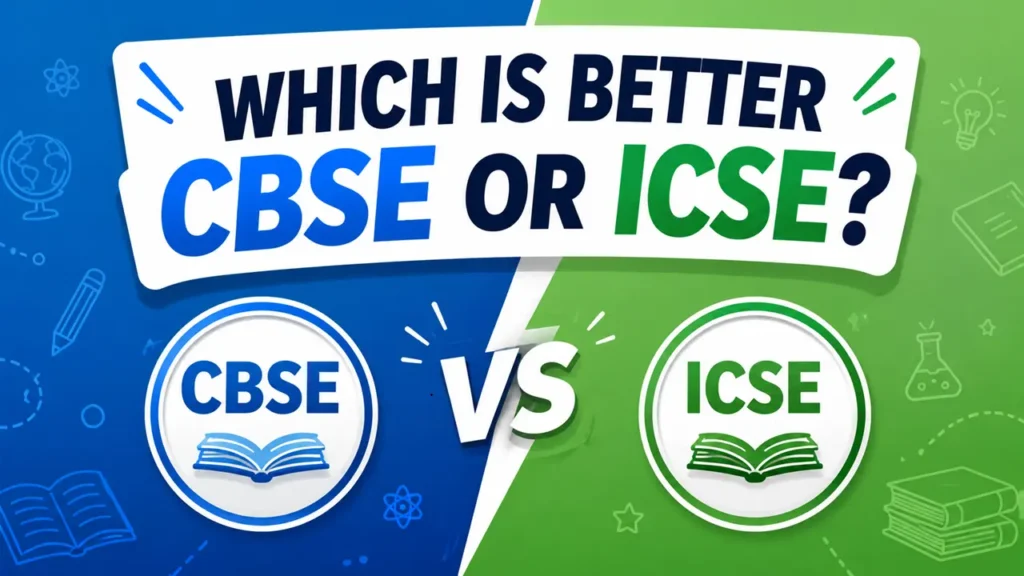
Choosing a school board is one of the most important decisions for any parent. It can shape how your child learns, how they prepare for exams, and even which career path feels easier later in life. In India, two boards are talked about more than any other: CBSE and ICSE. Walk into any parent-teacher meeting, scroll through any parenting forum, or talk to any neighbour with a school-going child, and you will hear the same question again and again: which is better CBSE or ICSE?
This question does not have one simple answer. CBSE and ICSE are both good boards. They are both recognised across India. They both produce toppers, doctors, engineers, artists, and entrepreneurs every year. But they are built differently, and that difference matters. In this blog, we will break down everything in plain, simple English. No confusing jargon, no biased opinions, just facts that will help you choose what is right for your child.
What Is CBSE Board?
CBSE stands for Central Board of Secondary Education. It is a national-level board run by the Government of India. CBSE was set up in 1962, and today it is the most widely followed school board in the country.
Schools that follow CBSE use textbooks published by NCERT, the National Council of Educational Research and Training. These books are known for being simple, direct, and exam-focused. They cover the syllabus without too many extra details, which makes studying feel lighter for many students.
CBSE conducts board exams for Class 10 and Class 12 every year. Lakhs of students across India, and even abroad in CBSE-affiliated international schools, appear for these exams. Because CBSE is connected to the central government, it is the preferred board for defence families, government employees, and anyone whose job involves frequent transfers across cities. If a family moves from Jaipur to Chennai, a CBSE-following child can join a new CBSE school without much trouble, because the syllabus stays almost the same everywhere.
CBSE is also the board most closely linked to India’s biggest competitive exams. JEE Main, JEE Advanced, and NEET are all based largely on the NCERT syllabus, which is the same syllabus CBSE schools follow. This is one big reason why so many parents pick CBSE for children who may want to study engineering or medicine later.
What Is ICSE Board?
ICSE stands for Indian Certificate of Secondary Education. It is run by a private body called CISCE, the Council for the Indian School Certificate Examinations. ICSE was introduced in 1958, and it has built a strong reputation for thorough, detailed education.
Unlike CBSE, ICSE does not depend only on NCERT books. Schools can choose textbooks from different publishers, as long as the content matches the syllabus set by CISCE. This often means ICSE textbooks go deeper into each topic, with more explanation, more examples, and more detail than NCERT books.
ICSE is well known for its strong focus on the English language. Students study grammar, comprehension, and literature in detail from a young age. This is one reason ICSE students are often praised for their writing skills and vocabulary.
After Class 10, ICSE students who continue in the same system move to ISC, the Indian School Certificate, for Class 11 and 12. ISC is also run by CISCE and follows the same detailed approach.
ICSE also gives real weight to internal assessment. Projects, practicals, and classroom work count toward the final result, not just the final written exam. This rewards students who stay consistent through the year, not just those who do well on one exam day.
CBSE vs ICSE: A Quick Comparison Table
Before going deeper, here is a simple side-by-side look at both boards.
| Point | CBSE | ICSE |
| Full Form | Central Board of Secondary Education | Indian Certificate of Secondary Education |
| Run By | Government of India | CISCE (a private body) |
| Started In | 1962 | 1958 |
| Textbooks | Mainly NCERT | Various publishers, more detailed content |
| Subjects in Class 10 | Around 5 main subjects | Around 7 to 9 subjects, more variety |
| Main Focus | Exam-oriented, simple and direct | Detailed, application and language focused |
| Best Known For | Science and Maths aligned with JEE/NEET | English, humanities and overall development |
| Number of Schools | Very high, found in almost every town | Lower, mostly in bigger cities |
| Fee Range | Often lower, government schools too | Usually higher, mostly private schools |
This table gives a quick snapshot, but real understanding comes from looking at each point closely. Let us go deeper into each one.
Curriculum and Syllabus: How CBSE and ICSE Are Different
The biggest difference between these two boards lies in their syllabus. CBSE keeps things simple. The syllabus is designed to be clear and exam-ready. Topics are explained directly, with fewer extra details. This is helpful for students who want to cover the syllabus quickly and revise easily before exams. It is also why so many coaching institutes for JEE and NEET prefer students who come from a CBSE background, since the overlap with the competitive exam syllabus is very high.
ICSE takes a different path. The syllabus is wider and goes deeper into each topic. A simple topic in CBSE might have extra layers of detail in ICSE. In English, for example, ICSE students study literature, grammar, and composition with more depth than CBSE students at the same level. In Science, ICSE often introduces concepts a little earlier and explains them with more real-world examples.
Take Mathematics as an example. Both boards cover similar core topics, such as algebra, geometry, and trigonometry. But ICSE often introduces more varied problem types and expects more written explanation in answers, while CBSE focuses on direct problem-solving, which matches how questions are framed in JEE and NEET. In Social Studies, ICSE splits the subject into History, Civics, and Geography as separate detailed sections, while CBSE often presents a more compact version. None of this makes one board ‘easier’ or ‘harder’ on its own; it simply shows that ICSE asks for more reading and writing, while CBSE asks for more direct application.
This does not mean one syllabus is better in a general sense. It means they serve different purposes. CBSE is built to match national-level exams. ICSE is built to create strong fundamentals and language skills, useful for students who may want to study abroad or pursue careers in writing, law, journalism, or research.
Difficulty Level: Which Board Is Tougher?
This is the part most people care about, so let us address it directly: which is better CBSE or ICSE when it comes to difficulty?
ICSE is usually considered the tougher board, mainly for three reasons. First, it has more subjects, often seven to nine in Class 10, compared to about five in CBSE. Second, English carries more weight, and the literature portion demands strong reading and writing skills. Third, the syllabus itself is more detailed, so students need to remember more information and explain answers with more depth.
CBSE is usually considered the more manageable board, not because it lacks depth, but because the syllabus is more compact. Fewer subjects mean less to juggle at exam time. The straightforward NCERT books also make self-study and revision easier, especially for students who are preparing for competitive exams alongside school.
However, tougher does not always mean worse. A student who genuinely enjoys reading, writing, and exploring subjects in detail may find ICSE more rewarding rather than more stressful. A student who prefers focused, exam-ready content may find CBSE less overwhelming and more efficient. It also depends on the individual school. A CBSE school with a heavy homework culture can feel tougher than a relaxed ICSE school, and the other way round too.
There is also a scoring pattern worth knowing. In ICSE, internal assessment such as projects and practicals can contribute around 20 percent of the final marks in many subjects. This gives consistent, hardworking students a chance to boost their overall score even if the final written paper feels tough. In CBSE, internal assessment exists too, but the final board exam usually carries more weight. This means CBSE students often need to perform well specifically on exam day, while ICSE students get more credit for steady, year-round effort.
Medium of Instruction and Language Options
Both CBSE and ICSE are primarily taught in English. Most schools following either board use English as the medium of instruction, though some CBSE government schools also offer Hindi medium, especially in smaller towns and rural areas.
When it comes to language subjects, ICSE usually asks students to study English in more depth, with a strong focus on literature, poetry, and composition writing from an early age. This builds vocabulary and writing confidence over time. CBSE also teaches English well, following NCERT books, but the approach is generally simpler and more direct, with a slightly lighter literature load.
For regional or second languages, both boards usually offer a good range of choices, including Hindi, Sanskrit, and various state languages, depending on the school. If language and literature are a priority for your child’s future, especially in fields like journalism, content writing, or law, this is a point worth weighing carefully.
It is worth mentioning that vernacular medium schools, where the main teaching language is a regional language rather than English, are far more common under CBSE than under ICSE. If your family prefers a regional language as the primary medium of instruction, especially in smaller towns, CBSE is usually easier to find. ICSE schools almost always teach in English, with regional languages offered only as a second or third subject rather than the main medium.
Exam Pattern and Assessment Style
The way each board tests students is quite different, and this affects how students prepare. CBSE exams generally use a mix of question types: multiple-choice questions, short answers, and long answers. In recent years, CBSE has added more competency-based questions, which test understanding and application rather than memory alone. The Class 10 and Class 12 board exams are the main events, carrying significant weight in the final result.
ICSE exams lean more toward descriptive, detailed answers. Students are expected to explain their reasoning, write in full sentences, and show their understanding clearly on paper, not just pick the right option. This style demands strong writing speed and clarity, but it also rewards students who understand a topic deeply, even if they forget an exact term or formula.
Internal assessment plays a bigger role in ICSE. Throughout the year, students complete projects, practicals, and assignments that are marked by their own teachers and added to the final score. This can really help students who work steadily but feel nervous during one big exam. CBSE also includes internal assessment, especially in subjects like Science and Social Science, but the final board exam usually holds more weight, particularly in Class 12, which matters most for college admissions.
For a student who performs well under exam pressure and prefers objective-style questions, the CBSE pattern might feel more comfortable. For a student who writes well, explains ideas clearly, and works consistently through the year, the ICSE pattern might bring out their best.
Subjects Offered in CBSE and ICSE
Another clear difference is the number and type of subjects. In Class 10, CBSE usually has five main subjects: English, Mathematics, Science, Social Science, and a third language, often Hindi or another regional language. Some schools add optional subjects like Computer Applications, but the core load stays light.
ICSE, on the other hand, typically includes seven to nine subjects in Class 10. Along with English, a second language, Mathematics, and Science split into Physics, Chemistry, and Biology, ICSE also includes History and Civics, Geography, and often a compulsory subject like Computer Applications or Environmental Science. Many schools add elective subjects such as Economics, Commercial Studies, or Art.
This means ICSE students study a wider range of topics at a younger age. The benefit is a more well-rounded education, with exposure to humanities, science, and practical subjects all at once. The trade-off is a heavier study load and more subjects to manage during exam time. CBSE’s lighter subject list can feel less overwhelming, especially for students who want to focus most of their energy on Science and Mathematics, which matters for future engineering or medical entrance exams.
Neither approach is wrong. A wider subject list builds broader knowledge. A focused subject list builds depth in fewer areas. The right choice depends on what kind of learner your child is, and what they genuinely enjoy studying.
Teaching Style and Classroom Methodology
Beyond syllabus and subjects, the way teachers actually teach in the classroom also differs between the two boards, though this varies a lot from school to school. CBSE classrooms often follow a structured, textbook-driven approach. Teachers move through the NCERT chapters in order, explain concepts clearly, and prepare students for the kind of direct questions that appear in board exams. This style suits students who like a predictable routine and clear, step-by-step learning.
ICSE classrooms tend to encourage more discussion, project work, and independent reading. Since the syllabus is wider and the textbooks are more detailed, teachers often ask students to research topics on their own, prepare presentations, and work on group projects. This builds confidence in public speaking and independent thinking, but it also asks more of a student’s time outside school hours.
Of course, a lot depends on individual schools and individual teachers, not just the board. A creative, discussion-based CBSE school can feel very similar to an ICSE classroom, and a strict, textbook-focused ICSE school can feel very similar to a typical CBSE one. When you visit schools, it is worth observing an actual class if possible, rather than judging purely by the board’s general reputation.
Extracurricular Activities and Overall Development
Academics are important, but school life is also about sports, art, music, and personal growth. Here too, the two boards take slightly different approaches, though once again, the individual school matters more than the board itself.
ICSE schools often build extracurricular work directly into the assessment system through projects, practicals, and portfolio-style internal assessment. This naturally pushes students to spend time on activities like art, craft, environmental projects, and community work, since these activities are formally graded and count toward the final result.
CBSE has also expanded its focus on overall development in recent years, with initiatives around skill-based subjects, sports periods, and life-skill education built into the curriculum. Many CBSE schools run strong sports programmes, science clubs, and cultural events, even though these activities may not always be tied directly to final marks in the same way as ICSE’s internal assessment.
For a child who thrives on hands-on projects and likes seeing their effort reflected directly in their report card, ICSE’s structure can feel motivating. For a child who enjoys extracurricular activities purely for fun, without the pressure of grading, CBSE’s more separate approach to academics and activities might feel more relaxed.
Which Board Helps More With Engineering and Medical Entrance Exams?
For many Indian families, this is the single biggest deciding factor. If your child dreams of becoming an engineer or a doctor, you naturally wonder which is better CBSE or ICSE for cracking exams like JEE and NEET.
Here is the honest answer: CBSE has a clear practical advantage, simply because its syllabus overlaps heavily with the NCERT-based syllabus used by JEE and NEET. CBSE students often find it easier to connect classroom learning directly to competitive exam preparation, since they are already familiar with NCERT books, the same books most coaching institutes recommend.
This does not mean ICSE students cannot crack JEE or NEET. Many ICSE students do extremely well in these exams every year. ICSE actually builds strong conceptual understanding in Physics, Chemistry, and Biology, often with more detail than CBSE. The only extra step ICSE students need is bridging their syllabus with NCERT books during the final two years of school, usually starting in Class 11. With some extra effort and good coaching, this gap closes quickly.
It is also worth noting that many CBSE schools naturally feel connected to India’s coaching ecosystem. Most major coaching institutes preparing students for JEE and NEET design their teaching schedule around the CBSE academic calendar and CBSE-style assessments. This makes it easier for CBSE students to manage school and coaching together without too much conflict. ICSE students sometimes need to plan their schedule more carefully, since the ICSE academic calendar can differ slightly from what coaching institutes expect. None of this is impossible to manage, but it is a practical detail many parents only discover later.
In short, CBSE offers a smoother, more direct path to competitive exam preparation, while ICSE offers strong fundamentals that need a small amount of extra alignment work. Both paths can lead to success.
Which Board Is Better for Humanities, Arts and Commerce Students?
Engineering and medicine are not the only goals, and it is worth remembering that. For students who lean toward humanities, arts, languages, or commerce, the comparison looks quite different.
ICSE often has an edge here. Its detailed approach to English, History, Civics, and Geography builds strong reading, writing, and analytical skills early on. Students who later want to pursue law, journalism, mass communication, literature, or the civil services often find that this strong base serves them well. The habit of writing detailed, structured answers in school also helps later in exams like UPSC, CLAT, or even university entrance tests abroad.
CBSE is not weak in humanities by any means. NCERT books for History, Political Science, and Geography are well written, clear, and respected. Many successful writers, lawyers, and civil servants have come from a CBSE background too. CBSE also pairs well with commerce subjects, since Accountancy, Business Studies, and Economics in Class 11 and 12 follow a clear, structured format that many students find easy to follow.
So if your child shows a genuine interest in reading, debating, writing, or expressing ideas, both boards can support that interest. ICSE may give a slightly deeper foundation early on, while CBSE offers a clear and steady path through Class 11 and 12, especially in commerce-related streams.
School Fees: CBSE vs ICSE
Fees matter to almost every family, so this point deserves honest attention. CBSE schools cover a very wide price range. On one end, there are government-run CBSE schools, including Kendriya Vidyalayas and Navodaya Vidyalayas, which charge very low fees or sometimes none at all. On the other end, there are private CBSE schools in big cities that charge fees similar to expensive private schools anywhere.
ICSE schools are almost always privately run. This means ICSE education usually comes with a higher average fee compared to CBSE, simply because very few low-cost or government ICSE schools are available. Parents choosing ICSE should generally expect a private-school-level fee.
This does not mean CBSE is automatically cheaper. A private CBSE school in a metro city can cost just as much as a nearby private ICSE school. But if budget is a major concern and you want affordable, government-supported options, CBSE generally offers more choices across India, especially in smaller towns and cities.
Beyond the basic tuition fee, it also helps to ask about additional costs. ICSE schools, with their stronger focus on projects and practicals, sometimes add extra charges for project materials, art supplies, lab work, or field trips connected to internal assessment. CBSE schools have similar additional costs too, but since the project and practical load is usually lighter, these extra charges tend to be smaller on average. It is always a good idea to ask any school directly for a full breakdown of fees before making a final decision, rather than relying only on the headline tuition figure.
Recognition and Acceptance: In India and Abroad
Both CBSE and ICSE are fully recognised by the Government of India, the University Grants Commission, and the Association of Indian Universities. Students from either board can apply to any college or university in India without any disadvantage. For competitive exams like JEE, NEET, CLAT, and various state-level entrance tests, both boards are accepted equally; the exam authorities do not favour one board over the other.
When it comes to studying abroad, ICSE sometimes gets extra credit informally, because its detailed, application-based style matches how many international curriculums, such as the IB or the British system, approach education. Some international admission officers find ICSE’s broader subject range and English-heavy curriculum easier to relate to.
That said, CBSE students study abroad successfully every single year too. Indian CBSE toppers regularly gain admission into top global universities. The board itself rarely makes or breaks an international application; what matters far more is the student’s overall academic record, entrance test scores, extracurricular achievements, and personal statement. Neither board holds back a student’s future, in India or abroad, as long as the student puts in consistent effort.
If you are planning a move abroad partway through school, it is worth knowing that both CBSE and ICSE certificates can usually be assessed for equivalence by foreign education authorities, a process most international schools and universities are familiar with. Keeping report cards, mark sheets, and syllabus documents organised over the years makes this kind of transition much easier, regardless of which board your child has studied under.
Can You Switch From CBSE to ICSE or ICSE to CBSE?
Yes, switching is possible, and many families do it, usually because of a job transfer, a change in city, or simply a change of mind about what suits their child better.
The easiest time to switch is during the early primary years, such as before Class 4 or 5. At this stage, the syllabus gap between boards is small, so children adjust quickly without much stress. Switching during middle school, around Class 6 to 8, is still manageable, though it may need a few months of extra support, especially in English and Science, where the syllabus depth differs the most.
Switching during Class 9 or 10 is the most difficult, since both boards are building toward their respective board exams, and the syllabus, exam pattern, and internal assessment structure are quite different by this stage. If a switch is unavoidable at this age, extra tuition or guided self-study for a few months usually helps bridge the gap.
If you know in advance that your family may relocate often, it may be worth choosing CBSE from the start, simply because CBSE schools and syllabus are more uniform and widely available across Indian cities, making future transfers smoother.
Advantages and Disadvantages of CBSE
Here is a simple breakdown of where CBSE shines and where it falls a little short.
- Syllabus matches JEE, NEET, and most competitive exams closely
- Lighter subject load makes study and revision easier
- Available almost everywhere in India, including small towns
- More affordable options, including government schools
- Uniform syllabus makes transfers between cities easy
- Slightly less depth in language, literature, and humanities
- Less emphasis on projects and hands-on internal assessment
- Sometimes criticised for leaning toward memory-based learning
Advantages and Disadvantages of ICSE
Now let us look at the same breakdown for ICSE.
- Strong foundation in English language and literature
- Detailed, application-based learning builds deep understanding
- Internal assessment rewards consistent effort through the year
- Wide subject range builds well-rounded knowledge
- Often suits students aiming for humanities, law, or study abroad
- Heavier study load with more subjects to manage
- Fewer schools available, mostly concentrated in larger cities
- Generally higher fees, since most schools are private
- Slightly more effort needed to align with NCERT for JEE or NEET prep
A Quick Checklist Before You Decide
Before settling on a board, it helps to step back from CBSE versus ICSE for a moment and ask a few honest questions about your own child and family situation.
- Does my child enjoy reading and writing, or do they prefer quick, direct problem-solving?
- Is there a clear early interest in engineering, medicine, law, the arts, or commerce?
- How likely is it that our family will relocate to another city in the next few years?
- What is our realistic education budget for the next ten to twelve years?
- Which good schools, of either board, are actually within a reasonable distance from home?
Once you answer these questions honestly, the choice between CBSE and ICSE often becomes much clearer, because the decision stops being about the board’s general reputation and starts being about what genuinely fits your family.
Which Is Better CBSE or ICSE? The Final Verdict
After comparing every major point, here is the honest truth: there is no single, universal winner between these two boards. The right choice depends entirely on your child’s interests, your family’s circumstances, and your long-term goals.
Choose CBSE if:
- Your child is interested in engineering, medicine, or other science-based careers
- You may relocate to a different city in the future
- You prefer a lighter, more exam-focused syllabus
- Budget matters, and you want access to government school options
Choose ICSE if:
- Your child enjoys reading, writing, and exploring subjects in depth
- You are leaning toward humanities, law, journalism, or studying abroad
- You like a curriculum that rewards steady, year-round effort
- A wider, more well-rounded subject list appeals to your child
At the end of the day, the school board is only one part of your child’s education. The quality of teachers, the school environment, the support at home, and your child’s own motivation matter just as much, if not more, than the board’s name on the certificate. Both CBSE and ICSE have produced brilliant, successful, happy adults. The real goal is to choose the board, and the school, that brings out the best in your specific child.
Conclusion
Choosing between CBSE and ICSE is not about finding a single best board in some general sense. It is about finding the best fit for your child. Think about what your child enjoys, how they like to study, what career path interests them, and what practical factors, like fees and possible relocation, matter to your family.
Whichever board you choose, remember that real success comes from curiosity, consistent effort, supportive teachers, and a home environment that encourages learning. The board is simply the framework. What your child builds within that framework is entirely up to them, and to the support you give along the way.
Frequently Asked Questions About CBSE and ICSE
Which Is Better CBSE or ICSE for Board Exam Marks?
Many ICSE schools tend to show slightly higher average marks because of strong internal assessment weight, while CBSE marks depend more on final exam performance. Neither board is designed to be easier on marks; it depends on the student’s strengths and study habits.
Is ICSE Harder Than CBSE?
ICSE generally has more subjects and a more detailed syllabus, which is often seen as tougher. However, many students find ICSE more interesting because of this depth, so harder does not always mean worse for every child.
Can ICSE Students Appear for JEE and NEET?
Yes, absolutely. ICSE students can appear for JEE, NEET, and any other competitive exam in India. They may need a little extra effort to fully align with the NCERT syllabus, but many ICSE students rank among the top scorers every year.
Which Board Has Better Scope for Studying Abroad?
Both boards are accepted by universities worldwide. ICSE’s detailed, application-based style sometimes feels closer to international curriculums, but CBSE students study abroad successfully every year too. Test scores, grades, and extracurriculars matter far more than the board itself.
Which Board Should I Choose If My Job Involves Frequent City Transfers?
CBSE is usually the safer choice in this case, since it is available almost everywhere in India and follows a more uniform syllabus, making school transfers smoother for your child.
Does CBSE or ICSE Have Better Teachers?
Teacher quality depends on the individual school, not the board. Both CBSE and ICSE have excellent schools with dedicated, experienced teachers, and both also have schools that struggle with staffing. When shortlisting a school, it is more useful to look at teacher experience, staff turnover, and parent feedback for that specific school than to assume one board guarantees better teaching than the other.
Which Board Is Better for a Shy or Introverted Child?
This depends on the child rather than the board alone. ICSE’s project-based and presentation-heavy style can gently push a shy child to build confidence over time, since speaking and presenting are part of regular assessment. CBSE’s more structured, written-exam-focused style can feel more comfortable for a child who finds public speaking stressful, since less weight is placed on classroom presentations. Either board can work well with the right support from teachers and parents at home.
Is It True That ICSE Gives Higher Marks Than CBSE?
There is a common perception that ICSE results in slightly higher average marks, mainly because of the generous weight given to internal assessment. This perception has some truth to it in certain schools, but it is not a fixed rule across the board. Marks ultimately depend on the student’s preparation, the specific school’s marking pattern, and the difficulty of that year’s papers, not simply which board the student belongs to.

StudentsTalk.in, is an education-focused platform dedicated to helping students stay informed about the latest academic updates, scholarships, entrance exams, career opportunities, government schemes, and study resources. With a passion for education and student success, she creates informative, easy-to-understand content.