
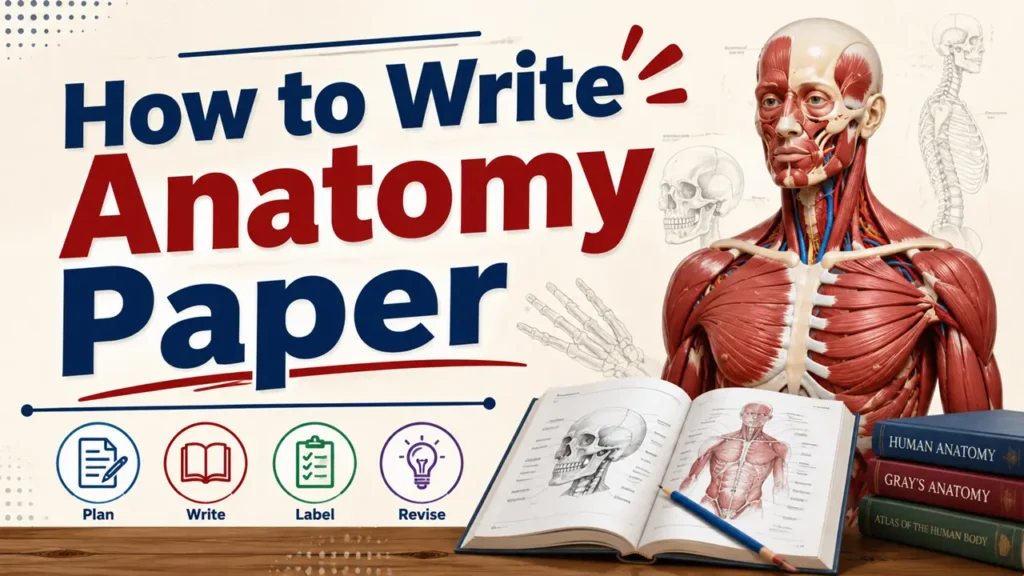
Anatomy is one of the first subjects that medical, nursing, physiotherapy, and biology students meet in their studies. It is also one of the subjects that feels the hardest when it comes to writing a paper about it. There are so many bones, muscles, organs, and systems to remember, and the names are often long and confusing. Many students know the topic well but still struggle when they sit down to write it in a proper academic format. If this sounds like you, do not worry. Writing an anatomy paper is not about being a genius. It is about following a clear method, step by step. In this blog, we will break down the whole process into simple parts so that any student can follow it and write a good anatomy paper with confidence.
Different Types of Anatomy Papers You Might Be Asked to Write
Before jumping into the writing process, it helps to know that not all anatomy papers are the same. Your teacher or professor might ask for different kinds of papers depending on the level of your course and the purpose of the assignment. Knowing the type you are dealing with will help you decide how deep or how simple your writing should be.
A descriptive anatomy paper is the most common type, especially for first year students. Here, you simply describe a structure in detail, covering its location, shape, parts, and function, without adding much personal analysis. A comparative anatomy paper asks you to compare two or more structures, such as comparing the anatomy of the upper limb with the lower limb, and highlight similarities and differences. A clinical anatomy paper connects the structure with a medical condition, for example explaining how a fracture of a particular bone affects nearby nerves or blood vessels. A research based anatomy paper is more advanced and usually asks you to review existing studies or findings about a structure, often required in higher semesters or postgraduate courses.
Once you know which type of paper you are writing, you can decide how much detail to include and which parts of this guide to focus on the most.
What Exactly Is an Anatomy Paper?
An anatomy paper is a written academic document that explains the structure of the human body or a part of it. It could be about a single organ like the heart, a system like the digestive system, or even a small structure like a single bone or nerve. The purpose of this paper is not just to describe what a body part looks like. It is meant to explain its structure, its location, its function, and sometimes how it connects with other parts of the body.
Some anatomy papers are simple descriptive essays for a class assignment. Others are detailed research papers that compare structures, discuss clinical importance, or explain a rare condition related to a body part. Whatever type you are asked to write, the basic approach stays almost the same, and that is what we will cover in this guide.
Why Anatomy Papers Feel Different from Other Subject Papers
If you have written papers for history, literature, or even chemistry, you might feel anatomy papers are a different challenge altogether. This is because anatomy is a highly visual subject. A lot of what you learn comes from images, models, and diagrams, not just from words. When you try to convert that visual knowledge into written sentences, it can feel awkward at first.
Another reason is the vocabulary. Anatomy has its own language, full of Latin and Greek based terms. Words like anterior, posterior, superior, inferior, medial, and lateral are used constantly, and if you are not comfortable with them, your writing can become confusing even to yourself. The good news is that once you understand this special vocabulary, writing becomes much easier because these terms actually make your descriptions more precise and shorter.
Step 1: Understand Your Topic Clearly Before You Start
The first and most important step is to fully understand what you are writing about. Do not start typing sentences the moment you get the topic. Instead, read about the topic from your textbook, class notes, and at least one extra trusted source. Try to answer these basic questions in your own mind first.
- Where exactly is this structure located in the body?
- What is it made of, and what does it look like?
- What is its main job or function in the body?
- How is it connected to nearby structures?
- Why is this structure important for doctors, students, or patients to know about?
If you can answer these five questions clearly, you already have the foundation of your paper ready in your mind. Writing becomes just a matter of putting these answers into proper sentences and paragraphs.
Step 2: Collect Information from Good and Reliable Sources
Never depend on just one source for an anatomy paper. Your class textbook is a great starting point, but you should also check standard anatomy references, your lecture notes, and if allowed, trusted medical websites or journals. Reliable sources give you accurate details about measurements, positions, and functions, which really matters in anatomy because small mistakes, like mixing up superior and inferior, can completely change the meaning of a sentence.
While reading, keep a small notebook or a separate document open. Write down important terms, their meanings, and any numbers or measurements you find, such as the length of a bone or the number of chambers in an organ. This habit saves a lot of time later when you actually sit down to write the paper, because you will not need to search for the same information again.
Also pay attention to labelled diagrams whenever you find them. Even if you are only writing text, looking at a labelled picture helps you understand the spatial relationship between different parts, and that understanding shows up naturally in your writing.
Step 3: Make a Simple Outline Before You Start Writing
Many students skip this step and jump straight to writing paragraphs. This is a common reason why anatomy papers turn out messy or repetitive. An outline is simply a short list of points arranged in the order you plan to discuss them. It works like a map for your paper.
A basic outline for an anatomy paper usually looks like this:
- Introduction – a short opening about the topic
- Location and position of the structure in the body
- Structure and parts – what it is made of
- Function – what job it performs
- Relations – how it connects with other body parts
- Clinical importance – why it matters in real life or medicine
- Conclusion – a short closing summary
Once you have this outline ready, writing the paper becomes much faster because you already know what comes next after every paragraph. You are not thinking and writing at the same time, which is what usually causes confusion.
Step 4: Write a Clear and Simple Introduction
The introduction of your anatomy paper should be short, usually not more than one small paragraph. Its job is to tell the reader what body part or system you are going to talk about and why it is worth studying. You do not need to give every detail here. Save that for the main body.
A good introduction usually mentions the name of the structure, a one line idea of where it is found in the body, and a short line about why it is important. For example, if your topic is the human heart, your introduction could simply state that the heart is a muscular organ found in the chest, responsible for pumping blood throughout the body, and that understanding its structure is the foundation for understanding many diseases related to the heart.
Step 5: Write the Main Body Using Correct Anatomical Terms
The main body is the heart of your paper, and this is where most of your marks come from. Follow the order you decided in your outline. Start with the location of the structure, then move to its structure and parts, then its function, and then its relations with nearby organs or tissues.
While writing, always try to use correct directional terms instead of vague words. Instead of writing that something is above another structure, use superior. Instead of writing that something is towards the back, use posterior. This might feel unusual at first, but your teachers and examiners expect this kind of precise language, and it actually makes your writing sound more professional and confident.
Keep your sentences short and clear. Anatomy already has complicated names, so there is no need to make your sentences complicated as well. One idea per sentence is a safe rule to follow. For example, instead of writing one long sentence describing the location, structure, and function of an organ together, break it into two or three separate sentences. This makes it much easier for anyone reading your paper to follow your explanation.
If your paper allows some depth, you can also briefly mention any variations found in different people, or any common conditions related to that structure. This shows that you understand the topic beyond just memorizing facts, and it can make your paper stand out.
Step 6: Use Diagrams and Labels the Right Way
If your assignment allows diagrams, always include at least one simple, clearly labelled diagram of the structure you are writing about. A diagram helps the reader understand the text much faster, and it also shows that you have a clear picture of the topic in your own mind.
When adding a diagram, keep these points in mind. Label every important part with a thin line pointing to the exact location. Keep the labels in simple, readable text, and place the diagram close to the paragraph where you are describing that same structure. Do not just place the diagram at the end of the paper without connecting it to your writing. Mention it in your text, for example by writing that the labelled diagram below shows the exact location of the structure you are describing.
If you are drawing the diagram yourself, keep it neat rather than detailed. A simple, clear outline diagram is always better than a messy, overly detailed one that is hard to read.
Step 7: Write a Strong and Short Conclusion
The conclusion should bring together everything you explained in the main body, but in a very short form. Do not introduce any new information here. Simply remind the reader what structure you talked about, its main function, and why understanding it is useful, especially in a medical or clinical context.
A good closing line often connects the topic back to real life. For example, you could end by mentioning how understanding the structure of a particular bone helps doctors diagnose fractures correctly, or how understanding a nerve pathway helps in treating certain injuries. This kind of ending leaves a good impression and shows that you understand the practical value of anatomy, not just the theory.
Common Mistakes Students Make While Writing Anatomy Papers
Knowing the common mistakes can help you avoid them easily. Here are the ones that come up again and again in student papers.
- Mixing up directional terms like superior, inferior, medial, and lateral, which changes the actual meaning of the sentence.
- Writing very long paragraphs that mix location, structure, and function all together, making it hard to follow.
- Copying sentences directly from textbooks or websites instead of explaining the topic in their own simple words.
- Forgetting to label diagrams properly, or adding diagrams that have no connection to the written text.
- Not proofreading the paper, which leaves spelling mistakes in important anatomical terms.
- Skipping the outline step and writing randomly, which leads to repeated points and a disorganized paper.
If you keep these mistakes in mind while writing, you can avoid most of the problems that pull down the quality of an anatomy paper.
Extra Tips to Make Your Anatomy Paper Even Better
Once you are comfortable with the basic structure, a few small habits can make your paper noticeably better.
- Read your paper out loud after writing it. If a sentence feels confusing to say, it will also feel confusing to read.
- Use headings to divide your paper into clear sections, especially if the paper is long. This makes it easier for the reader to follow.
- Keep a small glossary of anatomical terms you use often, along with their simple meanings, so you do not have to look them up every single time.
- Ask a classmate or friend to read your paper once. A fresh pair of eyes often catches confusing sentences that you might miss.
- Always check your paper against your college or university formatting guidelines, such as font size, spacing, and reference style, before submitting it.
These small habits do not take much extra time, but they make a real difference in how clear and professional your final paper looks.
How to Reference Your Sources Correctly
Anatomy papers, like any academic paper, need proper referencing whenever you use facts, figures, or ideas from a book, journal, or website. This is important for two reasons. First, it gives credit to the original author whose work helped you. Second, it protects you from being accused of copying someone else’s work without permission.
Most anatomy and medical courses ask students to follow a specific referencing style, commonly Vancouver style or sometimes APA style. Vancouver style uses numbers in the text that match a numbered list of references at the end of the paper, and it is very common in medical writing. Whatever style your institution asks for, the key habit to build is simple: note down the source, the author, and the page number the moment you use information from it, rather than trying to remember it later. Trying to add references after finishing the whole paper often leads to mistakes or missing citations.
Also remember that referencing is not just for direct quotes. Even when you explain an idea in your own words, if that idea came from a specific source, it should still be credited. This habit builds trust with your teacher and shows that your paper is based on solid, verified information rather than guesswork.
How Much Time Should You Spend on Each Step
A common question students ask is how to manage time while writing an anatomy paper, especially when there is also a deadline for other subjects. A simple and realistic time plan can help you avoid last minute stress.
- Spend about thirty percent of your total time on understanding the topic and collecting information from reliable sources.
- Spend about ten percent of your time making a clear outline before you begin writing.
- Spend about forty percent of your time actually writing the introduction, main body, and conclusion.
- Spend the remaining twenty percent on adding diagrams, checking references, and proofreading your final paper.
This kind of rough time division prevents the common mistake of spending too much time reading and too little time actually writing, which often leads to a rushed, poorly structured paper at the last moment.
How to Handle Difficult or Unfamiliar Anatomy Terms
Every student, at some point, comes across an anatomy term that feels impossible to pronounce or remember, let alone spell correctly in a paper. This is completely normal, since many anatomical names come from Latin and Greek roots that are not part of everyday language. Instead of avoiding these terms or replacing them with vague descriptions, it is better to slow down and break the word into smaller parts.
Many anatomical terms are built from prefixes, roots, and suffixes that repeat across the subject. For example, the prefix ‘hypo’ means below or under, while ‘hyper’ means above or excessive. The root ‘cardio’ relates to the heart, and ‘osteo’ relates to bone. Once you start recognizing these small building blocks, even a long and unfamiliar word becomes easier to understand and spell correctly. Keeping a small personal list of these common prefixes and roots, and reviewing it before you write a paper, can save you a lot of confusion.
It also helps to type out difficult terms a few times before using them in your paper, rather than typing them only once and hoping for the best. Spelling mistakes in anatomical terms are one of the easiest ways to lose marks, simply because the correct spelling often carries specific medical meaning.
Final Thoughts
Writing an anatomy paper does not have to feel overwhelming once you break it down into small, manageable steps. Understand your topic first, collect information from reliable sources, make a simple outline, and then write your introduction, main body, and conclusion in that order. Use correct anatomical terms, add clear diagrams where possible, and always proofread your work before submitting it.
Remember that anatomy is not just about memorizing names. It is about understanding how the human body is built and how every part works together. When you write your paper with that understanding, it naturally becomes clearer, more organized, and more interesting to read. With regular practice, writing anatomy papers will start to feel much easier, and you will find yourself explaining even complex structures in simple, confident words.

Poonam Pareek is the Founder, CEO, and Lead Writer of StudentsTalk.in, an education-focused platform dedicated to helping students stay informed about the latest academic updates, scholarships, entrance exams, career opportunities, government schemes, and study resources. With a passion for education and student success, she creates informative, easy-to-understand content.