
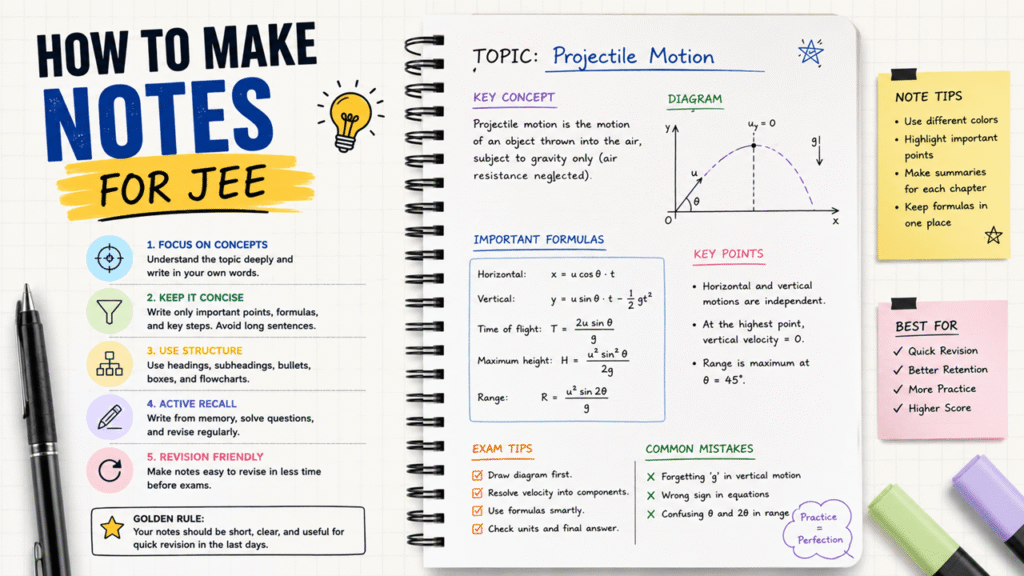
JEE — the Joint Entrance Examination — is one of the toughest exams in India. Every year, lakhs of students sit for JEE Main and JEE Advanced. The competition is very high. But here is the good news: smart preparation can make a big difference.
One of the most important habits of JEE toppers is making good notes. Notes help you revise faster. They keep all important formulas in one place. They save time during the last few months before the exam.
This blog will tell you exactly how to make notes for JEE in 2026. We will cover every subject — Physics, Chemistry, and Mathematics. We will also share the best formats, tools, and tips that actually work.
Why Making Notes is Important for JEE
Many students skip making notes. They think reading the textbook again and again is enough. But that is a big mistake. Here is why notes matter so much for JEE:
- Notes save revision time. Instead of reading 500 pages, you revise from 50 pages.
- Notes help you remember better. When you write something, your brain remembers it longer.
- Notes keep formulas, shortcuts, and tricks in one place.
- Notes help you identify weak topics quickly.
- Notes are your personal study material. They are made in your own words, so you understand them better.
A student who makes good notes has a huge advantage over someone who does not. This is proven by JEE toppers every year.
| Benefit | Without Notes | With Notes |
| Revision Speed | Slow — need to re-read full chapters | Fast — only revise your own short notes |
| Formula Recall | Difficult — scattered across books | Easy — all formulas in one place |
| Weak Topic Check | Hard to track | Easy to spot gaps |
| Last-Month Prep | Stressful and incomplete | Smooth and confident |
| Concept Clarity | Average | Strong — written in your own words |
When Should You Start Making Notes?
You should start making notes from day one of your preparation. Do not wait until you have finished a chapter. Make notes as you study.
Here is a simple timeline for when to make notes:
| Phase | When | What to Note |
| Phase 1 — Foundation | Class 11 / Start of Prep | Basic concepts, definitions, NCERT summaries |
| Phase 2 — Depth | Mid Preparation | Formulas, derivations, exceptions, shortcuts |
| Phase 3 — Practice | After Solving Problems | Common mistakes, tricky question types |
| Phase 4 — Revision | Last 3-4 Months | Quick-revision sheets, flashcards, formula lists |
| Phase 5 — Final Week | Last 7 Days | One-pagers per chapter, high-weightage topics only |
Starting early is the key. If you start making notes in the last few months, you will run out of time. Good notes take time to build.
Types of Notes You Should Make
There is no single type of note that works for everyone. Different types of notes serve different purposes. Here are the main types you should use for JEE:
3.1 Chapter Notes
These are your main notes. After reading each chapter, write a summary. Include all important concepts, formulas, and points. Keep it simple and short.
3.2 Formula Sheets
Make a separate sheet for formulas. Write all formulas for a chapter together. Use one sheet per chapter. This is extremely useful during revision.
3.3 Mistake Diary
This is very important and most students skip it. Every time you get a question wrong, note it down. Write the question, your mistake, and the correct approach. Review this diary regularly.
3.4 Shortcut Notes
JEE has many tricks and shortcuts. When you find a shortcut or a fast method, write it down. These small tricks can save minutes during the exam.
3.5 Quick Revision Cards
These are small cards or mini-sheets. Write the most important points of a chapter on one side of a card. You can use these in the last few weeks for fast revision.
| Note Type | Purpose | Best Time to Make | Format |
| Chapter Notes | Main study material | After studying the chapter | A4 pages, notebook |
| Formula Sheets | Quick formula lookup | After completing chapter | One page per chapter |
| Mistake Diary | Avoid repeating errors | After solving questions | Notebook or app |
| Shortcut Notes | Save exam time | As you discover shortcuts | Sticky notes or small book |
| Quick Revision Cards | Last-minute revision | Last 2-3 months | Index cards or digital |
How to Make Notes for Physics
Physics is a mix of concepts and mathematics. Your notes must have both — the idea behind the concept AND the formulas.
Step-by-Step Process for Physics Notes
- Read the NCERT chapter first. Understand the basic idea.
- Then read from a reference book like H.C. Verma or D.C. Pandey.
- Write the concept in 2-3 simple sentences in your own words.
- List all formulas and mention what each symbol means.
- Add diagrams wherever possible. A good diagram saves 100 words.
- Note all special cases and exceptions — these often appear in JEE.
- Write 2-3 solved examples in brief to understand application.
| Physics Chapter | JEE Weightage (Approx.) | Key Things to Note |
| Mechanics (Laws of Motion, Work-Energy) | High — 20-25% | FBD diagrams, energy conservation formulas |
| Electrostatics & Current Electricity | High — 18-22% | Coulomb’s law, circuit formulas, key derivations |
| Optics | Medium — 10-12% | Mirror and lens formulas, ray diagrams |
| Modern Physics | Medium — 8-10% | Nuclear reactions, photoelectric effect formulas |
| Thermodynamics | Medium — 8-10% | Cyclic process diagrams, laws of thermodynamics |
| Waves & Sound | Low-Medium — 5-8% | Wave equations, standing wave conditions |
| Magnetism | Medium — 8-10% | Biot-Savart law, force on current formulas |
Always draw diagrams in your Physics notes. JEE Physics questions often involve visualizing a situation. If your notes have clear diagrams, your brain will recall them during the exam.
How to Make Notes for Chemistry
Chemistry has three parts — Physical, Organic, and Inorganic. Each part needs a different approach for notes.
5.1 Physical Chemistry
Physical Chemistry is formula-based, just like Physics. Your notes should have all formulas clearly written. Also include solved numerical examples.
- Write all formulas clearly with units.
- Note important graphs — like PV vs P graphs in real gases.
- Write derivations for important equations like van der Waals.
- Practice problems are key — note the approach for each type.
5.2 Organic Chemistry
Organic Chemistry is about reactions and mechanisms. Your notes must have all named reactions and their mechanisms.
- Make a list of all named reactions — Aldol, Cannizzaro, Grignard, etc.
- Draw the mechanism step by step in your notes.
- Note the conditions — catalyst, temperature, solvent.
- Group similar reactions together. For example, all oxidation reactions in one section.
- Make a separate sheet for reagents and what they do.
5.3 Inorganic Chemistry
Inorganic Chemistry is mostly memory-based. Good notes are extremely important here.
- Use tables to organize information — like properties of d-block elements.
- Note the trends in the periodic table in one place.
- Make short notes on each group — Group 1, Group 2, etc.
- Note exceptions to general trends. JEE loves to ask about exceptions.
- Write all important reactions of compounds like KMnO4, Na2O2, etc.
| Chemistry Part | Note Format | Must Include |
| Physical Chemistry | Formula sheets + solved examples | Equations, units, graphs, numerical tricks |
| Organic Chemistry | Reaction charts + mechanism diagrams | Named reactions, conditions, reagents table |
| Inorganic Chemistry | Tables + bullet points | Periodic trends, exceptions, compound reactions |
How to Make Notes for Mathematics
Mathematics for JEE requires both conceptual understanding and problem-solving practice. Your notes should reflect both.
Step-by-Step Process for Maths Notes
- Start with the basic definition and concept — write it simply.
- List all key formulas. Number them so they are easy to find.
- Write important identities and their derivations.
- Note the different types of problems in each topic.
- For each problem type, write the approach in 3-4 steps.
- Add tricky sub-cases that often appear in JEE — like when the denominator is zero.
- Write any useful tricks for faster calculation.
| Maths Topic | JEE Weightage (Approx.) | Key Notes Focus |
| Calculus (Differentiation, Integration) | High — 30-35% | Standard integrals, limits, differentiation rules |
| Coordinate Geometry | High — 20-25% | Equation forms, distance/slope formulas, conics |
| Algebra (Sequences, Complex Numbers, Matrices) | Medium — 20% | AP/GP formulas, complex number properties |
| Trigonometry | Medium — 10-15% | All identities, inverse trig formulas |
| Probability & Statistics | Low-Medium — 8-10% | Bayes theorem, distributions, combination formulas |
| 3D Geometry & Vectors | Medium — 8-10% | Dot/cross product, plane and line equations |
For Maths, do not just copy formulas. Write 1-2 example problems showing how each formula is used. This makes revision much more effective.
Best Format for JEE Notes
The format of your notes matters a lot. Bad format means you waste time finding things. Good format means you can revise in minutes.
The Cornell Method — Best for JEE
The Cornell Note-Taking System is one of the best formats for JEE. Here is how it works:
- Divide your page into three parts: a narrow left column (30%), a wide right column (70%), and a small bottom section.
- In the right column: write your main notes — concepts, formulas, examples.
- In the left column: write key words, questions, or topic headings.
- At the bottom: write a 2-3 line summary of the page.
This format makes revision very easy. You can cover the right side and use the left-side keywords to test yourself. This is called active recall, and it is one of the best study techniques.
| Note Format | Best For | Pros | Cons |
| Cornell Method | Concept-heavy topics | Great for active recall and self-testing | Takes slightly more time to set up |
| Mind Maps | Organic Chemistry, Inorganic topics | Visual, easy to connect ideas | Hard to include detailed formulas |
| Table Format | Inorganic Chemistry, Comparisons | Very organized, great for revision | Not good for derivations |
| Flowcharts | Reaction mechanisms, Problem steps | Shows process clearly | Can get messy if not planned |
| Linear Notes | Maths derivations, Physics formulas | Simple and fast to write | Hard to find specific information later |
Digital vs Handwritten Notes — What Works Better for JEE?
This is one of the most common questions among JEE aspirants. The short answer: both have their place.
Handwritten Notes
Research shows that writing by hand improves memory. When you write something down, your brain processes it more deeply. For most JEE topics — especially Maths and Physics — handwritten notes are better.
- Better for memory retention.
- Easier to draw diagrams and circuits.
- No screen time fatigue.
- Works offline — no need for internet or device.
Digital Notes
Digital notes are great for organizing and searching. Apps like Notion, OneNote, and Anki are very popular among JEE students in 2026.
- Easy to search and organize.
- Easy to edit and update.
- Great for flashcards and spaced repetition (Anki).
- Can attach images and PDFs.
| Criteria | Handwritten Notes | Digital Notes |
| Memory Retention | Better — writing by hand helps | Slightly lower, but still useful |
| Organization | Harder — needs physical files | Very easy — folders and search |
| Revision Speed | Good for formulas and quick scans | Excellent — Ctrl+F and hyperlinks |
| Diagrams and Circuits | Easy to draw naturally | Needs tools, slightly slower |
| Portability | Carry physical notebooks | On your phone or laptop anywhere |
| Best Use | Main chapter notes, Maths, Physics | Flashcards, Inorganic lists, Anki decks |
The best strategy in 2026 is to use both. Write your main chapter notes by hand. Use digital tools for revision cards, formula lists, and Inorganic Chemistry tables.
Common Mistakes Students Make While Taking Notes
Many students make notes but still do not get good results. That is usually because of these common mistakes:
Mistake 1: Copying the Textbook Word-for-Word
This is the most common mistake. If you just copy what is written in the book, you are not learning. You are just rewriting. Good notes should be in YOUR own words. Write what you understand.
Mistake 2: Making Notes Too Long
Some students write 10 pages of notes for a single chapter. This defeats the purpose. Notes should be short. The goal is to reduce the chapter to its most important points — not to rewrite the whole chapter.
Mistake 3: Not Revising Notes
Making notes without revising them is useless. Notes only help if you review them regularly. Schedule time every week to look at your old notes.
Mistake 4: Skipping Diagrams
Many students think diagrams take too much time. But a good diagram can help you remember a concept for months. Always include diagrams in Physics and Chemistry notes.
Mistake 5: Not Updating Notes
As you learn more, your understanding grows. If you find a better way to explain a concept, update your notes. Notes should be a living document that grows with you.
| Mistake | Why It Hurts | What to Do Instead |
| Copying textbook | No deep understanding, waste of time | Write in your own simple words |
| Notes too long | Hard to revise, defeats the purpose | Keep notes short — 1-2 pages per chapter |
| Not revising | Forget everything you wrote | Revise notes weekly, especially old chapters |
| Skipping diagrams | Weaker visual memory | Draw diagrams for Physics and Chemistry |
| Not updating notes | Notes become outdated or incorrect | Update notes as you learn more |
Revision Strategy Using Notes
Making notes is only half the job. Revising them properly is the other half. Here is a simple revision system you can follow:
The 1-7-30 Revision Rule
This is based on the idea of spaced repetition. When you make notes on a topic:
- Revise it after 1 day (next day).
- Revise it again after 7 days (one week later).
- Revise it again after 30 days (one month later).
Each time you revise, the concept becomes stronger in your memory. You will need less and less time for each revision cycle.
| Revision Cycle | Time After Making Notes | What to Revise |
| 1st Revision | Next day (Day 1) | Full notes of the chapter — 15-20 minutes |
| 2nd Revision | After 7 days | Formulas and key concepts — 10 minutes |
| 3rd Revision | After 30 days | Only formula sheet and quick points — 5 minutes |
| 4th Revision | Before each Mock Test | Quick revision cards only — 2-3 minutes |
| Final Revision | Last 7 days before JEE | One-pager per chapter — 1-2 minutes each |
If you follow this system, you will never feel like you have forgotten a topic before the exam. It takes effort in the beginning but becomes easy over time.
Tools and Resources for Note-Making in 2026
In 2026, there are many tools that make note-making easier and more effective. Here are the best ones for JEE aspirants:
| Tool / App | Type | Best For | Free or Paid |
| Anki | Flashcard App | Quick revision using spaced repetition | Free |
| Notion | Digital Notes | Organized chapter notes, formulas, tables | Free (basic) |
| OneNote | Digital Notes | Handwritten digital notes on tablet | Free with Microsoft account |
| GoodNotes / Notability | Digital Handwriting | Handwritten notes on iPad — best of both worlds | Paid |
| Canva | Design Tool | Making visual formula sheets and mind maps | Free (basic) |
| Quizlet | Flashcard App | Chemistry definitions and reactions | Free (basic) |
| Google Keep | Quick Notes | Saving quick shortcut tricks on the go | Free |
| Physical Notebook (A4) | Handwritten | Main chapter notes for Maths and Physics | Low cost |
You do not need all of these. Pick 2-3 tools that work for you. Most students in 2026 use a combination of a physical notebook and one digital tool like Notion or Anki.
Subject-Wise Notes Template for JEE 2026
Here is a simple template you can follow for each subject. Use this as a guide when making your own notes.
Physics Chapter Notes Template
- Chapter Name and Date
- Main Concept — 3-4 sentences in own words
- Formulas List — with symbol meanings and units
- Important Diagrams or Graphs
- Derivations — if asked in JEE (keep short)
- Special Cases and Exceptions
- JEE-Level Application Examples — 2-3 problems with approach
- Common Mistakes in This Chapter
Chemistry Chapter Notes Template
- Chapter Name and Date
- Core Idea — 2-3 lines
- Formulas (Physical Chemistry) OR Reactions List (Organic) OR Property Tables (Inorganic)
- Conditions and Reagents
- Exceptions and Tricks
- Important Previous Year JEE Questions — just note the type, not full solutions
Mathematics Chapter Notes Template
- Chapter Name and Date
- Key Definitions
- All Formulas — numbered
- Important Identities and Proofs (if short)
- Types of Problems in This Chapter — 4-5 types
- Approach for Each Problem Type — 3-4 step method
- Tricky Sub-Cases and Edge Cases
- Shortcut Tricks and Patterns
JEE 2026 Important Topics — Focus Your Notes Here
JEE Main and JEE Advanced have certain topics that appear more often. Make sure your notes for these topics are especially strong.
| Subject | High Priority Topics | Approximate Weightage |
| Physics | Mechanics, Electricity, Magnetism, Optics | 60-65% of Physics section |
| Physics | Modern Physics, Thermodynamics | 20-25% of Physics section |
| Chemistry | Organic Reactions, Coordination Compounds | 35-40% of Chemistry section |
| Chemistry | Electrochemistry, Chemical Kinetics, Equilibrium | 25-30% of Chemistry section |
| Chemistry | p-block, d-block elements, Periodic Trends | 20-25% of Chemistry section |
| Mathematics | Calculus (Differential + Integral) | 30-35% of Maths section |
| Mathematics | Coordinate Geometry, Conic Sections | 20-25% of Maths section |
| Mathematics | Algebra, Sequences, Complex Numbers | 15-20% of Maths section |
Give more time and attention to these topics when making notes. A strong set of notes for high-weightage topics can directly improve your JEE score.
How Many Pages Should Your Notes Be?
This is a very common doubt. Here is a simple guideline:
| Content Type | Recommended Length |
| Chapter Notes (1 full chapter) | 3-5 A4 pages maximum |
| Formula Sheet (1 chapter) | 1 A4 page maximum |
| Mistake Diary (1 week) | Half to 1 page |
| Quick Revision Card (1 chapter) | 1 index card or half A5 page |
| Complete Physics Notes | 100-150 pages total |
| Complete Chemistry Notes | 120-180 pages total |
| Complete Maths Notes | 100-150 pages total |
These are guidelines, not strict rules. Every student is different. What matters is that your notes cover all important points and are easy for YOU to understand and revise.
Final Tips for Making the Best JEE Notes in 2026
Here are some final quick tips from JEE toppers:
- Use different colors for different things — one color for formulas, one for concepts, one for exceptions. This makes scanning faster.
- Date your notes. This helps you track your progress and revise in order.
- Leave some space on each page. You will want to add things later as you learn more.
- Review your notes after every mock test. Add anything new you learn.
- Do not make notes for topics you already know very well. Focus your note-making on topics you find difficult.
- Study in a group once in a while. Your friend might have noted something you missed.
- Do not rewrite notes unless they are messy or wrong. Rewriting without purpose is a waste of time.
- Practice writing notes fast. In the beginning it is slow, but with practice you get much faster.
| Quick Tips Summary | Action |
| Use color coding | Different colors for formulas, concepts, and exceptions |
| Date your notes | Helps track progress and organize revision |
| Leave blank space | For future additions and corrections |
| Review after mock tests | Add insights from tests to your notes |
| Focus on weak areas | Do not over-note topics you already know well |
| Keep notes short | 3-5 pages per chapter maximum |
| Revise on schedule | Follow the 1-7-30 rule for each chapter |
Conclusion
Making good notes is one of the smartest things you can do for JEE 2026. It takes time and effort in the beginning. But the results are worth it.
Here is the simple summary of what you need to do:
- Start making notes from day one.
- Use the right format for each subject — Cornell, tables, or flowcharts.
- Keep notes short, clear, and in your own words.
- Make formula sheets, mistake diaries, and revision cards.
- Revise your notes using the 1-7-30 rule.
- Use digital tools like Anki or Notion to support your handwritten notes.
- Focus extra attention on high-weightage topics.
The goal of notes is not to write everything. The goal is to capture the most important things in the least amount of space so you can revise fast and recall easily during the exam.

Poonam Pareek is the Founder, CEO, and Lead Writer of StudentsTalk.in, an education-focused platform dedicated to helping students stay informed about the latest academic updates, scholarships, entrance exams, career opportunities, government schemes, and study resources. With a passion for education and student success, she creates informative, easy-to-understand content.