Have you ever seen a huge ship on TV carrying thousands of containers across the ocean? Or a massive oil tanker traveling from the Middle East to India? The people who work on those ships — who sail them, maintain them, and make sure cargo reaches safely — belong to the Merchant Navy.
The Merchant Navy is NOT part of the Indian Army, Navy, or any defence force. It is a commercial fleet of ships that carry goods, oil, chemicals, passengers, and other things from one country to another. It is a civilian job — but one of the most exciting and high-paying ones in the world.
Every year, thousands of Indian students join the Merchant Navy after their 12th standard. India is one of the top suppliers of seafarers in the world. If you are reading this guide, you are already one step ahead. Let’s understand everything — from what courses to take, to how much you will earn.
| Did You Know?
India produces more than 9% of the world’s total seafarers. There are over 1.6 lakh Indian seafarers working on ships all over the world right now. The demand is only growing! |
Why Should You Choose the Merchant Navy?
Before we talk about how to join, let’s talk about why so many students are choosing this career. Here are the biggest reasons:
1. Very High Salary
Merchant Navy is one of the highest-paying careers you can get straight after 12th or a short course. Here is a rough salary chart based on rank:
| Rank / Position | Experience | Monthly Salary (Approx. in USD) | In Indian Rupees (Approx.) |
| Deck Cadet / Engine Cadet (Trainee) | Freshers | $400 – $600 | ₹33,000 – ₹50,000 |
| Junior Officer / 4th Engineer | 1–3 years | $1,200 – $2,500 | ₹1 – ₹2 Lakh |
| 2nd Officer / 3rd Engineer | 3–6 years | $2,500 – $4,500 | ₹2 – ₹3.7 Lakh |
| Chief Officer / 2nd Engineer | 6–10 years | $4,500 – $7,000 | ₹3.7 – ₹5.8 Lakh |
| Captain / Chief Engineer | 10–15 years | $8,000 – $15,000+ | ₹6.6 – ₹12.5 Lakh |
Note: These salaries are TAX-FREE in India if you spend more than 182 days on a ship (as per Indian Income Tax rules for NRI seafarers). This makes the take-home pay even better!
2. Travel the World for Free
Imagine getting paid to see Singapore, Dubai, Rotterdam, New York, and hundreds of other ports — all without spending a single rupee from your pocket. Your food, accommodation, and travel are all covered by the company. You live on the ship!
3. Work for a Few Months, Rest for a Few Months
Most seafarers work on a “contract basis”. You go to sea for 4 to 6 months, then come back home for 2 to 4 months. This gives you long vacations at home — something very few jobs offer.
4. Fast Career Growth
If you are hardworking and pass your exams, you can become a Captain or Chief Engineer in 10–12 years. Compare this to a government job or corporate job where it takes 25–30 years to reach a top position.
5. No Language Barrier for Work
English is the official language of the sea. If you can speak basic English, you are already qualified to communicate on a ship. This is great news for students from all parts of India.
Two Main Departments on a Ship
Before choosing your course, you need to understand that a ship has two main departments. Every person on a ship belongs to one of these:
| Department | What They Do | Who Should Choose This? |
| DECK Department | Navigates the ship, handles cargo, ensures the ship goes in the right direction, maintains safety equipment | Students who love geography, oceans, travelling, and leadership |
| ENGINE Department | Takes care of the ship’s engine, machinery, pumps, and electrical systems | Students who love machines, physics, engineering, and technical work |
Apart from these two, there is also a “HOSPITALITY / CATERING” department on passenger ships (cruise ships) — for students who want to work in hotel management at sea.
Eligibility: What Do You Need After 12th?
This is the most important part. Your eligibility depends on which stream you studied in 12th standard. Read this carefully:
1. For PCM Students (Physics, Chemistry, Maths)
PCM students have the most options. They can apply for Deck and Engine officer roles:
| Course Name | Duration | Department | Minimum Marks in PCM |
| B.Sc. Nautical Science | 3 years | Deck | 60% in PCM, English |
| B.E. Marine Engineering | 4 years | Engine | 60% in PCM, English |
| Diploma in Nautical Science (DNS) | 1 year + sea training | Deck | 50% in 12th PCM |
| B.Tech Marine Engineering | 4 years | Engine | 60% in PCM, English |
| ETO (Electro-Technical Officer) Course | 1 year diploma | Engine (Electrical) | 50% in 12th PCM |
2. For Non-PCM / Commerce / Arts Students
Don’t worry if you did not study PCM. You can still join the Merchant Navy! Here are your options:
| Course Name | Duration | What You Do on Ship | Who Can Apply |
| GP Rating (General Purpose) | 6 months | Deck/Engine Rating (crew level) | 10th pass, or 12th any stream |
| Saloon Rating / Catering | 3–6 months | Work in kitchen, housekeeping on cruise ships | 12th any stream |
| Pump Man Course | Short term | Handle cargo pumps on tankers | 10th or 12th pass |
| Hospitality / Hotel Mgmt at Sea | 3 years degree | Food, housekeeping, passenger care | 12th any stream |
| Important Note for Non-PCM Students
GP Rating is the most popular entry point for non-PCM students. After joining as a Rating, you can study further and appear for officer-level exams (called ‘Competency Certificates’). Many Chief Officers and Captains today started as GP Ratings! |
Top Courses Explained in Detail
1. B.Sc. Nautical Science (3 Years)
This is the most popular degree course for students who want to become Deck Officers (navigators). After completing this, you join the ship as a Deck Cadet and work your way up to become a Captain.
- Duration: 3 years college + 12 months sea training
- Eligibility: 60% in 12th with Physics, Chemistry, Maths, and English
- Admission: Through IMU-CET (Indian Maritime University Common Entrance Test)
- After completing: You appear for 2nd Mate exam by DGS (Directorate General of Shipping)
- Top Institutes: TS Chanakya (Mumbai), IMU Chennai, MERI Kolkata, AMET University
2. B.E. / B.Tech Marine Engineering (4 Years)
This is the top choice for students who want to become Engine Officers. After this course, you join as an Engine Cadet and can eventually become a Chief Engineer.
- Duration: 4 years
- Eligibility: 60% in 12th with Physics, Chemistry, Maths, and English
- Admission: IMU-CET or direct admission at approved institutes
- Starting salary after sea training: ₹1 – ₹1.5 Lakh/month
- Top Institutes: Vels University, AMET University, SRM, Tolani Maritime Institute
3. Diploma in Nautical Science (DNS) — 1 Year
This is a shorter and more affordable route to becoming a Deck Officer. It is very popular among students who want a quicker entry into the Merchant Navy.
- Duration: 1 year pre-sea training + approximately 18 months onboard training
- Eligibility: 50% in 12th with PCM and English
- After completing: You appear for 2nd Mate Foreign Going exam
- Course fee: Relatively lower than the 3-year degree
- Preferred by: Students who want to start earning sooner
4. GP Rating — The Best Option for Non-PCM Students
GP Rating stands for “General Purpose Rating”. This is an entry-level position on a ship. You work as a crew member, helping deck and engine officers. This is a great starting point if you studied Arts, Commerce, or did not score well in science.
- Duration: 6 months pre-sea training
- Eligibility: 10th pass or 12th pass (any stream), age 17.5 to 25 years
- Starting salary: ₹25,000 – ₹50,000 per month (tax-free)
- Growth: With experience and exams, you can become an Officer
- Top institutes: Anglo Eastern, Fleet Management, Samundra Institute, IMU
Medical Requirements — Very Important!
The Merchant Navy has strict medical requirements. Before joining any course, you MUST pass a medical test. Here is what they check:
| Medical Requirement | What It Means | Can It Be Fixed? |
| Eyesight (Vision) | Minimum 6/6 vision (with or without glasses in some cases) | Lasik surgery sometimes allowed — check latest DGS rules |
| Colour Blindness | You MUST NOT be colour blind | No — this disqualifies you for Deck and Engine officer roles |
| Height & Weight | No strict limit, but must be fit and healthy | Yes, maintain fitness |
| No Serious Disease | No heart problems, diabetes (uncontrolled), epilepsy, mental disorders | Depends on condition |
| Hearing | Normal hearing in both ears | Mild issues can be managed with devices in some cases |
The medical test is done at DGS-approved hospitals. The certificate issued is called the “ENG-1” or “Indian Medical Certificate”. Get your medical check done BEFORE paying any course fee.
| Warning!
Many students pay their entire course fee and then find out they are colour blind or have a vision problem. ALWAYS get the medical test done FIRST. It is the most important step before everything else. |
Important Exams and Certificates You Need to Know
1. IMU-CET (Indian Maritime University Common Entrance Test)
This is the main entrance exam for most degree courses (B.Sc. Nautical Science, B.Tech Marine Engineering). It is conducted by the Indian Maritime University (IMU).
- Conducted: Usually in June every year
- Subjects: English, Maths, Physics, Chemistry, General Aptitude
- Mode: Online (Computer Based Test)
- Application: Apply at imu.edu.in
- Important: Check the official IMU website for the 2026 exam schedule
2. STCW Courses (Standards of Training, Certification and Watchkeeping)
Once you join a maritime institute, you will also do STCW basic safety training. These are internationally required courses. Without these certificates, you CANNOT work on a ship.
- PSSR: Personal Safety and Social Responsibility
- Elementary First Aid (EFA)
- Fire Prevention and Fire Fighting (FPFF)
- Personal Survival Techniques (PST)
- These are usually done DURING your pre-sea course. Do not worry — your institute handles this.
3. CDC (Continuous Discharge Certificate)
The CDC is like your “passport” for working on ships. It is issued by the DGS (Directorate General of Shipping, under the Ministry of Ports, Shipping & Waterways, Government of India). Without a CDC, no company will hire you as a seafarer.
4. DGS Competency Exams (For Promotions)
As you gain experience at sea, you need to pass government exams to get promoted. These are called Competency Certificate exams (CoC):
| Exam Name | Who Appears? | After This, You Become: |
| 2nd Mate Foreign Going | Deck Cadets with sea experience | 2nd Officer / Junior Navigator |
| 1st Mate Foreign Going | 2nd Officers with more experience | Chief Officer |
| Master / Captain (FG) | Chief Officers | Captain of the Ship |
| 4th Engineer | Engine Cadets | Junior Engineer Officer |
| 2nd Engineer (MEO Class 2) | Junior Engineers | 2nd Engineer |
| Chief Engineer (MEO Class 1) | 2nd Engineers | Chief Engineer |
Step-by-Step Process — How to Actually Join
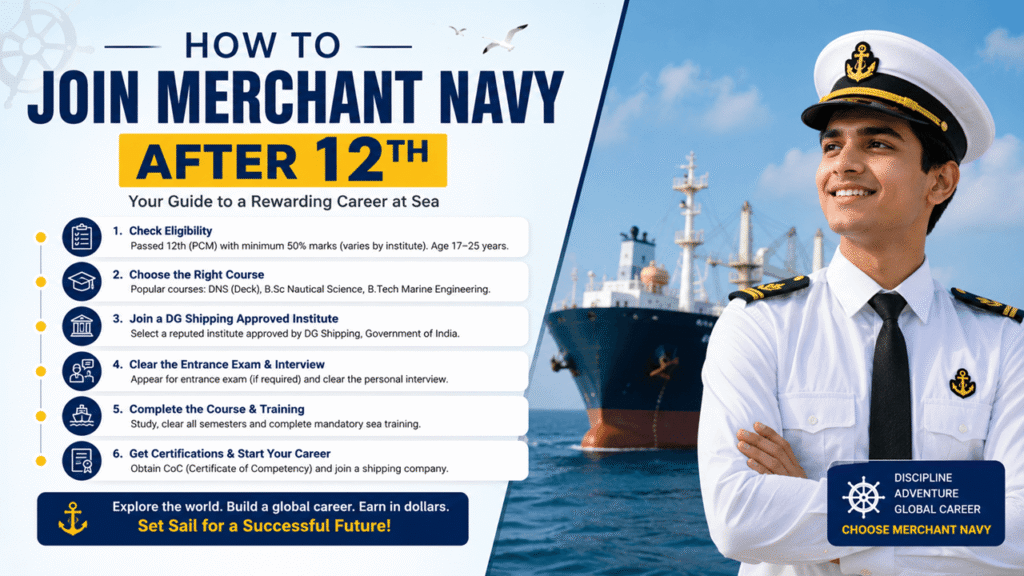
Here is the complete roadmap from 12th to your first job on a ship:
- Step 1: Get your medical test done at a DGS-approved hospital. Make sure you pass colour vision, eyesight, and general fitness tests.
- Step 2: Appear for IMU-CET (if you are going for a degree course) OR directly apply to a DGS-approved maritime training institute for DNS / GP Rating / diploma courses.
- Step 3: Get admission to a DGS-approved institute. This is very important — only study at institutes approved by the Directorate General of Shipping. Do NOT join any random institute.
- Step 4: Complete your pre-sea training course (6 months to 4 years depending on the course). During this time, you will do STCW safety courses too.
- Step 5: Apply for your CDC (Continuous Discharge Certificate) through the DGS Seafarer Portal (dgsshipping.gov.in).
- Step 6: Apply to shipping companies for a cadet or rating berth (a job on a ship). Your institute usually helps with placements.
- Step 7: Join the ship! Complete your required sea time (usually 12–18 months for officers, 6 months for ratings).
- Step 8: Appear for your Competency Certificate exam to get promoted to the next rank.
- Step 9: Keep gaining sea time, pass exams, and grow from Junior Officer all the way to Captain or Chief Engineer.
Top DGS-Approved Maritime Institutes in India (2026)
Always verify the institute approval status on the official DGS website (dgshipping.gov.in) before taking admission. Here are some of the most well-known institutes:
| Institute Name | Location | Courses Offered | Type |
| TS Chanakya | Mumbai, Maharashtra | B.Sc. Nautical Science, DNS | Government |
| IMU — Indian Maritime University | Chennai + multiple campuses | B.Sc., B.Tech, DNS, M.Sc. | Central University |
| MERI — Marine Engineering & Research Institute | Kolkata, West Bengal | B.Sc., Marine Engineering | Government |
| Samundra Institute of Maritime Studies | Mumbai, Maharashtra | B.Sc. Nautical Science, DNS, ETO | Private |
| AMET University | Chennai, Tamil Nadu | B.Sc., B.Tech Marine Engineering | Deemed University |
| Tolani Maritime Institute | Pune, Maharashtra | B.Sc. Nautical Science, Marine Engineering | Private |
| Anglo-Eastern Maritime Academy | Mumbai, Maharashtra | GP Rating, Ratings, Cadet Programs | Private (Company) |
| Vels University (Maritime) | Chennai, Tamil Nadu | B.Tech Marine Engineering | Private University |
| LBS College of Engineering (Maritime) | Kasaragod, Kerala | B.Sc. Nautical Science | Government |
| Pro Tip
Always check if the institute is listed on dgshipping.gov.in under ‘Approved Institutes’. A fake or unapproved institute will waste your money and your CDC will not be issued. Many students have been cheated by fake institutes — be very careful! |
Course Fees — How Much Does It Cost?
Fees vary a lot depending on the institute and the course. Here is a general idea for 2026:
| Course | Approximate Total Fee | Duration |
| B.Sc. Nautical Science | ₹5 Lakh – ₹12 Lakh (3 years) | 3 years |
| B.E. / B.Tech Marine Engineering | ₹6 Lakh – ₹14 Lakh | 4 years |
| DNS (Diploma in Nautical Science) | ₹3 Lakh – ₹6 Lakh | 1 year |
| GP Rating Course | ₹50,000 – ₹1.5 Lakh | 6 months |
| ETO Course | ₹1.5 Lakh – ₹3 Lakh | 1 year |
| Saloon / Catering Rating | ₹30,000 – ₹80,000 | 3–6 months |
1. Scholarships and Loans
- Government scholarships are available for SC/ST students and OBC students — check the National Scholarship Portal (scholarships.gov.in).
- Many banks offer education loans for maritime courses (SBI, Bank of Baroda, Union Bank).
- Some shipping companies (like Anglo Eastern, Synergy, Fleet Management) sponsor cadets — they pay your fees and in return, you work with them for 1–2 contracts after training.
- IMU offers merit scholarships for top-ranking IMU-CET students.
Life on a Ship — What Should You Expect?
Many students wonder: what is it actually like to live on a ship? Here is an honest picture:
1. The Good Things
- You will live in a cabin (like a small hotel room) with your own bathroom. Modern ships are very comfortable.
- Free food — the ship has a mess/canteen where all meals are provided.
- Free internet (basic speed) on most modern ships.
- No rent, no electricity bill, no grocery expense — your salary is 100% savings!
- You can video call your family on most ships via internet.
- See amazing places — ports in 30–40 different countries over a career.
2. The Challenges
- You will be away from family for 4–6 months at a stretch. This can be emotionally tough, especially at the beginning.
- The sea can be rough. Seasickness is common for new sailors, but most people get used to it in a few days.
- Your social life is limited while at sea. You will mostly interact with your shipmates.
- You may miss important family events like Diwali, weddings, or birthdays.
- The work can be physically demanding — especially on tankers and bulk carriers.
| Reality Check
The first 1–2 years at sea can be tough. But most seafarers say that after you get used to it, the lifestyle is incredibly rewarding. The long vacations at home and the salary make up for the time away. |
Career Growth Path — From Cadet to Captain
Here is the typical career ladder for a Deck Officer. Engine officers follow a similar path:
| Rank | How to Get There | Years of Experience (Approx.) |
| Deck Cadet | Complete B.Sc. Nautical Science or DNS | Fresher |
| 3rd Officer | Pass 2nd Mate exam + 12 months sea time | 2–3 years |
| 2nd Officer | Pass 1st Mate exam + more sea time | 4–6 years |
| Chief Officer | Pass Chief Mate exam + more sea time | 7–9 years |
| Captain (Master) | Pass Master’s Certificate of Competency | 10–15 years |
For Engine Officers, the path is: Engine Cadet → 4th Engineer → 3rd Engineer → 2nd Engineer → Chief Engineer. Top-level engineers (MEO Class 1) can earn ₹10–15 Lakh per month.
Common Mistakes to Avoid
Many students make mistakes that cost them time and money. Here is what NOT to do:
- Do NOT join any institute without verifying its DGS approval. Check dgshipping.gov.in first.
- Do NOT pay any money without a proper receipt and official admission letter.
- Do NOT skip the medical test. It must be done at a DGS-approved hospital.
- Do NOT trust agents who promise you a “direct ship job” without any training. This is a scam.
- Do NOT choose a course without understanding if you are medically eligible (especially for colour vision).
- Do NOT delay applying for IMU-CET — the application window is usually February to April.
- Do NOT ignore physical fitness. Start exercising regularly. Being fit helps at sea.
Frequently Asked Questions (FAQs)
Q1. Can a girl join the Merchant Navy?
Yes! Women can join the Merchant Navy. The number of female seafarers is growing every year. Women work as Deck Officers, Engine Officers, and in hospitality on cruise ships. Some top female officers from India have even become Captains.
Q2. I have spectacles. Can I still join?
Yes, in most cases. The DGS allows vision correction with glasses or contact lenses up to a certain limit. Lasik surgery is also allowed in some cases. You need to get a proper medical examination to confirm your eligibility.
Q3. What is the age limit?
Most courses require you to be between 17 and 25 years of age at the time of admission. The upper age limit can vary slightly by institute and course. Apply early and do not wait.
Q4. I studied Commerce in 12th. What can I do?
Your best option is the GP Rating course. After gaining experience and passing maritime exams, you can grow to higher levels. Some commercial or administrative roles with shipping companies (not on ships) also welcome commerce graduates.
Q5. Is Merchant Navy better than Indian Navy?
They are very different. Indian Navy is a defence/military career. Merchant Navy is a commercial career. Merchant Navy salaries are often much higher. Indian Navy has job security and pension. The choice depends on your personal goals, interest, and eligibility.
Q6. How do I find legitimate shipping companies for jobs?
After completing your training and getting your CDC, you can apply to shipping companies directly. Some trusted companies that recruit Indian cadets include: Anglo Eastern Univan, Fleet Management Ltd, Synergy Maritime, Bernhard Schulte Shipmanagement, Wallem Group, and V Group.
Q7. Is there a future in Merchant Navy or will AI replace sailors?
The demand for skilled seafarers is growing globally. While technology is automating some tasks, you still need qualified humans on ships for safety, decision-making, and emergency response. The IMO (International Maritime Organization) estimates a shortage of 89,000 officers globally by 2026. The future is bright.
Quick Summary Checklist
Here is a simple checklist for students planning to join the Merchant Navy after 12th in 2026:
| Step | Action Item | Status |
| 1 | Check your stream — PCM or Non-PCM? | ☐ Done |
| 2 | Get medical test done at DGS-approved hospital | ☐ Done |
| 3 | Check colour vision — no colour blindness | ☐ Done |
| 4 | Choose your course (B.Sc., DNS, GP Rating, etc.) | ☐ Done |
| 5 | Check IMU-CET dates on imu.edu.in | ☐ Done |
| 6 | Apply to DGS-approved institute only | ☐ Done |
| 7 | Check for scholarships on scholarships.gov.in | ☐ Done |
| 8 | Prepare physically — improve fitness | ☐ Done |
| 9 | Learn basic English communication | ☐ Done |
| 10 | Apply for CDC after training at dgsshipping.gov.in | ☐ Done |
Final Words
The Merchant Navy is not just a job — it is a lifestyle. It is for those who are brave enough to leave home, travel the world, and earn money while doing it. India has produced thousands of successful Captains and Chief Engineers who started exactly where you are right now — just after 12th standard, not sure about what to do next.
The key is to start right. Get your medical done. Choose the right course. Join a DGS-approved institute. Work hard. And never stop learning.
The ocean is calling. Are you ready to answer?
| Official Websites to Bookmark
DGS Official Website: dgshipping.gov.in | IMU Official Website: imu.edu.in | Seafarer CDC Portal: mpassport.dgshipping.gov.in | National Scholarship Portal: scholarships.gov.in | STCW Certification Info: stcw.org |

Poonam Pareek is the Founder, CEO, and Lead Writer of StudentsTalk.in, an education-focused platform dedicated to helping students stay informed about the latest academic updates, scholarships, entrance exams, career opportunities, government schemes, and study resources. With a passion for education and student success, she creates informative, easy-to-understand content.