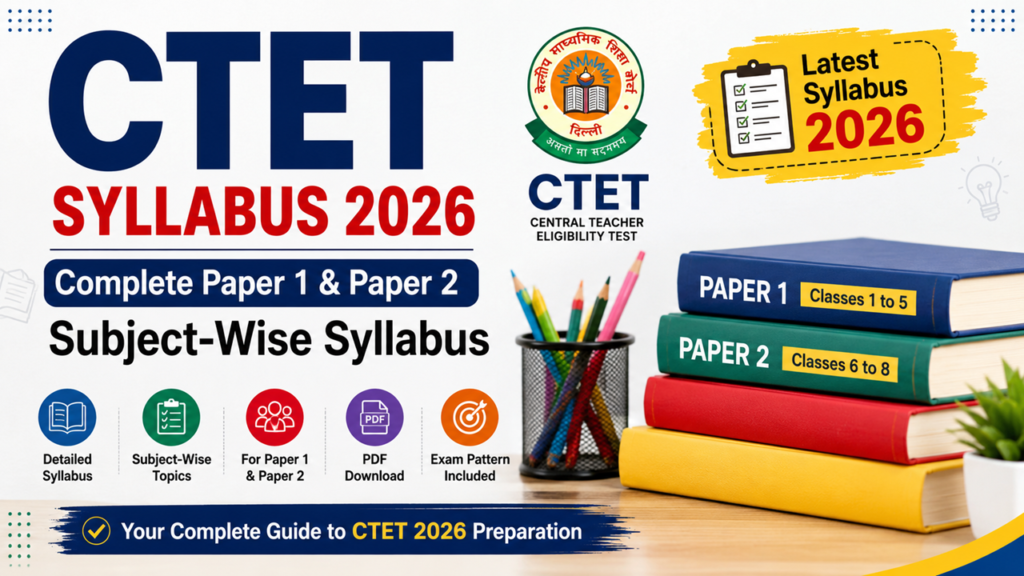
Are you preparing for CTET 2026? Then the first and most important thing you need to do is understand the complete CTET syllabus. Many students start studying without checking the syllabus first. This is a big mistake. When you know exactly what topics will come in the exam, you can plan your preparation better, save time, and score higher marks.
In this blog, we have given you the complete CTET Syllabus 2026 for both Paper 1 and Paper 2. We have explained every subject, every topic, and every section in simple language so that any student can understand it easily. Whether you are a fresher or someone who is giving CTET again, this guide will help you a lot.
What is CTET? A Quick Overview
CTET stands for Central Teacher Eligibility Test. It is a national-level exam conducted by the Central Board of Secondary Education (CBSE). If you want to become a teacher in central government schools like Kendriya Vidyalaya (KVS), Navodaya Vidyalaya (NVS), or other central government schools, you must pass CTET first.
| Conducted by: Central Board of Secondary Education (CBSE)
Official Website: https://ctet.nic.in Paper 1: For teaching Classes 1 to 5 (Primary Level) Paper 2: For teaching Classes 6 to 8 (Upper Primary Level) Exam Duration: 2 hours 30 minutes per paper Negative Marking: None Passing Marks: 60% (90 out of 150) for General; 55% for reserved categories |
You can appear for only Paper 1, only Paper 2, or both papers depending on which classes you want to teach. Both papers have 150 questions carrying 150 marks each. There is no negative marking, which means you should attempt all questions.
Download Official CTET Syllabus PDF
CTET Exam Pattern 2026
Paper 1 Exam Pattern (Classes 1 to 5)
| Subject | No. of Questions | Marks |
| Child Development & Pedagogy (CDP) | 30 | 30 |
| Language 1 (Compulsory) | 30 | 30 |
| Language 2 (Compulsory) | 30 | 30 |
| Mathematics | 30 | 30 |
| Environmental Studies (EVS) | 30 | 30 |
| Total | 150 | 150 |
Paper 2 Exam Pattern (Classes 6 to 8)
| Subject | No. of Questions | Marks |
| Child Development & Pedagogy (CDP) | 30 | 30 |
| Language 1 (Compulsory) | 30 | 30 |
| Language 2 (Compulsory) | 30 | 30 |
| Mathematics & Science (for Maths/Science teachers) | 60 | 60 |
| Social Studies/Social Science (for Social Studies teachers) | 60 | 60 |
| Total | 150 | 150 |
| Important Note for Paper 2: In Paper 2, you must choose EITHER Mathematics & Science OR Social Studies/Social Science. You cannot choose both. Choose based on the subject you want to teach. |
CTET Paper 1 Syllabus 2026 — Complete Subject-Wise Topics
CTET Paper 1 is for candidates who want to teach students of Classes 1 to 5. This is the primary level. The exam has five sections. Let us look at the full syllabus of each section one by one.
1. Child Development and Pedagogy (CDP) — 30 Questions
This section tests your knowledge of how children grow, how they learn, and how a teacher should teach them. It has three parts:
Part A — Child Development (Primary School Child) — 15 Questions
- Concept of development and how it is related to learning
- Principles of development in children
- Role of Heredity and Environment in child development
- Socialization processes — how children learn from teachers, parents, and peers
- Piaget, Kohlberg, and Vygotsky theories — their main ideas and critical views
- Child-centered and progressive education concepts
- Intelligence — what it is and different types (Multi-Dimensional Intelligence)
- Language and Thought — how they are connected
- Gender as a social concept — gender roles, gender bias, and education
- Individual differences in learners — diversity of language, caste, gender, religion
- Assessment for learning vs. assessment of learning
- Continuous and Comprehensive Evaluation (CCE) — what it is and how to apply it
- How to make good questions to check student learning and critical thinking
Part B — Inclusive Education and Children with Special Needs — 5 Questions
- Teaching children from disadvantaged backgrounds
- Helping children with learning difficulties or disabilities
- Teaching talented, creative, and specially-abled students
Part C — Learning and Pedagogy — 10 Questions
- How children think and learn — why some children fail in school
- Basic processes of teaching — learning as a social activity
- Child as a problem solver and a scientific investigator
- Understanding children’s mistakes as learning steps
- Cognition and Emotions in learning
- Motivation and its role in learning
- Personal and environmental factors that affect learning
| Study Tip: CDP is the most important section in both Paper 1 and Paper 2. Focus on Piaget, Vygotsky, and Kohlberg theories. Also learn about CCE, Inclusive Education, and different teaching methods. These topics come every year. |
2. Mathematics — 30 Questions
This section tests your knowledge of primary-level maths topics as well as how to teach maths to young students.
Part A — Content (Mathematics Topics) — 15 Questions
- Geometry — basic shapes and spatial understanding
- Solids around us — 3D shapes
- Numbers — counting, place value
- Addition and Subtraction
- Multiplication and Division
- Measurement — length, weight, volume
- Time
- Data Handling
- Patterns
- Money
Part B — Pedagogical Issues (How to Teach Maths) — 15 Questions
- Nature of Mathematics and logical thinking
- How children think and reason in maths
- Place of Mathematics in the curriculum
- Language of Mathematics
- Community Mathematics — real-life maths applications
- Evaluation methods — formal and informal
- Common problems in teaching maths
- Error analysis — understanding student mistakes
- Diagnostic and Remedial Teaching
| Study Tip: For the Maths section, read NCERT textbooks of Classes 1 to 5. Focus on the pedagogy part — it has more questions than the content part in many exams. |
3. Environmental Studies (EVS) — 30 Questions
This section covers topics about the environment, nature, and society that are taught in Classes 1 to 5.
Part A — Content Topics — 15 Questions
- Family and Friends — relationships, work, play, animals, plants
- Food — types of food, sources, importance
- Shelter — types of homes, materials used
- Water — sources, uses, water cycle
- Travel — modes of transport
- Things We Make and Do — daily life activities
Part B — Pedagogical Issues — 15 Questions
- Concept and scope of EVS
- Why EVS is important — Integrated EVS approach
- Difference between Environmental Studies and Environmental Education
- Learning principles in EVS
- Relation of EVS with Science and Social Science
- Approaches to teaching EVS concepts
- Activities, experiments, and practical work in EVS
- Discussion-based learning
- CCE in EVS
- Teaching materials and aids for EVS
| Study Tip: EVS is related to both Science and Social Studies. Study NCERT books of Classes 3, 4, and 5 for content topics. The pedagogy part requires understanding of how to make learning interesting for young children. |
4. Language 1 — 30 Questions
Language 1 is the medium of instruction — the language in which you will teach. You must choose a language that you are comfortable teaching in. Most candidates choose Hindi or English.
Part A — Language Comprehension — 15 Questions
- Two unseen passages — one prose/drama and one poem
- Questions on comprehension, inference, grammar, and verbal ability
- Prose passages may be literary, scientific, narrative, or discursive
Part B — Pedagogy of Language Development — 15 Questions
- Learning and language acquisition — how children learn a language naturally
- Principles of language teaching
- Role of listening and speaking in language development
- Function of language and how children use it as a tool
- Role of grammar in communicating ideas
- Challenges of teaching language in a diverse classroom
- Language difficulties, errors, and disorders
- Language skills — reading, writing, listening, speaking
- Evaluating language comprehension and proficiency
- Teaching-learning materials — textbooks, multimedia, multilingual resources
- Remedial Teaching
5. Language 2 — 30 Questions
Language 2 is a different language from Language 1. It is meant to test your understanding of another language. Many candidates choose English as Language 2 if they chose Hindi as Language 1.
Part A — Comprehension — 15 Questions
- Two unseen prose passages — discursive, literary, narrative, or scientific
- Questions on comprehension, grammar, and verbal ability
Part B — Pedagogy of Language Development — 15 Questions
The topics are the same as Language 1 Pedagogy. This includes learning and acquisition, teaching principles, language skills, and remedial teaching.
| Study Tip: For both language sections, practice reading unseen passages. For pedagogy, focus on language acquisition theories, methods of language teaching, and how to handle diverse classrooms. These topics are very commonly asked. |
CTET Paper 2 Syllabus 2026 — Complete Subject-Wise Topics
CTET Paper 2 is for candidates who want to teach Classes 6 to 8, which is the upper primary level. The syllabus is a bit more detailed than Paper 1 because the topics are more advanced.
1. Child Development and Pedagogy (CDP) — 30 Questions
The CDP section in Paper 2 is very similar to Paper 1, but here the focus is on children at the elementary school level (Classes 6 to 8), not primary level.
Part A — Child Development (Elementary School Child) — 15 Questions
- Concept of development and its relationship with learning
- Principles of child development
- Influence of Heredity and Environment
- Socialization — how children learn from teachers, parents, and friends
- Piaget, Kohlberg, and Vygotsky theories — main ideas and critical perspectives
- Child-centered and progressive education
- Intelligence — critical perspectives and Multi-Dimensional Intelligence
- Language and Thought
- Gender as a social construct — roles, bias, and educational practice
- Individual differences — diversity of language, caste, gender, religion
- Assessment for learning vs. assessment of learning
- CCE — Continuous and Comprehensive Evaluation
- Making good assessment questions for students
Part B — Inclusive Education and Children with Special Needs — 5 Questions
- Teaching students from diverse or disadvantaged backgrounds
- Addressing the needs of children with learning difficulties or disabilities
- Teaching talented, creative, and specially-abled learners
Part C — Learning and Pedagogy — 10 Questions
- How children think and learn — why children fail to succeed
- Teaching and learning processes — learning as a social activity
- Child as a problem solver and scientific investigator
- Understanding children’s errors as learning steps
- Cognition and Emotions
- Motivation and learning
- Personal and environmental factors in learning
2. Language 1 — 30 Questions
Same structure as in Paper 1. Choose the language in which you plan to teach. The syllabus includes language comprehension and pedagogy of language development.
Key topics: reading unseen passages, inference, grammar, principles of language teaching, language skills, and remedial teaching. (Topics are same as Paper 1 Language 1 — refer above.)
3. Language 2 — 30 Questions
Same structure as in Paper 1 Language 2. Focus on comprehension from two unseen prose passages and the pedagogy of language development.
4. Mathematics and Science — 60 Questions (for Maths/Science Teachers)
This optional section is for candidates who want to teach Mathematics or Science in Classes 6 to 8. It has two sub-sections — Mathematics (30 questions) and Science (30 questions).
Part A — Mathematics — 30 Questions
Content Topics — 20 Questions
Number System:
- Knowing our Numbers — large numbers, comparison
- Playing with Numbers — factors, multiples, divisibility
- Whole Numbers — properties and operations
- Negative Numbers and Integers
- Fractions — types, operations, comparison
Algebra:
- Introduction to Algebra — variables, expressions
- Ratio and Proportion
Geometry:
- Basic Geometrical Ideas — 2D shapes, lines, angles
- Understanding Elementary Shapes — 2D and 3D
- Symmetry — reflection and rotational
- Construction — using ruler, protractor, compass
- Mensuration — area, perimeter, volume
- Data Handling — bar graphs, pie charts
Pedagogical Issues — 10 Questions
- Nature of Mathematics and logical thinking
- Place of Mathematics in the curriculum
- Language of Mathematics
- Community Mathematics — maths in real life
- Evaluation in Mathematics
- Remedial Teaching
- Problems in teaching Mathematics
Part B — Science — 30 Questions
Content Topics — 20 Questions
Food:
- Sources of food
- Components of food — nutrients, their functions
- Cleaning food — methods and importance
Materials:
- Materials of daily use — fibres, plastics, metals
The World of the Living:
- Plants, animals, microorganisms, and their life processes
- Cell — structure and functions
Moving Things, People and Ideas:
- Motion, speed, force and work
How Things Work:
- Electric current and circuits — components and working
- Magnets — properties and uses
Natural Phenomena:
- Rain, thunder, lightning, earthquakes, etc.
Natural Resources:
- Air, water, soil — their importance and conservation
Pedagogical Issues — 10 Questions
- Nature and structure of Science
- Aims and objectives of Natural Science
- Understanding and appreciating Science
- Integrated and approaches-based teaching
- Observation, experiment, and discovery — scientific methods
- Innovation in Science teaching
- Text material and teaching aids
- Evaluation — cognitive, psychomotor, and affective
- Problems in Science teaching
- Remedial Teaching in Science
| Study Tip: For the Science section, NCERT textbooks of Classes 6, 7, and 8 are the most important resources. Most questions come directly from these books. For pedagogy, focus on inquiry-based learning and the scientific method. |
5. Social Studies/Social Science — 60 Questions (for Social Studies Teachers)
This optional section is for candidates who want to teach Social Studies in Classes 6 to 8. It covers History, Geography, and Social and Political Life (Civics).
History Topics — Part of Content Section
- When, Where and How — introduction to history
- The Earliest Societies — Stone Age, hunter-gatherers
- The First Farmers and Herders
- The First Cities — Harappan Civilization
- Early States
- New Ideas — rise of religions like Buddhism, Jainism
- The First Empire — Maurya Empire
- Contacts with Distant Lands — trade, cultural exchange
- Political Developments — Gupta period
- Culture and Science
- New Kings and Kingdoms
- Sultans of Delhi — Delhi Sultanate
- Architecture — ancient and medieval
- Creation of an Empire — Mughal period
- Social Change — medieval period
- Regional Cultures
- The Establishment of Company Power — British rule
- Rural Life and Society
- Colonialism and Tribal Societies
- The Revolt of 1857-58
- Women and Reform — 19th century social reforms
- Challenging the Caste System
- The Nationalist Movement — freedom struggle
- India After Independence
Geography Topics — Part of Content Section
- Geography as a social study and as a science
- The Earth in the Solar System — planets, moon, sun
- Globe — latitudes, longitudes, time zones
- Natural Environment — land, water, air
- Air — atmosphere, weather, climate
- Water — rivers, oceans, water cycle
- Human Environment — settlement, transport, communication
- Resources — natural and human resources
- Agriculture — types, green revolution
Social and Political Life (Civics) Topics
- Diversity — in India, importance of diversity
- Government — types and functions
- Local Government — panchayat, municipality
- Making a Living — livelihoods in India
- Democracy — meaning and importance
- State Government — functions and powers
- Understanding Media — role of media in democracy
- Unpacking Gender — gender equality in society
- The Constitution of India
- Parliamentary Government — how Parliament works
- The Judiciary — courts and justice
- Social Justice and the Marginalised
Pedagogical Issues for Social Studies — 20 Questions
- Concept and nature of Social Science and Social Studies
- Classroom processes, activities, and discussion
- Developing critical thinking in students
- Inquiry-based learning and use of empirical evidence
- Problems in teaching Social Science
- Primary and secondary sources — using historical evidence
- Project work in Social Studies
- Evaluation in Social Studies
| Study Tip: For the Social Studies section, read NCERT books for Classes 6, 7, and 8 — Our Pasts (History), The Earth Our Habitat (Geography), and Social and Political Life (Civics). These three sets of books cover almost all the content topics in this section. |
Best Books and Resources for CTET 2026 Preparation
Choosing the right books is very important for CTET preparation. Here are the best resources that most CTET toppers recommend:
NCERT Textbooks (Most Important)
- Classes 1 to 5 — for Paper 1 content (Maths, EVS, Languages)
- Classes 6 to 8 — for Paper 2 content (Maths, Science, Social Studies)
Download NCERT Books Free at ncert.nic.in
Official CTET Syllabus and Notification
Official CTET Website — ctet.nic.in
Recommended Reference Books
- Child Development and Pedagogy by Disha Publication
- CTET Paper 1 by Arihant Publication (full syllabus coverage)
- CTET Paper 2 by Arihant Publication
- Previous Year Question Papers — solve at least 10 to 15 years papers
CTET 2026 Preparation Tips — How to Study Smart
Just knowing the syllabus is not enough. You also need a good study plan. Here are some simple but effective tips that will help you prepare well for CTET 2026:
Tip 1 — Start with CDP
Child Development and Pedagogy (CDP) is common in both Paper 1 and Paper 2, and it has 30 questions. Many students find it difficult at first, but if you study it well, it can be your highest-scoring section. Start your preparation with CDP.
Tip 2 — Study NCERT Books First
Most of the content questions in CTET come directly from NCERT textbooks. If you are preparing for Paper 1, read NCERT books for Classes 1 to 5. If you are preparing for Paper 2, read NCERT books for Classes 6 to 8. Do not skip NCERT.
Tip 3 — Focus on Pedagogy
Every subject in CTET has a pedagogy section. Pedagogy means how you teach a subject. Many students focus only on content and ignore pedagogy. This is a big mistake because pedagogy questions have high weightage in the exam.
Tip 4 — Solve Previous Year Papers
Previous year CTET question papers are one of the best ways to prepare. They help you understand what type of questions come in the exam. Try to solve at least the last 10 years of CTET papers.
Tip 5 — Take Mock Tests
After completing the syllabus, start giving mock tests regularly. Mock tests help you improve speed, accuracy, and time management. Aim to attempt all 150 questions within the 2 hours 30 minutes time limit.
Tip 6 — Revise Regularly
Make short notes while studying. Revise your notes every week. CDP theories, pedagogy concepts, and formulae need regular revision to remember them in the exam.
| Suggested Study Plan:
• Month 1 — Complete CDP (Paper 1 + Paper 2) • Month 2 — Complete Language 1 and Language 2 (both papers) • Month 3 — Complete subject-specific section (Maths + EVS for Paper 1 / Maths + Science or Social Studies for Paper 2) • Month 4 — Full revision + Previous year papers + Mock tests |
How to Download the Official CTET Syllabus 2026 PDF
You can download the official CTET Syllabus PDF directly from the CBSE website. Follow these simple steps:
- Step 1 — Go to the official CTET website: https://ctet.nic.in
- Step 2 — Look for the ‘CTET 2026 Notification’ or ‘Syllabus’ section
- Step 3 — Click on the link for Paper 1 Syllabus or Paper 2 Syllabus
- Step 4 — The PDF will open in a new window
- Step 5 — Click the download button to save the PDF on your device
Visit Official CTET Website: ctet.nic.in
CTET 2026 Passing Marks and Certificate
| Category | Minimum Percentage | Minimum Marks (out of 150) |
| General / Unreserved | 60% | 90 Marks |
| OBC / SC / ST | 55% | 82–83 Marks |
| PwD (Persons with Disability) | 55% | 82–83 Marks |
Once you pass CTET, you will receive a Certificate of Eligibility. From the year 2021 onwards, the CTET certificate is valid for Lifetime. This means once you clear CTET, you do not have to clear it again.
CTET 2026 Important Dates (Tentative)
The CTET exam is conducted twice a year — usually once in July/August and once in December/January. Here are the tentative important dates for the 2026 session:
| CTET September 2026 Session (Tentative):
• Notification Release: July 2026 • Application Start Date: July 2026 • Last Date to Apply: August 2026 • Admit Card Release: August/September 2026 • Exam Date: September 2026 • Result Declaration: October/November 2026
Note: Always check the official website ctet.nic.in for the exact dates. |
Final Words — Your CTET 2026 Journey Starts Now
CTET is not a very difficult exam if you prepare smartly. The key is to know your syllabus well, follow a proper study plan, and practice regularly with mock tests and previous year papers.
In this blog, we have given you the complete CTET Syllabus 2026 for both Paper 1 and Paper 2 with all topics explained in simple language. We hope this blog helps you in your preparation.
Frequently Asked Questions (FAQs) about CTET Syllabus 2026
Q1. Has the CTET syllabus changed in 2026?
No major changes have been made to the CTET syllabus in 2026. The syllabus is mostly the same as previous years. However, always check the official CTET notification to confirm.
Q2. Which paper should I appear for — Paper 1 or Paper 2?
If you want to teach Classes 1 to 5, appear for Paper 1. If you want to teach Classes 6 to 8, appear for Paper 2. If you want to be eligible for both, you can appear for both papers. Both papers are on the same day but at different times.
Q3. Is CDP syllabus the same for Paper 1 and Paper 2?
The topics are mostly the same, but Paper 1 focuses on the Primary School Child (ages 6 to 11) and Paper 2 focuses on the Elementary School Child (ages 11 to 14). The level of questions is also slightly different.
Q4. What is the most important subject in CTET?
Child Development and Pedagogy (CDP) is considered the most important subject because it has 30 marks in each paper and the questions require good conceptual understanding. Most experts recommend starting your preparation with CDP.
Q5. Can I use a calculator in the CTET exam?
No, calculators are not allowed in the CTET exam. You have to solve all maths problems manually. The maths questions are not very difficult, so practice mental calculations.
Q6. Is there any negative marking in CTET?
No, there is no negative marking in CTET. This means you should attempt all 150 questions, even if you are not sure of the answer. Never leave any question blank.
Q7. Which NCERT books should I read for CTET Paper 2 Social Studies?
For CTET Paper 2 Social Studies, read the following NCERT books: Our Pasts (History) for Classes 6, 7, and 8; The Earth Our Habitat (Geography) for Classes 6, 7, and 8; and Social and Political Life (Civics) for Classes 6, 7, and 8.
Official CTET Website: https://ctet.nic.in
Download NCERT Books: https://ncert.nic.in

StudentsTalk.in, is an education-focused platform dedicated to helping students stay informed about the latest academic updates, scholarships, entrance exams, career opportunities, government schemes, and study resources. With a passion for education and student success, she creates informative, easy-to-understand content.