
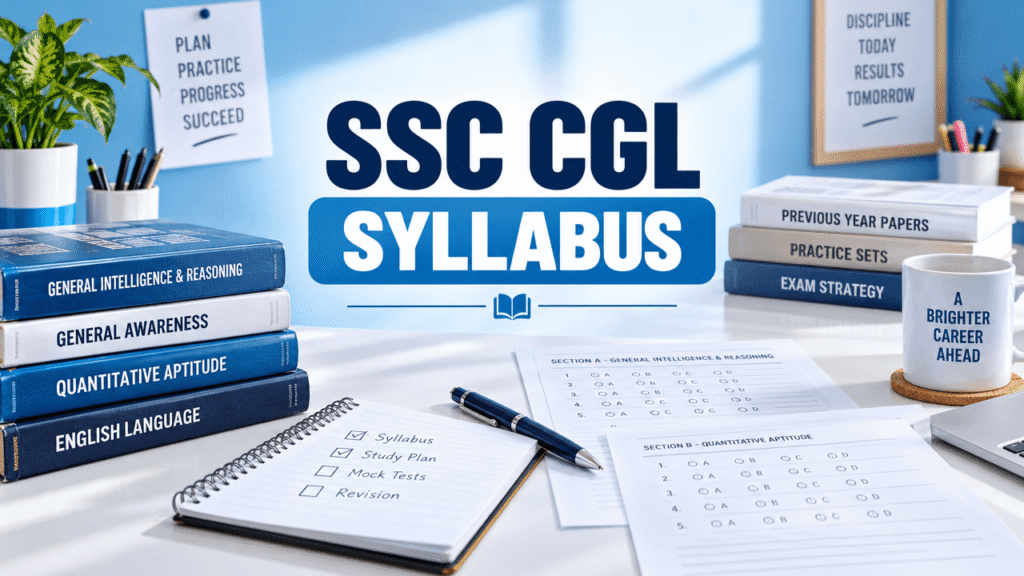
The SSC CGL exam gives graduates a chance to apply for different posts in central government departments. Many students begin preparing by collecting books, but the first useful step is much simpler: understand the syllabus. When you know what each paper tests, you can use your study time better.
This guide explains the SSC CGL syllabus in simple English. It covers Tier 1, Tier 2, a practical study plan, useful habits, and common preparation mistakes.
What is SSC CGL?
SSC CGL means Staff Selection Commission Combined Graduate Level Examination. It is a recruitment exam for graduate-level posts in different central government offices. The available posts and eligibility rules depend on the official notice.
The exam includes two computer-based tiers. Tier 1 checks basic skills in four subjects. Tier 2 asks more detailed questions and includes other tests such as computer knowledge and data entry. Some posts also require a Statistics paper.
Always check the official notice for the year in which you apply. Examination rules can change.
SSC CGL Tier 1 Exam Pattern
Tier 1 contains four subjects, with 25 questions in each section. The full paper carries 200 marks. The standard total test time is one hour, with sectional timers under the current notice. Every wrong answer carries a 0.50-mark deduction.
| Subject | Questions | Marks |
|---|---|---|
| General Intelligence and Reasoning | 25 | 50 |
| General Awareness | 25 | 50 |
| Quantitative Aptitude | 25 | 50 |
| English Comprehension | 25 | 50 |
| Total | 100 | 200 |
Students often focus only on maths or reasoning because they enjoy these subjects. A better plan gives a little time to all four areas every week.
Tier 1 Reasoning Syllabus
Reasoning questions ask you to understand patterns, relationships and logic. Speed matters, but making correct decisions matters more.
Some important study areas are:
- Analogies and classification
- Number series and letter series
- Coding and decoding
- Blood relations and direction questions
- Order and ranking
- Venn diagrams
- Statements and conclusions
- Visual and non-verbal reasoning
Try a short mixed practice set every day. When you make a mistake, write down the reason. Was the rule unclear? Did you miss a word? Did you take too long? This is more useful than simply checking the answer key.
General Awareness Syllabus
General Awareness covers many areas. These include Indian history, geography, economics, the Constitution, science, culture and events of public importance.
A good way to study is to divide your notebook into small sections. For example, keep separate pages for important constitutional terms, scientific facts and geography topics.
Reading basic textbooks can help you understand difficult points. You should also revise current affairs regularly, but do not depend only on headlines.
Try this simple revision habit: read one topic, close the book, and write five facts you remember. Then check your notes.
Quantitative Aptitude Syllabus
Maths is a subject where regular practice helps a great deal. Important areas include:
- Number system and basic calculations
- Percentage and ratio
- Average
- Profit, loss and discount
- Simple and compound interest
- Time, speed and distance
- Time and work
- Algebra
- Geometry and mensuration
- Trigonometry
- Data interpretation
Do not start with the most difficult questions in every chapter. First learn the method, solve simple problems, and then practise questions under a time limit.
Keep a small formula book. Revising the same notebook each week can save time before the exam.
English Comprehension Syllabus
The English section may include grammar, vocabulary, spelling, idioms, sentence correction, fill-in-the-blanks and reading passages.
Students who find English difficult should start with short reading exercises. Read a paragraph, explain it in your own words, and then answer two or three questions about it.
For grammar, practise one topic at a time. For vocabulary, learn words in real sentences instead of memorising a long list with no examples.
A daily 20-minute English routine is easier to follow than studying the subject only once every two weeks.
SSC CGL Tier 2 Syllabus
Tier 2 has a more detailed structure. The compulsory Paper I covers mathematical abilities, reasoning, English, general awareness, computer knowledge and a data entry test. A Statistics paper applies to relevant posts.
Mathematical Abilities
This area builds on basic arithmetic and mathematics. Revise percentage, ratios, algebra, geometry, mensuration, trigonometry, and the reading of graphs or tables.
Reasoning and General Intelligence
Continue practising number patterns, letter patterns, coding, logical relations and visual reasoning. Mixed question sets help you move between different problem types.
English Language and Comprehension
Study sentence structure, grammar, vocabulary and comprehension. When you attempt practice questions, read every option before choosing one.
General Awareness
Revise subjects such as history, geography, science, polity and economics. Short notes are easier to revise than pages of copied textbook material.
Computer Knowledge
Learn everyday computer concepts such as hardware, software, operating systems, files, office applications, email, internet basics and safe online behaviour.
Data Entry Speed Test
Typing is a skill that improves with practice. Begin slowly and aim for accuracy. Use a real keyboard if possible. Check the examination notice for the exact conditions of the test.
Statistics
A separate Statistics paper is relevant only for specified posts. It may include data presentation, averages, variation, probability, correlation, regression and sampling concepts. Check the post requirements before spending time on this paper.
How to Prepare for SSC CGL in 30 Days
Thirty days may not be enough to finish everything from the beginning, but it is a useful period for starting a steady routine or improving revision.
| Study Period | Main Focus | Your Goal |
|---|---|---|
| Days 1–7 | Understand the subjects and strengthen basics | Find weak areas |
| Days 8–14 | Practise core chapters across subjects | Improve accuracy |
| Days 15–21 | Solve previous-year questions | Learn question styles |
| Days 22–26 | Take timed mock tests | Improve time management |
| Days 27–30 | Revise mistakes and formulas | Build confidence |
If you are a college student, two focused study sessions each day may work well. If you are working, begin with shorter daily sessions and use weekends for mock tests.
Make Better Use of Mock Tests
Mock tests do not help much if you only look at your score. After each test, check three things.
First, find questions you could not solve because you did not understand the topic. Study those concepts again.
Second, find questions you solved correctly but too slowly. Practise those question types under a timer.
Third, find careless mistakes. These may include missed instructions, wrong calculations or selecting an answer too quickly.
Keep a mistake notebook. You will begin to notice patterns in your errors, and these patterns show where you need extra practice.
Five Mistakes to Avoid
Skipping revision: Facts and formulas become harder to remember without regular revision.
Changing books too often: Finish a small set of useful materials instead of collecting many unfinished books.
Ignoring weaker subjects: A balanced timetable is better than studying only your favourite sections.
Using an old exam pattern: Always check the latest official notice for your recruitment cycle.
Studying without practice: Reading explanations is important, but you must solve questions yourself.
Where to Find the Official SSC CGL Notice
Visit the Staff Selection Commission’s official website, ssc.gov.in. Look for the Combined Graduate Level examination notification and its syllabus details. Use the official notice to confirm exam dates, eligibility, marking rules and post-specific requirements.
Conclusion
The SSC CGL syllabus looks large when you see every subject on one page. It becomes easier when you divide the work into small daily tasks. Learn the basics, practise questions, review your mistakes and revise regularly. Give every subject a place in your timetable. A consistent routine can help you prepare more effectively than studying without a plan.
Frequently Asked Questions
Is SSC CGL Tier 1 different from Tier 2?
Yes. Tier 1 covers four basic subjects, while Tier 2 has a wider and more detailed structure.
Does SSC CGL include maths?
Yes. Mathematical questions are an important part of the examination.
Can working students prepare for SSC CGL?
Yes. A fixed routine with short daily sessions and longer practice periods on weekends can help.
Are previous-year papers useful?
Yes. They show question styles and help you practise time management. The current notice should still be used for the latest pattern.
Where should I check the latest syllabus?
Check the official SSC website and the notice for the year in which you want to apply.

StudentsTalk.in, is an education-focused platform dedicated to helping students stay informed about the latest academic updates, scholarships, entrance exams, career opportunities, government schemes, and study resources. With a passion for education and student success, she creates informative, easy-to-understand content.