If you are a student of a Sanskrit Vidyalaya in Rajasthan, you must have heard about the Madhyama exam. This exam is conducted by the Board of Sanskrit Education, Rajasthan, and it is equal to the Class 10 level of a normal school. Many students in cities like Jaipur, Jodhpur, Kota, Udaipur, Ajmer, Bikaner, and small towns of Rajasthan appear for this exam every year. The board recently updated the syllabus, and this new syllabus has brought some changes in the subjects, the marking scheme, and the way questions are asked in the exam.
In this blog, we will talk about the Madhyama new syllabus in very simple words. We will also share a complete sample question paper with answers, so that you can understand the pattern of the real exam. This blog is made for students, parents, and teachers who want an easy guide to the Madhyama exam without going through long and confusing government documents.
The Madhyama level sits between Purva Madhyama (junior level) and Uttar Madhyama (senior secondary level, equal to Class 12). After clearing Madhyama, a student becomes eligible to join Uttar Madhyama and later can also appear for many government exams that ask for a Class 10 equivalent certificate. So this exam is not just another school test, it is an important step in a student’s education journey.
Rajasthan has a long history of Sanskrit education. The state runs a separate department only for Sanskrit schools, and this system is different from the regular Rajasthan Board of Secondary Education. Students who join Sanskrit Vidyalayas usually come from families that want their children to learn Sanskrit along with normal subjects like Science, Maths, Hindi, English, and Social Science. Over the years, thousands of students have passed the Madhyama exam and moved ahead to become Sanskrit teachers, priests, researchers, translators, and even government officers. This shows that the Madhyama exam, though based on an old language, still opens many doors for the future.
About The Board Of Sanskrit Education, Rajasthan
The Board of Sanskrit Education, Rajasthan works under the state government, and it is separate from the regular Rajasthan Board of Secondary Education. This board looks after Sanskrit Vidyalayas spread across the state, from big cities to small villages. It decides the syllabus, conducts exams, checks answer sheets, and declares results for levels like Purva Madhyama, Madhyama, and Uttar Madhyama.
Since this board focuses only on Sanskrit medium and Sanskrit-based education, its structure is a little different from a normal school board. Students here study Sanskrit as the main subject along with other regular subjects, and the schools usually also include some traditional practices like shlok recitation, sandhya vandan, and other cultural activities, along with the modern subjects.
How Is Madhyama Different From RBSE Class 10
Many people confuse Madhyama with the regular Class 10 exam conducted by the Rajasthan Board of Secondary Education (RBSE). While both are equal in terms of level and value for further studies and jobs, there are a few clear differences.
- Madhyama is conducted by the Board of Sanskrit Education, while Class 10 is conducted by RBSE.
- In Madhyama, Sanskrit is the compulsory main subject with the highest importance, while in RBSE Class 10, Sanskrit is usually an optional third or fourth language.
- Madhyama schools often follow some traditional Sanskrit culture and rituals as part of daily school life, which is not common in regular RBSE schools.
- Both exams are treated as equal for admission and eligibility purposes in Rajasthan, so a Madhyama certificate holds the same value as a Class 10 certificate from RBSE.
Understanding this difference helps students and parents feel confident that choosing the Sanskrit stream does not put them at any disadvantage compared to a regular school student.
Understanding Purva Madhyama, Madhyama, And Uttar Madhyama
Students and parents who are new to the Sanskrit education stream often get confused between these three terms. Let us break them down in simple words.
- Purva Madhyama: This is the junior level, roughly equal to the primary and upper primary classes of a regular school. It builds the base of Sanskrit reading, writing, and simple grammar.
- Madhyama: This is the middle level, equal to Class 10. This is the exam we are discussing in this blog. It has a bigger syllabus, more sections, and stronger focus on grammar, literature, and applied Sanskrit.
- Uttar Madhyama: This is the senior secondary level, equal to Class 12. After Madhyama, a student moves here and studies advanced Sanskrit topics along with a choice of other subjects.
So, Madhyama is basically the middle step of a three-step ladder in the Sanskrit education system of Rajasthan. Clearing it properly with a good understanding of the new syllabus makes the next step, Uttar Madhyama, much easier to handle.
What Is New In The Madhyama New Syllabus
Every few years, the education board reviews the old syllabus and makes changes based on the needs of students and the job market. The new syllabus for Madhyama has been designed to make Sanskrit learning more practical and less about only cramming rules. Here are the main changes that students should know about.
More Focus On Understanding, Not Just Memory
In the old syllabus, many questions were based on memory. A student could pass just by learning the answers by heart. In the new syllabus, more questions are based on understanding. This means a student needs to read the passage or the poem carefully and then answer in their own words.
Practical Sanskrit Usage
The new syllabus adds more weight to daily use of Sanskrit language. Students are asked to write small dialogues, simple letters, and short paragraphs in Sanskrit. This helps them use the language in real life, not just in the exam hall.
Balanced Weightage To Grammar And Literature
Earlier, grammar used to carry very high marks compared to literature. Now the syllabus tries to give a fair balance between grammar (Vyakaran), literature (Sahitya), and applied language skills. This makes the subject easier for average students who were earlier scared of heavy grammar rules.
Internal Assessment And Project Work
The new syllabus also gives some marks for internal assessment, project work, and classroom activities. This reduces the full pressure of a single final exam and rewards students who work well through the year.
Simple Language In Question Papers
One more change is in the language used to frame the questions. The board is now trying to use simple and clear Sanskrit and Hindi in the question paper, so that students do not get confused by the wording of the question itself.
Old Syllabus vs New Syllabus: A Simple Comparison
Many parents and students ask how the new syllabus is actually different from the old one. The table below gives a simple side by side comparison, so that the change becomes easy to understand.
| Area | Old Syllabus | New Syllabus |
| Question Type | Mostly memory based, long theory answers | Mix of understanding based and short practical questions |
| Grammar Weightage | Very high, almost half of total marks | Balanced with literature and applied Sanskrit |
| Writing Skills | Very limited practice of letters or dialogues | Dedicated section for dialogue, letter, and translation |
| Assessment | Only final exam marks counted | Internal assessment and project marks also included |
| Language Of Paper | Slightly complex wording in questions | Simple and clear wording in questions |
As we can see from this table, the new syllabus tries to reduce the burden of pure memory work. It gives students a fair chance to score well even if they are not very strong in heavy grammar, as long as they understand the language and can use it in simple daily situations.
Madhyama Exam Pattern And Subjects
The Madhyama exam is usually held once a year, and it covers a group of subjects, just like a normal Class 10 board exam. Sanskrit is the most important and compulsory subject, since the entire education stream is built around Sanskrit learning. Along with Sanskrit, students also study Hindi, English, Mathematics, Science, and Social Science.
Below is a simple table that shows a general idea of how marks are usually divided in the Madhyama exam. Please note that the exact marks can change a little every year, so students should always check the latest official notice from the Board of Sanskrit Education, Rajasthan, before the exam.
| Subject | Theory Marks | Internal Marks | Total Marks |
| Sanskrit | 80 | 20 | 100 |
| Hindi | 80 | 20 | 100 |
| English | 80 | 20 | 100 |
| Mathematics | 80 | 20 | 100 |
| Science | 80 | 20 | 100 |
| Social Science | 80 | 20 | 100 |
Each subject paper is usually of three hours, and students need to score at least the minimum passing marks in both theory and internal assessment separately. This structure is quite close to the pattern followed by the Rajasthan Board of Secondary Education, since both boards work under the same state government.
Sanskrit Paper Section-Wise Breakdown
Since Sanskrit is the main subject of the Madhyama exam, let us understand how the Sanskrit paper is divided under the new syllabus. The paper is generally split into four broad sections.
- Section A – Grammar (Vyakaran): sandhi, samas, karak, dhatu roop, shabd roop, and sentence formation.
- Section B – Literature (Sahitya): questions from prose lessons and poems given in the textbook.
- Section C – Unseen Passage And Comprehension: a new passage is given, and students answer questions based on it.
- Section D – Applied Sanskrit And Writing Skills: dialogue writing, letter writing, and translation from Hindi to Sanskrit or Sanskrit to Hindi.
This structure helps a student prepare in an organised manner. Instead of feeling that Sanskrit is one big scary subject, a student can practice each section one by one and slowly become confident in all four parts.
Why Practicing A Sample Paper Matters
Reading a textbook is not the same as attempting a real exam. A sample paper gives a student the actual feel of sitting for three hours, managing time between sections, and writing answers under a little bit of pressure. It also shows the exact style in which questions can be framed from the new syllabus, which is very different from just reading chapter notes.
Many students who score low marks are not weak in the subject. They simply never practiced writing full answers within a fixed time, and they get confused on the actual exam day. Solving the sample paper given below, along with a few more from your school or coaching class, will remove this problem and build real exam confidence.
Complete Sample Question Paper With Answers
Below is a complete sample question paper for the Sanskrit subject, made according to the pattern of the Madhyama new syllabus. This paper is created only for practice purpose, so that students can understand the type and level of questions they may face. The answers are given right after each question, so students can check their preparation instantly.
Time: 3 Hours Maximum Marks: 80
Note: All questions are compulsory. Marks for each question are written in front of it.
Section A: Grammar (Vyakaran) – 20 Marks
Q0. Choose the correct option (multiple choice questions). (1 x 5 = 5 marks)
- (i) The plural (बहुवचन) form of बालकः is: (a) बालकौ (b) बालकाः (c) बालकान् (d) बालकेन
- (ii) Which of these is a सर्वनाम (pronoun)? (a) गच्छति (b) सः (c) पुस्तकम् (d) विद्यालयः
- (iii) The Sanskrit word for ‘water’ is: (a) फलम् (b) जलम् (c) वनम् (d) गृहम्
- (iv) पठ् धातु belongs to which गण (verb class)? (a) भ्वादिगण (b) अदादिगण (c) दिवादिगण (d) तुदादिगण
- (v) The Sanskrit word लता is of which लिङ्ग (gender)? (a) पुल्लिङ्ग (b) स्त्रीलिङ्ग (c) नपुंसकलिङ्ग (d) none of these
Answer 0: (i) b – बालकाः (ii) b – सः (iii) b – जलम् (iv) a – भ्वादिगण (v) b – स्त्रीलिङ्ग
Q1. Join the following words using the correct sandhi rule. (1 x 4 = 4 marks)
- (a) विद्या + आलय
- (b) सूर्य + उदय
- (c) राम + अयन
- (d) मुनि + ईश्वर
Answer 1: (a) विद्यालय (b) सूर्योदय (c) रामायण (d) मुनीश्वर
Q2. Write the correct समास (compound) name for the following words. (1 x 4 = 4 marks)
- (a) राजपुत्र
- (b) पीताम्बर
- (c) यथाशक्ति
- (d) त्रिभुवन
Answer 2: (a) तत्पुरुष समास (b) बहुव्रीहि समास (c) अव्ययीभाव समास (d) द्विगु समास
Q3. Fill in the blanks with the correct case (कारक) ending. (1 x 4 = 4 marks)
- (a) रामः ग्रामम् ____ गच्छति। (to)
- (b) बालकः वृक्षात् ____ पतति। (from)
- (c) सः पुस्तकेन ____ पठति। (with/by)
- (d) गुरवे ____ नमः। (for/to)
Answer 3: (a) प्रति / द्वितीया विभक्ति (b) पञ्चमी विभक्ति (c) तृतीया विभक्ति (d) चतुर्थी विभक्ति
Q4. Write the धातु रूप (verb forms) of पठ् धातु (लट् लकार) for the following. (1 x 4 = 4 marks)
- (a) प्रथम पुरुष एकवचन
- (b) प्रथम पुरुष बहुवचन
- (c) मध्यम पुरुष एकवचन
- (d) उत्तम पुरुष एकवचन
Answer 4: (a) पठति (b) पठन्ति (c) पठसि (d) पठामि
Q5. Write the शब्द रूप (noun forms) of राम शब्द in प्रथमा विभक्ति for all three vachan. (1 x 4 = 4 marks)
Answer 5: एकवचन – रामः, द्विवचन – रामौ, बहुवचन – रामाः
Q5A. Write the correct विलोम शब्द (opposite word) for the following. (1 x 4 = 4 marks)
- (a) सत्यम्
- (b) दिवा
- (c) उच्चैः
- (d) सुखम्
Answer 5A: (a) असत्यम् (b) रात्रिः (c) नीचैः (d) दुःखम्
Section B: Literature (Sahitya) – 20 Marks
Read the following passage carefully and answer the questions given below it.
विद्या ददाति विनयं विनयाद् याति पात्रताम्। पात्रत्वात् धनमाप्नोति धनात् धर्मं ततः सुखम्॥
Q6. What does knowledge (विद्या) give to a person, according to this shloka? (4 marks)
Answer 6: According to this shloka, knowledge gives humility (विनय) to a person. When a person becomes humble, he becomes worthy of respect, and this worthiness later brings wealth, righteous living, and finally happiness.
Q7. Explain the full meaning of this shloka in simple words. (6 marks)
Answer 7: This shloka teaches that real education is not just about collecting information. True knowledge makes a person humble. A humble person is respected by society and is considered worthy (पात्र) of good things. Because of this respect and worthiness, the person earns wealth in an honest way. This wealth is used for good deeds (धर्म), and finally, all these good things lead to true happiness in life. The shloka reminds students that the final aim of learning is not marks or degrees, it is a good and happy life built on humility and honesty.
Q8. Give one word (एक शब्द) from the passage that means the following: (1 x 4 = 4 marks)
- (a) Humility
- (b) Wealth
- (c) Happiness
- (d) Righteous living
Answer 8: (a) विनयं (b) धनम् (c) सुखम् (d) धर्मं
Q9. Write a short note (in about 60 words) on any one moral value you learn from this shloka. (6 marks)
Answer 9: This shloka teaches the value of humility. Many students think that scoring high marks or gaining a big degree makes them great. But this shloka says that without humility, knowledge has no real value. A humble student listens more, respects teachers and elders, and learns faster. This humility later helps in every area of life, whether it is a job, business, or personal relationships. So the biggest lesson from this shloka is that a good human being is more important than just a well-read person.
Read the following second shloka and answer the question given below it.
अयं निजः परो वेति गणना लघुचेतसाम्। उदारचरितानां तु वसुधैव कुटुम्बकम्॥
Q9A. Explain the meaning of this shloka in about 40 words. (4 marks)
Answer 9A: This shloka says that small-minded people always divide the world into ‘my own’ and ‘others’. But people with a broad and generous heart consider the whole world as one family. This teaches students the value of universal brotherhood and treating everyone with kindness, without any narrow feeling of difference.
Section C: Unseen Passage – 15 Marks
Read the following unseen passage and answer the questions given below.
एकस्मिन् वने एकः सिंहः वसति स्म। सः प्रतिदिनं एकं पशुं हत्वा भक्षयति स्म। एकदा सः एकं शशकं दृष्ट्वा तम् आहारार्थं चलितुम् आदिशत्। शशकः बुद्ध्या सिंहं कूपस्य समीपं नीतवान् एवं तस्य जलप्रतिबिम्बं दर्शितवान्। सिंहः तत् प्रतिबिम्बं शत्रुं मत्वा कूपे पतितः मृतः च।
Q10. Who lived in the forest in this story? (3 marks)
Answer 10: A lion (सिंहः) lived in the forest and used to hunt one animal every day to eat.
Q11. How did the rabbit save itself from the lion? (4 marks)
Answer 11: The rabbit used its intelligence. It took the lion near a well and showed him his own reflection in the water. The lion thought the reflection was an enemy lion, and in anger, he jumped into the well and died. In this way, the clever rabbit saved not only itself but also the other animals of the forest from the lion.
Q12. What is the moral of this story? (4 marks)
Answer 12: The moral of this story is that intelligence is more powerful than physical strength. Even a small and weak animal like a rabbit can defeat a strong animal like a lion by using a clever plan. This teaches students that in real life too, smart thinking often works better than brute force.
Q13. Find one word from the passage that means ‘well’ (a place where water is stored underground). (2 marks)
Answer 13: कूपः / कूपस्य
Q14. Change the following sentence into plural (बहुवचन) form: सिंहः वने वसति। (2 marks)
Answer 14: सिंहाः वने वसन्ति।
Q14A. Why did the lion fall into the well, according to the passage? (2 marks)
Answer 14A: The lion saw his own reflection in the water of the well and mistook it for another lion, his enemy. In anger, he jumped into the well to attack the reflection, and because of this, he fell in and died.
Section D: Applied Sanskrit And Writing Skills – 25 Marks
Q15. Translate the following sentences from Hindi to Sanskrit. (1 x 5 = 5 marks)
- (a) राम विद्यालय जाता है।
- (b) मैं प्रतिदिन पुस्तक पढ़ता हूँ।
- (c) वह बालक ईमानदार है।
- (d) हम फल खाते हैं।
- (e) तुम कहाँ जाते हो?
Answer 15: (a) रामः विद्यालयं गच्छति। (b) अहं प्रतिदिनं पुस्तकं पठामि। (c) सः बालकः ईमानदारः अस्ति। (d) वयं फलानि खादामः। (e) त्वं कुत्र गच्छसि?
Q16. Write a short dialogue (संवाद) of about 6 to 8 lines between two friends discussing their daily routine, in simple Sanskrit. (8 marks)
Answer 16: मोहनः: भवतः दिनचर्या का अस्ति? रमेशः: अहं प्रातः पञ्चवादने उत्थाय व्यायामं करोमि। मोहनः: ततः किं करोषि? रमेशः: ततः स्नानं कृत्वा पूजां करोमि, पश्चात् विद्यालयं गच्छामि। मोहनः: विद्यालयात् अनन्तरं किं करोषि? रमेशः: गृहकार्यं करोमि, ततः क्रीडां क्रीडामि। मोहनः: भवतः दिनचर्या अतीव उत्तमा अस्ति। रमेशः: धन्यवादः, अहम् एतत् प्रतिदिनं पालयामि।
Q17. Write a short letter (पत्र) in Sanskrit to your friend, inviting him or her to your birthday celebration. (about 60 to 80 words) (7 marks)
Answer 17: प्रिय मित्र सुरेश, सप्रेम नमस्ते। अहम् आशासे यत् त्वं कुशलेन असि। अग्रिमे रविवासरे मम जन्मदिनम् अस्ति। अहं तं दिनं स्वगृहे उत्सवरूपेण आचरिष्यामि। अतः त्वां सादरं निमन्त्रयामि, यत् त्वं सायं पञ्चवादने मम गृहम् आगच्छ। तत्र वयं सर्वे मित्राणि सह भोजनं करिष्यामः, गीतानि गास्यामः, तथा क्रीडाः क्रीडिष्यामः। कृपया अवश्यम् आगच्छ। भवतः प्रतीक्षा करोमि। तव मित्र, राकेश।
Q18. Answer any one question in about 40 words: What is the importance of learning Sanskrit in today’s time? (5 marks)
Answer 18: Sanskrit is called the mother of many Indian languages. Learning Sanskrit helps students understand grammar rules better and also improves memory and concentration. It connects us to our old texts, culture, and values. In today’s time, Sanskrit knowledge also helps in research, yoga studies, and government exams, so it remains a useful and respected subject even now.
This completes the sample question paper of 80 marks. Students can use this paper as a practice test before their real exam. It is a good idea to first attempt the paper without looking at the answers, and then check the answers to see how many marks you would have scored.
Marks Distribution Of This Sample Paper
| Section | Marks |
| Section A: Grammar (including MCQs) | 25 |
| Section B: Literature | 18 |
| Section C: Unseen Passage | 13 |
| Section D: Applied Sanskrit And Writing | 25 |
| Section D: Value Based Question | (included above) |
| Total | 80 |
This kind of breakdown helps a student understand where the maximum marks are coming from. Since Section A and Section D together carry more than half of the total marks, students should never ignore grammar practice or writing skill practice, even if literature feels more interesting to read.
Sample One-Month Study Timetable Before The Exam
A clear timetable helps students cover the whole syllabus without last minute stress. Here is a simple plan that a Madhyama student can follow in the last month before the exam. This plan can be adjusted based on how many subjects a student needs to cover and how comfortable they already are with each topic.
| Week | Focus Area |
| Week 1 | Revise all grammar topics: sandhi, samas, karak, shabd roop, and dhatu roop. Practice at least 10 questions daily from grammar. |
| Week 2 | Go through all prose and poetry lessons of literature. Write short summaries of each lesson in your own words. |
| Week 3 | Practice unseen passages daily, and work on writing skills such as dialogue, letter, and translation exercises. |
| Week 4 | Solve full sample papers under timed conditions, revise weak areas, and clear doubts with your teacher. |
Following a simple plan like this removes confusion and gives a student a clear direction every single day before the exam.
Preparation Tips For Madhyama Students
Scoring well in the Madhyama exam is not difficult if a student follows a proper study routine. Sanskrit can feel heavy in the beginning because of its grammar rules, but with steady daily practice, most students find it becomes much easier by the middle of the year. Here are some simple tips that can help.
- Make a small daily timetable and give fixed time to Sanskrit grammar, since it forms the base of the whole subject.
- Learn shabd roop and dhatu roop by writing them down repeatedly, instead of only reading them silently.
- Read the prose and poetry lessons at least three times, and try to explain the meaning in your own words after each reading.
- Practice a few unseen passages every week, since this section checks your real understanding of the language.
- Write small dialogues and letters in Sanskrit on your own, even if they are not perfect, because writing practice builds confidence for the exam.
- Solve at least three to four sample papers before the final exam, so that time management becomes easy on the actual exam day.
- Revise all sandhi and samas rules a few days before the exam, since these questions are usually scoring and quick to attempt.
- Ask your teacher to check your written answers so that you know where you are losing marks.
- Form a small study group with two or three classmates and practice speaking simple Sanskrit sentences together, since group practice makes learning more fun and less stressful.
- Keep a separate notebook only for new words and their meanings, and revise this word list every weekend so your vocabulary keeps growing steadily.
Time Management Tips During The Exam
Even a well-prepared student can lose marks if time is not managed properly during the exam. Here are a few simple tips to manage the three hours of the Sanskrit paper.
- Spend the first five minutes reading the whole paper carefully, so you know how many questions you need to attempt.
- Attempt the grammar section first, since these questions are usually short and can be finished quickly, giving you confidence for the rest of the paper.
- Give proper time to the unseen passage, and read it at least twice before answering, since rushing through it often leads to wrong answers.
- Keep about twenty minutes at the end for revision, so you can check spelling, matras, and any missed questions.
- If a question feels difficult, do not spend too much time on it in the beginning. Attempt the easier questions first and come back to the difficult one later.
Common Mistakes Students Make In The Sanskrit Paper
Many students lose easy marks because of small mistakes, not because they do not know the subject. Here are some common mistakes to avoid.
- Mixing up similar sounding shabd roop and dhatu roop, especially in madhyam purush and uttam purush forms.
- Skipping the unseen passage section due to fear, even though it only needs careful reading and does not need memory.
- Writing very short answers in the literature section, where the question clearly asks for a detailed explanation.
- Not practising translation sentences, which leads to silly grammar mistakes during the exam.
- Leaving the applied Sanskrit section (dialogue or letter writing) for the last minute, resulting in an incomplete or rushed answer.
If a student stays aware of these small mistakes and practices regularly, it becomes much easier to score good marks in the Madhyama Sanskrit paper. Most of these mistakes happen not because of lack of knowledge, but because of exam pressure or poor time planning. A calm mind and a clear plan on the exam day can prevent almost all of them.
Role Of Parents And Teachers
Parents and teachers play a big role in helping a Madhyama student prepare well. Since Sanskrit is not an everyday spoken language for most families, students often need extra support and encouragement at home. Here are a few simple ways parents and teachers can help.
- Sit with the student once a week and ask them to read a Sanskrit passage aloud, even if you do not understand every word.
- Encourage the student to speak a few simple Sanskrit sentences during the day, such as greetings or short daily lines.
- Provide a quiet study corner at home with the textbook, notebook, and previous sample papers easily available.
- Teachers should give regular class tests based on the new syllabus pattern, so students get used to the format before the final exam.
- Praise small improvements, since Sanskrit grammar can feel tough at first, and positive encouragement keeps students motivated.
When parents and teachers work together with the student, the whole process of learning Sanskrit becomes much smoother and less stressful. A student who feels supported at home and guided well at school naturally develops more interest in the subject, and this interest reflects directly in better exam performance.
What Comes After Madhyama? Future Options For Students
Many students wonder what benefit they get after putting in so much effort into a subject like Sanskrit. The truth is, Madhyama opens several paths for the future.
- Students can join Uttar Madhyama, which is equal to Class 12, and continue their Sanskrit education stream.
- A strong Sanskrit background helps in cracking many competitive exams, since Sanskrit knowledge often supports better understanding of Hindi grammar and general Indian language questions.
- Students interested in teaching can later become Sanskrit teachers in schools, which is a respected and stable career option in Rajasthan.
- Sanskrit scholars are also needed in research institutes, universities, and cultural organisations that study ancient Indian texts.
- Knowledge of Sanskrit also helps students who want to pursue Vedic studies, astrology, Ayurveda, or become a priest (पुरोहित), since these fields are closely connected to Sanskrit texts.
So, clearing the Madhyama exam is not just about passing one exam. It is the beginning of many possible career paths connected to language, teaching, research, and culture.
Conclusion
The Madhyama new syllabus has made the Sanskrit subject more balanced and practical for students. Instead of only testing memory, it now checks real understanding, writing skills, and daily language use. With regular practice, a proper study routine, and a good understanding of the exam pattern, any student can score well in this exam.
We hope this blog and the sample question paper with answers help you prepare better for your Madhyama exam. Keep practicing grammar, read your literature lessons carefully, and do not skip the unseen passage and writing sections. All the best for your exam.
Remember, learning Sanskrit is not only about clearing one exam. It connects you to a rich language that has shaped Indian culture, literature, and thought for thousands of years. Every shabd roop you learn, every shloka you understand, and every sentence you write in Sanskrit adds to your knowledge in a way that stays with you far beyond the exam hall. So take your Madhyama preparation seriously, stay consistent with your daily practice, and approach the new syllabus with confidence rather than fear.
Frequently Asked Questions
Is Madhyama equal to Class 10?
Yes, Madhyama, conducted by the Board of Sanskrit Education, Rajasthan, is considered equal to the Class 10 level of a regular school board.
Which subject carries the highest importance in Madhyama?
Sanskrit is the main and most important subject, since the entire Madhyama stream is built around learning the Sanskrit language along with other regular subjects.
How many sections are there in the Sanskrit paper?
Under the new syllabus, the Sanskrit paper is generally divided into four sections: Grammar, Literature, Unseen Passage, and Applied Sanskrit with writing skills.
Can a student pass by only studying grammar?
No, the new syllabus gives balanced weightage to grammar, literature, and applied writing skills, so a student needs to prepare all sections to score well.
Where can students get the official syllabus and previous papers?
Students should always check the official website of the Board of Sanskrit Education, Rajasthan, or ask their school for the latest official syllabus and sample papers, since small changes can happen every year.
Is internal assessment compulsory in the new syllabus?
Yes, under the new syllabus, internal assessment marks are added to the theory marks, so students should also take classroom tests and project work seriously, not only the final exam.
How many times should a student solve sample papers before the exam?
Solving at least three to four full sample papers under a timed setting is a good practice, as it builds both speed and confidence for the actual exam day.
Does the new syllabus reduce the difficulty level of Sanskrit?
The new syllabus does not reduce the depth of the subject, but it makes the questions more practical and understanding based, which many students find easier compared to the old memory heavy pattern.
Is a Madhyama certificate valid for government job applications?
Yes, since Madhyama is officially recognised as equal to Class 10, its certificate is generally accepted wherever a Class 10 qualification is asked for, subject to the specific rules of that job or exam.
What should a student do if they find grammar very difficult?
Such students should not lose confidence. Breaking grammar topics into small daily portions, practicing with a teacher, and using simple sentence writing every day usually helps even a weak student improve steadily over a few months.
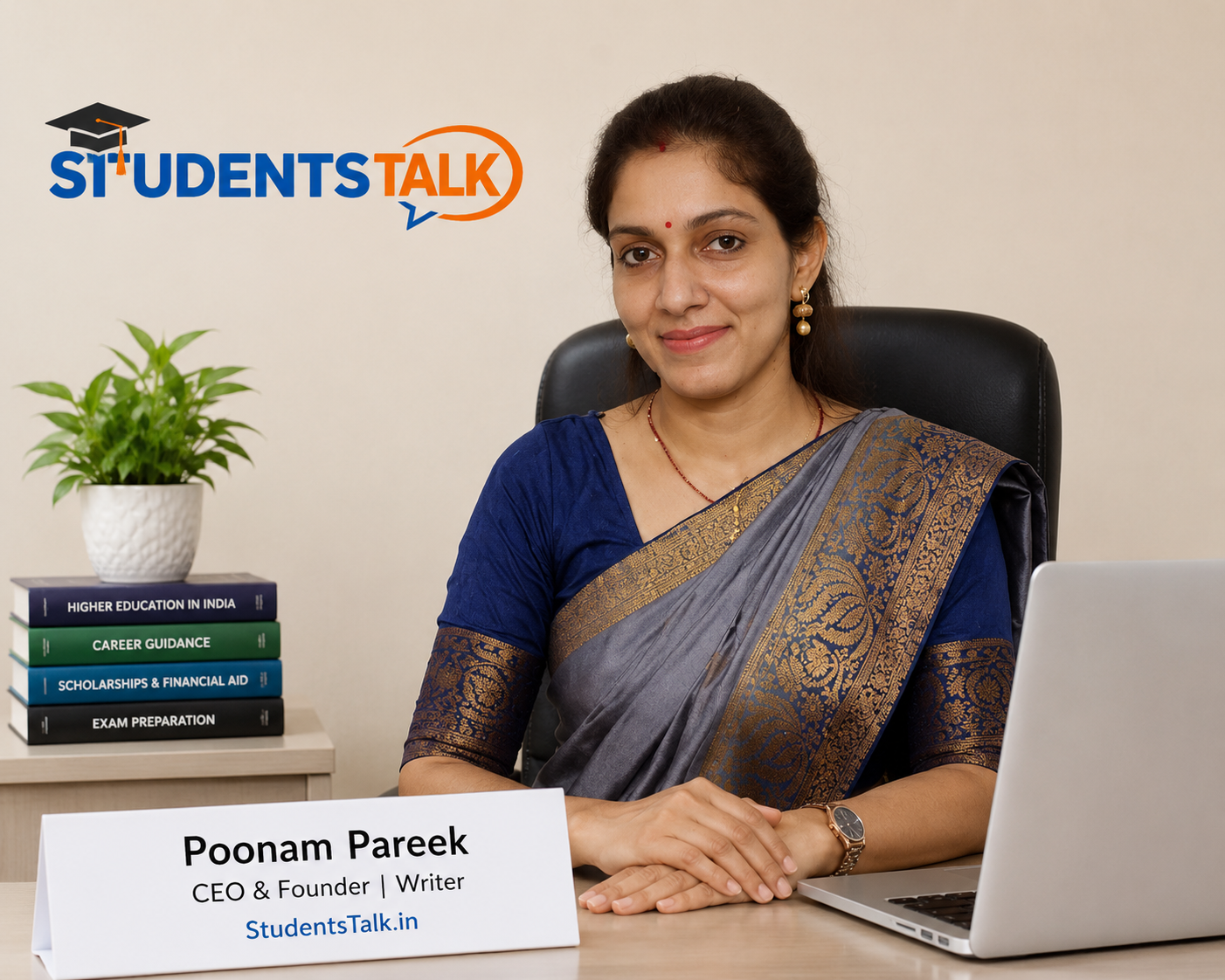
Poonam Pareek is the Founder, CEO, and Lead Writer of StudentsTalk.in, an education-focused platform dedicated to helping students stay informed about the latest academic updates, scholarships, entrance exams, career opportunities, government schemes, and study resources. With a passion for education and student success, she creates informative, easy-to-understand content.