Imagine waking up one day and finding that the job you always dreamed of now requires skills you never learned in school. Sounds scary, right? Well, for millions of students around the world, this is already happening. Artificial Intelligence — AI — is changing everything, from the way doctors diagnose diseases to the way companies hire people, create ads, write code, and manage money. The good news? You do not need to be a genius or a computer science expert to ride this wave. You just need to know where to start.
This blog is written especially for students — whether you are in high school, college, or just someone who wants to future-proof their career. We are going to talk about the most important AI skills students should learn right now, and we will explain every single one of them in plain, simple language. No confusing jargon. No overwhelming technical terms. Just real, useful information that can help you take the next step.
By the end of this guide, you will have a clear roadmap of what to learn, which tools to use, where to learn them, and why each skill matters. So grab a cup of chai, sit back, and let us dive into the future together.
Why AI Skills Matter More Than Ever in 2026
Before we jump into the list of AI skills students should learn, let us take a moment to understand the big picture. According to the World Economic Forum, more than 85 million jobs could be displaced by AI and automation by 2025. However — and this is the exciting part — over 97 million new roles are expected to emerge that require people to work alongside AI tools and systems.
This means that the students who learn how to use, understand, and build AI tools will be the ones who thrive. The ones who ignore it might struggle to find well-paying, stable jobs. We are not trying to scare you — we are trying to motivate you. The window of opportunity is wide open right now, and 2026 is the perfect year to walk through it.
Now, let us explore each AI skill in detail, starting from the most accessible ones that any student can pick up, all the way to more advanced capabilities.
1. Prompt Engineering — Talking to AI the Right Way
What Is It?
Prompt engineering is the skill of writing the right instructions — called “prompts” — to get the best possible output from an AI tool like ChatGPT, Claude, or Gemini. Think of it like this: if you ask a brilliant chef to “make me food,” you will get something random. But if you say “make me a spicy chicken tikka wrap with extra mint chutney,” you will get exactly what you want. Prompt engineering works the same way with AI.
Why Should You Learn It?
This is hands-down one of the most in-demand AI skills students should learn right now, and for a very simple reason: every company is using AI tools today. Businesses want people who can squeeze maximum value out of these tools. Prompt engineers are being hired by companies like Google, Meta, and hundreds of startups at salaries ranging from $60,000 to $300,000 per year.
Tools to Explore:
- ChatGPT by OpenAI (openai.com)
- Claude by Anthropic (ai)
- Google Gemini (google.com)
- PromptBase — a marketplace to buy and sell prompts (com)
Where to Learn:
DeepLearning.AI offers a free short course called “ChatGPT Prompt Engineering for Developers” at deeplearning.ai. It is beginner-friendly and completely free. You can also practice daily by using any AI chatbot and experimenting with different phrasings of the same question.
2. Machine Learning Basics — How AI Actually “Learns”
What Is It?
Machine learning (ML) is the branch of AI where computers learn from data instead of being programmed with specific rules. Imagine teaching a child to recognise dogs. You do not write a rulebook that says “four legs + fur + tail = dog.” You just show them hundreds of pictures of dogs and they figure it out. That is exactly how machine learning works.
Why Should You Learn It?
Understanding machine learning is one of the most foundational AI skills students should learn, especially if you plan to go into data science, software development, healthcare technology, finance, or research. Even a basic understanding of how ML works will set you apart from the crowd. You will understand why AI sometimes makes mistakes, how to train models, and how to evaluate them.
Key Concepts to Understand:
- Supervised vs Unsupervised Learning
- Training data and test data
- Overfitting and underfitting
- Neural networks and how they work
Tools and Platforms:
- Scikit-learn — a Python library for simple ML models
- Google Colab — free browser-based Python environment
- Kaggle — data science competitions and free datasets
- TensorFlow and PyTorch — more advanced deep learning frameworks
Where to Learn:
Andrew Ng’s Machine Learning course on Coursera (coursera.org) is the gold standard. It is free to audit and has been completed by millions of students worldwide. Also check out fast.ai’s free Practical Deep Learning for Coders course at fast.ai.
3. Python Programming — The Language of AI
What Is It?
Python is a programming language that is famous for being easy to read and write. It looks almost like plain English. And here is the thing — nearly every AI tool, machine learning framework, and data science library is built in Python. If AI is the engine, Python is the fuel.
Why Should You Learn It?
Python programming is easily one of the most critical AI skills students should learn, regardless of what field you plan to enter. Doctors, lawyers, marketers, and artists are all learning Python now because it allows them to automate boring tasks, analyse data, and build their own AI-powered mini applications. You do not need to become a full-stack developer. Just the basics will open enormous doors.
What to Learn in Python:
- Variables, loops, and functions — the building blocks
- Pandas — for working with data tables (like Excel but far more powerful)
- NumPy — for numerical calculations
- Matplotlib and Seaborn — for creating charts and visualisations
- Requests library — for connecting your Python code to AI APIs
Where to Learn:
CS50P from Harvard at cs50.harvard.edu/python is one of the best free Python courses available. Also try Python.org’s beginner guide at python.org/about/gettingstarted or the beginner path on Codecademy.
4. Data Literacy and Analysis — Making Sense of Numbers
What Is It?
Data literacy is the ability to read, understand, question, and communicate with data. It is not about being a maths wizard. It is about being able to look at a chart or a table of numbers and understand what story it is telling. In the AI age, data is like gold — and data-literate people are the ones who can mine it properly.
Why Should You Learn It?
Every business decision today is made based on data. If you are a marketing student, you need to understand what the analytics are telling you. If you are studying medicine, you need to interpret clinical trial data. If you are in finance, data is the core of everything. Data literacy is one of the most universally applicable AI skills students should learn, because it applies to literally every field.
Key Skills Within Data Literacy:
- Reading graphs, pie charts, bar charts, and line graphs
- Understanding mean, median, and standard deviation
- Spotting bias in data
- Using Excel or Google Sheets for basic data analysis
- Building dashboards using tools like Tableau or Power BI
Tools to Use:
- Tableau Public (free version) — tableau.com
- Microsoft Power BI (free for students) — microsoft.com
- Google Looker Studio (free) — google.com
5. Generative AI Tools — Creating Content with AI
What Is It?
Generative AI refers to AI systems that can create new content — text, images, music, code, videos, and even 3D models — based on a prompt you give them. Tools like ChatGPT generate text. Midjourney and DALL-E generate images. Suno generates music. Runway ML generates videos. This technology is revolutionising the entire creative industry.
Why Should You Learn It?
Whether you are a student of art, commerce, journalism, engineering, or medicine — generative AI tools can save you enormous amounts of time and help you produce professional-quality work. This is one of the AI skills students should learn because it directly translates into productivity. You can write essays faster, design presentations better, create marketing content instantly, and brainstorm ideas at the speed of thought.
The Top Generative AI Tools Right Now:
- ChatGPT (OpenAI) — text generation, coding, tutoring, writing | openai.com
- Midjourney — AI image generation from text prompts | com
- Adobe Firefly — AI creative tools integrated with Adobe Suite | adobe.com
- Runway ML — AI video generation and editing | com
- Suno — AI music creation from text | com
- ElevenLabs — AI voice cloning and text-to-speech | io
The key to mastering generative AI tools is not just knowing they exist — it is knowing when and how to use them responsibly, ethically, and creatively. That is what will make you valuable.
6. AI Ethics and Responsible AI — The Moral Side of the Machine
What Is It?
AI ethics is the study of how AI should behave, what kinds of decisions it should make, and how we ensure that AI systems are fair, transparent, and safe. This includes topics like bias in algorithms, privacy concerns, job displacement, misinformation created by AI, and who is responsible when an AI system makes a mistake.
Why Should You Learn It?
As AI becomes more powerful, the organisations building and regulating it are desperately looking for people who understand both the technology AND the ethical implications. Governments, NGOs, tech companies, law firms, and universities all need experts in this area. Among all the AI skills students should learn, this one is perhaps the most unique because it does not require coding — it requires critical thinking and a strong moral compass.
Topics in AI Ethics:
- Algorithmic bias — when AI treats different groups unfairly
- Privacy and surveillance concerns
- Deepfakes and AI-generated misinformation
- The environmental cost of training large AI models
- Explainability — can we understand why an AI made a decision?
- AI and human rights — what jobs should AI never do?
Where to Learn:
The University of Helsinki offers a free “Elements of AI” course at elementsofai.com which includes strong ethics modules. MIT OpenCourseWare also has free resources on AI ethics at ocw.mit.edu.
7. Natural Language Processing (NLP) — Teaching AI to Understand Human Language
What Is It?
Natural Language Processing, or NLP, is the area of AI that deals with how computers understand, interpret, and generate human language — whether written or spoken. Every time you use voice search, get a translation on Google Translate, chat with a customer service bot, or use a grammar checker, you are interacting with NLP technology.
Why Should You Learn It?
NLP is at the heart of the AI revolution right now. Every large language model — including ChatGPT, Claude, and Gemini — is built on NLP principles. If you are a student of linguistics, journalism, law, humanities, or social sciences, NLP is one of the AI skills students should learn that sits right at the intersection of language and technology. It is perfect for people who love words but also want to understand the technology behind them.
Practical Applications of NLP:
- Sentiment analysis — figuring out if a review is positive or negative
- Chatbots and virtual assistants
- Automatic text summarisation
- Language translation tools
- Spam filters in email
Tools to Explore:
- Hugging Face — the GitHub of NLP models | co
- NLTK — Natural Language Toolkit for Python
- spaCy — industrial-strength NLP library
8. AI-Powered Automation and No-Code Tools — Build Without Coding
What Is It?
No-code and low-code platforms allow you to build apps, automate workflows, and create AI-powered tools without writing a single line of code. These platforms use drag-and-drop interfaces, pre-built templates, and built-in AI features to help non-programmers create powerful solutions. Think of tools like Zapier, Make (formerly Integromat), Notion AI, or Bubble.
Why Should You Learn It?
This is one of the most exciting AI skills students should learn because it democratises technology. You do not need a computer science degree to build a custom AI chatbot for your business, automate your social media scheduling, or create a database-driven app. If you can think clearly and understand processes, you can build powerful tools. Entrepreneurs especially love no-code AI because it reduces the need for expensive developers.
Top No-Code and Automation Tools:
- Zapier — connect different apps and automate workflows | com
- Make (Integromat) — advanced automation without code | com
- Bubble — build full web apps with no code | io
- Notion AI — smart note-taking and project management | so
- Airtable AI — intelligent database management | com
9. Computer Vision — Teaching AI to See
What Is It?
Computer vision is the field of AI that trains machines to interpret and understand visual information — images, videos, medical scans, or live camera feeds. When your phone unlocks with your face, when a self-driving car detects a pedestrian, when Instagram automatically tags people in photos — all of that is computer vision at work.
Why Should You Learn It?
Computer vision is booming across healthcare (disease detection from X-rays), agriculture (crop health monitoring via drones), retail (cashier-free stores), manufacturing (quality control), and security. For students in engineering, medical imaging, environmental science, or robotics, this is one of those AI skills students should learn that could define your career path entirely.
Key Tools in Computer Vision:
- OpenCV — the most widely used computer vision library
- YOLO (You Only Look Once) — real-time object detection
- TensorFlow and Keras — for building custom image classifiers
- Roboflow — label and train computer vision models without expertise | com
10. Critical Thinking and AI Fact-Checking — Not Everything AI Says Is True
What Is It?
Critical thinking in the age of AI means being able to evaluate information produced by AI tools — questioning whether it is accurate, unbiased, and appropriate for the situation. AI systems can “hallucinate” — which is the technical term for when an AI confidently makes up facts that are completely false. It can also produce content that is biased, outdated, or inappropriate for specific cultural contexts.
Why Should You Learn It?
Because AI is everywhere and not always right. If you blindly trust everything an AI tool tells you, you will make mistakes — potentially serious ones. The ability to critically evaluate AI outputs is increasingly listed in job descriptions across journalism, healthcare, law, education, and government. It is one of those soft-but-essential AI skills students should learn that no algorithm can replace.
How to Build This Skill:
- Always verify AI-generated facts with authoritative sources
- Practice lateral reading — open multiple sources to verify claims
- Learn to spot AI-generated images and text using tools like GPTZero or Originality.AI
- Study logic, argumentation, and research methodology — these strengthen your BS detector
How to Start Learning AI Skills as a Student — A Practical Roadmap
Now that you know the key AI skills students should learn, the next question is: how do you actually start? Here is a simple, practical roadmap you can follow regardless of your current level.
Week 1–2: Build Your Foundation
- Sign up for the free “Elements of AI” course at elementsofai.com
- Spend 30 minutes a day using ChatGPT, Claude, or Gemini and experiment with different prompts
- Read one AI news article per day from MIT Technology Review (technologyreview.com) or The Verge AI section
Month 1: Pick Your Lane
- If you are interested in building things: Start Python on CS50P or Codecademy
- If you are creative: Explore Midjourney, ElevenLabs, and Runway ML
- If you are a business or management student: Learn data literacy and automation tools like Zapier and Notion AI
- If you are interested in ethics or law: Dive into AI governance and policy discussions
Month 2–3: Build and Share
- Complete a Kaggle beginner competition or personal project using your chosen tools
- Share your work on LinkedIn or GitHub to start building your portfolio
- Write a blog post or short video explaining something you learned — teaching is the fastest way to deepen knowledge
The Best Free Resources to Learn AI Skills in 2026
Here are some of the best free platforms where you can build all the AI skills discussed in this guide:
- Coursera (coursera.org) — Audit most courses for free. Andrew Ng’s AI and ML courses are world-class.
- edX (edx.org) — Harvard and MIT courses, many free to audit.
- Kaggle (kaggle.com) — Free datasets, competitions, and Python/ML courses.
- AI (deeplearning.ai) — Short, focused courses on AI, ML, and LLMs.
- Elements of AI (elementsofai.com) — Perfect for absolute beginners. Free, fun, and very easy to follow.
- Harvard CS50 (cs50.harvard.edu) — Legendary free computer science and Python courses.
- ai (fast.ai) — Practical deep learning for programmers. Top-down approach, ideal for self-learners.
- Hugging Face Learn (huggingface.co/learn) — Free NLP and transformer model courses.
Common Mistakes Students Make When Learning AI
As you begin your journey with the AI skills students should learn, watch out for these common pitfalls that slow many students down:
Mistake 1: Trying to Learn Everything at Once
AI is a massive field. If you try to learn machine learning, Python, ethics, computer vision, NLP, and automation all at the same time, you will burn out in a week. Pick one area, go deep, build something small, then move on. Depth beats breadth when you are starting out.
Mistake 2: Learning Without Building
Watching 50 hours of YouTube videos about machine learning without actually writing a single line of code is almost useless. AI is a hands-on field. Build small projects. Even something as simple as a sentiment analysis tool or a custom prompt template counts. You learn by doing.
Mistake 3: Ignoring the Business Side
Technical skills are important, but so is understanding why an AI solution is useful and for whom. The most sought-after professionals are those who can bridge the gap between technical AI capabilities and real-world business problems. Always think about how the AI skill you are learning solves a problem for someone.
Mistake 4: Underestimating Ethics
Many students skip AI ethics because it feels less exciting than building cool tools. But understanding the responsible use of AI is increasingly a legal and professional requirement. Companies face massive penalties and reputational damage when their AI systems discriminate or cause harm. Do not skip this.
The Future Is AI — And It Is Waiting for You
We are living through one of the most transformative periods in human history. The decisions you make as a student today — what skills to build, what tools to learn, what problems to solve — will shape your career for the next two decades. The gap between those who understand AI and those who do not is growing every single day.
The AI skills students should learn are not just resume bullet points — they are keys to a future where you can work smarter, contribute more meaningfully, earn better, and create things that have never existed before. Whether you dream of becoming a doctor who uses AI to detect cancer earlier, a teacher who personalises learning for every child, a filmmaker who creates entire movies with AI tools, or an entrepreneur who builds the next billion-dollar app — AI skills will be at the foundation of it all.
The best part? You do not need to wait for anyone’s permission to start. The tools are free. The courses are free. The internet is full of communities ready to help you. All you need is the decision to begin.
Conclusion — Start Today, Not Tomorrow
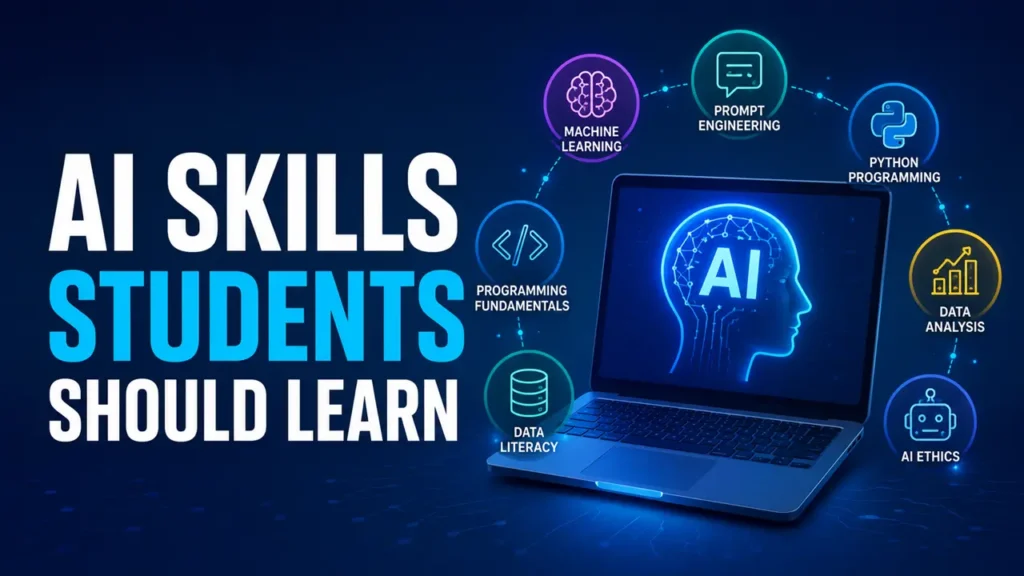
In this blog, we covered ten of the most important AI skills students should learn in 2026: prompt engineering, machine learning basics, Python programming, data literacy, generative AI tools, AI ethics, natural language processing, no-code automation, computer vision, and critical thinking in the AI age. Each one was explained in simple language with real examples, tools, and free learning resources.
You do not need to master all ten overnight. Start with just one. Commit to 30 minutes a day for the next 30 days. By the end of next month, you will have learned more than most of your peers, and you will have taken the first real step towards a future that is not just ready for AI — but shaped by it.

StudentsTalk.in, is an education-focused platform dedicated to helping students stay informed about the latest academic updates, scholarships, entrance exams, career opportunities, government schemes, and study resources. With a passion for education and student success, she creates informative, easy-to-understand content.