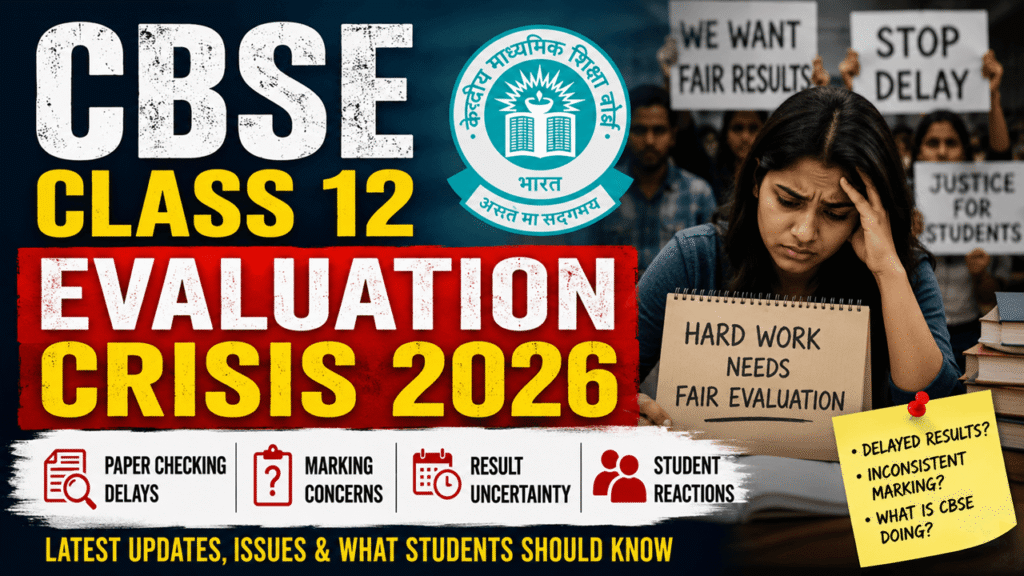
The Central Board of Secondary Education (CBSE) declared the Class 12 results on May 13, 2026. What followed was an immediate wave of outrage from students, parents, and teachers across the country. The reason was simple: thousands of students received unexpectedly low marks, especially in science subjects like Physics, Chemistry, Biology, and Mathematics.
This year, CBSE introduced a new digital evaluation method called the On-Screen Marking (OSM) system. While the board argues that OSM improves transparency and reduces errors, many students believe it is the root cause of their poor scores. The controversy has sparked a nationwide debate about whether digital evaluation systems truly serve students’ interests.
What Is the On-Screen Marking (OSM) System?
The On-Screen Marking system is a digital method for evaluating students’ answer sheets. Under this system, physical answer booklets are scanned into digital format. Teachers and examiners then review and mark these scanned copies on a computer screen rather than handling paper answer sheets directly.
CBSE introduced OSM to eliminate manual errors that were common in traditional paper-based evaluation. The system ensures that every answer is marked step by step, and no section is accidentally skipped. According to the board, OSM also allows better tracking and auditing of how marks are awarded across different examiners and regions.
However, critics point out that OSM also removes the informal flexibility that human examiners traditionally applied. In the past, teachers sometimes awarded grace marks or rounded up scores slightly. With OSM, the system enforces stricter and more objective marking, which may have lowered overall scores this year.
Why Are Students Upset?
The complaints that flooded social media after the result announcement were both specific and widespread. Students who had performed well in pre-board exams and even cleared highly competitive entrance tests like JEE were shocked to find that they had failed or scored very low in their CBSE board exams.
This disconnect between pre-board performance and final board results raised serious questions. If a student can qualify for the JEE, how can they fail a board-level Mathematics paper? Parents and educators found this difficult to explain, and many pointed directly at the OSM system as the culprit.
Students reported harsh marking in subjects where partial credit is usually awarded. In subjects like Physics and Mathematics, students expect step marks even when the final answer is wrong. Many claimed that the OSM system did not properly account for their working steps, resulting in zero marks for partially correct answers.
Key Statistics: CBSE Class 12 Results at a Glance
The table below summarizes the most important data points from the CBSE Class 12 Result 2026 controversy.
| Metric | 2025 | 2026 |
| Overall Pass Percentage | 88.39% | 85.20% |
| Change in Pass Rate | — | –3.19% (Decline) |
| Lowest in How Many Years? | — | 7 Years (Since 2019) |
| Subjects Most Affected | — | Physics, Chemistry, Biology, Math |
| Evaluation Method | Traditional Paper | On-Screen Marking (OSM) |
| Re-evaluation Process Opens | — | May 19, 2026 |
Source: CBSE Official Statement, May 2026 | India TV News | Sunday Guardian Live
CBSE’s Official Defense of the OSM System
The board responded to the mounting criticism through an official statement shared on social media on May 15, 2026. CBSE defended the OSM system firmly, calling it a step toward making the evaluation process more transparent, fair, and consistent for all students across the country.
In its statement, CBSE clarified that OSM was not an automated AI system. Human evaluators, specifically trained teachers, were the ones reviewing and marking the digitally scanned answer sheets. The board emphasized that the system ensures step-wise marking, which means each part of an answer receives appropriate credit.
CBSE also pointed out that the system significantly reduces the possibility of manual mistakes. In traditional evaluation, answer booklets can be misplaced, pages can be missed, or marks can be totalled incorrectly. OSM minimizes all of these risks by centralizing and digitizing the entire evaluation process.
What Education Experts Are Saying
Not all experts are critical of the OSM system. Praneet Mungali, Educationist and Trustee of Sanskriti Group of Schools in Pune, offered a measured view. He acknowledged that OSM has introduced more rigour into the evaluation process, and that this stricter approach may explain the change in pass rates. However, he also cautioned against drawing firm conclusions too quickly. He argued that at least a few more years of data are needed before a definitive judgment can be made about whether OSM is truly beneficial or harmful for students.
Other experts believe that the removal of informal moderation is a double-edged sword. While it eliminates inconsistency, it also removes the human judgment that sometimes helped marginal students pass. This year’s results may simply reflect what scoring looks like when strictly applied without any informal adjustments.
There are also those who suspect that the issue lies not with OSM itself, but with how teachers were trained to use it. If evaluators were not adequately prepared for the digital platform, they may have marked differently than they would on paper. This could explain the wide variation in student experiences.
What Can Students Do Now?
CBSE has opened a structured re-evaluation process for students who are dissatisfied with their scores. The process involves multiple steps, and students must follow them carefully within the prescribed deadlines.
- Step 1: Apply for a scanned copy (photocopy) of the evaluated answer sheet.
- Step 2: Review the photocopy carefully and identify any marking errors.
- Step 3: Apply for verification of marks if totalling errors are suspected.
- Step 4: Apply for re-evaluation of specific answers if marking is disputed.
- Step 5: Pay the required fees through the official CBSE portal.
CBSE has also assured students that corrective action will be taken if any genuine discrepancies are found during re-evaluation. However, students should be aware that marks can go up or down during the re-evaluation process, and the revised marks will be considered final.
Students who failed in one subject also have options. CBSE has clarified that they may be eligible to appear for compartment examinations, provided they fulfil the required conditions under the board’s examination rules. This offers a second chance for students to clear their Class 12 exams without losing an entire academic year.
Broader Implications for Indian Education
The CBSE OSM controversy raises important questions about how India evaluates its students at scale. With millions of students appearing for board exams every year, any change in evaluation method has enormous consequences. The switch to digital evaluation, if done poorly, can unfairly affect students who had no role in the system change.
The timing is also particularly sensitive. This year, the CBSE result controversy coincided with the NEET UG 2026 paper leak row, adding to the overall sense of crisis in India’s education system. Students and parents are increasingly questioning whether the institutions meant to assess and support them are truly working in their interest.
At the same time, modernizing the evaluation system is a legitimate goal. Manual paper-based checking at this scale is prone to errors, inconsistencies, and even malpractice. OSM, if implemented correctly with proper training and quality checks, could genuinely improve the fairness of board evaluations in the long run.
Conclusion
The CBSE Class 12 result controversy of 2026 has brought the On-Screen Marking system under intense public scrutiny. Students have expressed genuine distress, and their concerns should not be dismissed lightly. A drop in the pass percentage to a seven-year low is a significant event that demands a thorough and honest explanation.
CBSE’s response of offering re-evaluation from May 19 is a necessary step. But the board must also conduct an internal review of how the OSM system was implemented this year. Were evaluators trained well enough? Were step marks applied consistently? Did any technical issues affect scoring? These questions deserve clear and transparent answers.
For students currently dealing with unexpected results, the advice is to act quickly. Apply for the photocopy of your answer sheet, review it carefully, and use the re-evaluation process if you believe an error was made. The system allows for correction, and students should not hesitate to use that right within the given deadlines.

Poonam Pareek is the Founder, CEO, and Lead Writer of StudentsTalk.in, an education-focused platform dedicated to helping students stay informed about the latest academic updates, scholarships, entrance exams, career opportunities, government schemes, and study resources. With a passion for education and student success, she creates informative, easy-to-understand content.