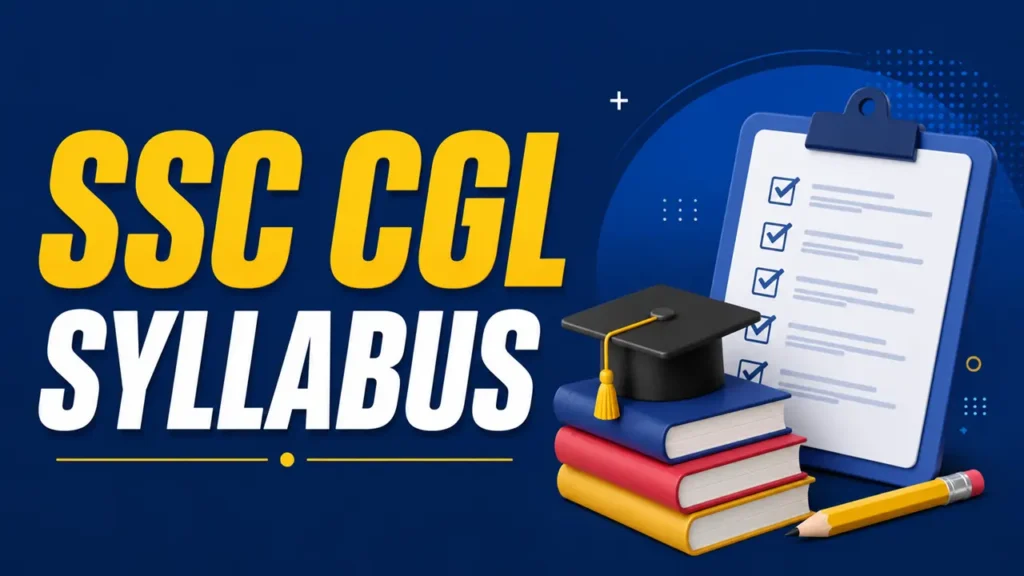
If you are preparing for one of India’s most popular government exams, the first and most important step is to understand the complete SSC CGL syllabus. The Staff Selection Commission Combined Graduate Level (SSC CGL) exam is conducted every year to recruit eligible graduates for Group B and Group C posts in various central government departments. In 2026, the exam has seen some important updates, including the introduction of sectional timing, a new Paper III in Tier 2, and expanded eligibility for certain posts. This blog gives you a complete, easy-to-understand guide to the ssc cgl syllabus so that you can start your preparation on the right path.
Whether you are a first-time aspirant or someone who has attempted this exam before, reading and understanding the ssc cgl syllabus carefully before making a study plan will save you a lot of time and effort. Many students waste months preparing topics that carry little weight in the exam. This blog is written to help you avoid that mistake.
What is SSC CGL 2026?
The SSC CGL exam stands for Staff Selection Commission Combined Graduate Level examination. It is conducted by the Staff Selection Commission (SSC), which is a central government body under the Ministry of Personnel, Public Grievances and Pensions. The exam is held to fill thousands of vacancies across government ministries, departments, and organisations.
In 2026, SSC has announced 12,256 vacancies through the SSC CGL recruitment cycle. This is slightly lower than the 14,582 vacancies announced in 2025, which means competition is higher this year. The online application window opened on 21 May 2026 and will close on 22 June 2026. Candidates can apply through the official SSC website at ssc.gov.in.
Important Link: Apply for SSC CGL 2026 at the Official SSC Website before the deadline.
SSC CGL 2026 Exam Structure: An Overview
Before going into the ssc cgl syllabus in detail, it is important to understand how the exam is structured. The SSC CGL 2026 exam is conducted in two stages, known as Tier 1 and Tier 2. Both tiers are conducted in Computer-Based Test (CBT) mode.
| Tier | Mode | Nature | Total Marks | Duration |
| Tier 1 | CBT (Online) | Qualifying (Screening) | 200 Marks | 60 Minutes |
| Tier 2 | CBT (Online) | Merit-Based (Final Selection) | 450 Marks | Varies by Paper |
One of the most critical points every student must understand is that Tier 1 is only a qualifying exam. This means that your marks in Tier 1 do not count toward your final merit list. The final selection is based entirely on your performance in Tier 2. So while you must clear Tier 1, the real battle is Tier 2.
SSC CGL Syllabus 2026: Tier 1 Exam Pattern
The Tier 1 exam is the first stage of the SSC CGL selection process. According to the updated ssc cgl syllabus, Tier 1 includes 100 objective-type MCQ questions carrying a total of 200 marks. The exam is divided into four equal sections, with 25 questions and 50 marks each. A major new change in 2026 is the introduction of sectional timing — candidates are now given 15 minutes for each section, making time management more critical than ever.
| Subject | Questions | Marks | Time | Negative Marking |
| General Intelligence & Reasoning | 25 | 50 | 15 mins | 0.50 |
| General Awareness | 25 | 50 | 15 mins | 0.50 |
| Quantitative Aptitude | 25 | 50 | 15 mins | 0.50 |
| English Comprehension | 25 | 50 | 15 mins | 0.50 |
| Total | 100 | 200 | 60 mins |
1. General Intelligence & Reasoning
This is one of the most scoring sections in the ssc cgl syllabus for Tier 1. The questions test your logical thinking, problem-solving ability, and pattern recognition skills. This section has both verbal and non-verbal reasoning questions.
Key topics in this section include:
- Analogies (both verbal and non-verbal)
- Similarities and differences
- Space visualisation and spatial orientation
- Problem solving and analysis
- Judgement and decision making
- Visual memory and discrimination
- Observation and relationship concepts
- Arithmetic reasoning and figural classification
- Arithmetic number series and non-verbal series
- Coding and decoding
- Statement conclusion and syllogistic reasoning
- Semantic analogy, symbolic operations, and trends
- Figural pattern — folding and completion
- Indexing, address matching, and date & city matching
- Classification of centre codes and roll numbers
- Critical thinking and emotional intelligence
- Social intelligence
2. General Awareness
General Awareness is a section that tests your knowledge of current events, Indian and world history, geography, economy, science, and general knowledge. This section requires regular reading and a habit of staying updated with the news.
Important topics in General Awareness as per the ssc cgl syllabus include:
- Current events — national and international
- Indian History — ancient, medieval, and modern
- Indian Polity and Constitution
- Indian Geography — physical, economic, and social
- Indian Economy and Five-Year Plans
- General Science — Physics, Chemistry, and Biology
- Science and Technology — new inventions and discoveries
- Books and authors, sports events and awards
- Important government schemes and policies
- Environmental studies and ecology
- India’s neighbouring countries and their capitals
Useful Resource: Stay updated with current affairs on PIB (Press Information Bureau) for government news and policy updates.
3. Quantitative Aptitude
Quantitative Aptitude is one of the most challenging sections for many students. It tests your mathematical knowledge and problem-solving speed. The questions in this section are at the Class 10 level, though the difficulty can vary.
Important topics as per the ssc cgl syllabus for Quantitative Aptitude include:
- Number systems — integers, fractions, and real numbers
- Computation of whole numbers and decimals
- Relationship between numbers
- Percentages and its applications
- Ratio and proportion
- Square roots and averages
- Interest — simple and compound
- Profit and loss, discount
- Partnership business problems
- Mixture and allegation
- Time and distance, time and work
- Basic algebraic identities and graphs of linear equations
- Triangle and its various centres
- Congruence and similarity of triangles
- Circle and its chords, tangents
- Mensuration — cylinder, cone, sphere, and cuboid
- Trigonometry — ratios, complementary angles, height and distance
- Statistical charts — bar graphs, pie charts, histograms, frequency polygon
4. English Comprehension
English Comprehension tests your grammar knowledge, vocabulary, and ability to understand written passages. This section is scoring if you have a basic command of English grammar and reading.
Key topics in English Comprehension as per the ssc cgl syllabus are:
- Spot the error in sentences
- Fill in the blanks
- Synonyms and antonyms
- Spelling and detecting misspelt words
- Idioms and phrases
- One word substitution
- Improvement of sentences
- Active and passive voice conversion
- Conversion of direct to indirect speech
- Shuffling of sentence parts and passage
- Cloze passage
- Comprehension passage
SSC CGL Syllabus 2026: Tier 2 Exam Pattern
Tier 2 is the most important stage in the SSC CGL selection process because your final merit list is prepared based on Tier 2 marks. The ssc cgl syllabus for Tier 2 is more advanced and detailed compared to Tier 1. Tier 2 consists of three papers — Paper I (compulsory for all posts), Paper II (only for JSO posts), and Paper III (only for AAO posts, newly added in 2026).
| Paper | Applicable For | Questions | Marks | Negative Marking |
| Paper I | All Posts (Compulsory) | ~150 Q | 450 | 1 mark (Sec I-III) |
| Paper II | Junior Statistical Officer (JSO) | 100 Q | 200 | 0.50 |
| Paper III | Assistant Audit Officer (AAO) — NEW in 2026 | 100 Q | 200 | 0.50 |
Paper I — Compulsory for All Posts
Paper I is divided into multiple sections covering Mathematical Abilities, Reasoning & General Intelligence, English Language & Comprehension, General Awareness, Computer Knowledge, and DEST (Data Entry Speed Test).
Section 1: Mathematical Abilities
This section tests your advanced mathematical skills. Topics include:
- Number systems, HCF, LCM, fractions, and decimals
- Percentage, ratio, proportion, and averages
- Profit and loss, discount, and simple and compound interest
- Time, speed, distance, and work problems
- Algebra — polynomials, equations, and identities
- Geometry — triangles, circles, polygons, and coordinate geometry
- Mensuration — areas, volumes of 2D and 3D shapes
- Trigonometry — heights and distances
- Data interpretation — tables, bar charts, pie charts
Section 2: Reasoning & General Intelligence
This section mirrors the reasoning syllabus of Tier 1 but is asked at a slightly higher difficulty level. Topics include verbal reasoning, non-verbal reasoning, analytical reasoning, and critical thinking.
Section 3: English Language & Comprehension
This is an advanced version of the English section from Tier 1. Topics include reading comprehension, vocabulary, grammar, sentence correction, and error detection. The level of questions is higher and passage-based questions are more detailed.
Section 4: General Awareness
This section covers current affairs, history, geography, economy, and general science, similar to Tier 1 but at a more advanced level.
Section 5: Computer Knowledge
Computer Knowledge is a qualifying section in Paper I. Topics include:
- Basics of computers — hardware, software, and operating systems
- Computer memory — RAM, ROM, and storage devices
- Input and output devices
- MS Office — Word, Excel, and PowerPoint
- Internet basics — browsers, email, and search engines
- Introduction to networking and cybersecurity basics
- Commonly used shortcuts and commands
Study Resource: For computer knowledge preparation, visit NIELIT’s Official Website for free computer courses and study material.
Section 6: DEST — Data Entry Speed Test
The Data Entry Speed Test (DEST) is a qualifying section applicable for certain posts like Tax Assistant. Candidates are required to type at a speed of 2000 key depressions per hour. This section is qualifying in nature and the marks are not counted in the final merit list. Good typing practice is essential to clear this section comfortably.
Paper II — Statistics (For JSO Posts Only)
Paper II of the ssc cgl syllabus is designed for candidates who apply for the post of Junior Statistical Officer (JSO) under the Ministry of Statistics and Programme Implementation. This paper has 100 questions of 200 marks. Topics in this paper include:
- Collection and representation of data — primary and secondary data, frequency distributions
- Measures of central tendency — mean, median, and mode
- Measures of dispersion — range, quartile deviation, mean deviation, and standard deviation
- Moments — skewness and kurtosis
- Correlation and regression — linear regression, scatter diagram
- Multiple and partial correlation for three variables
- Probability theory — definitions, theorems, and Bayes’ theorem
- Random variables — discrete and continuous probability distributions
- Binomial, Poisson, and Normal distributions
- Sampling theory — simple random, stratified, systematic, and cluster sampling
- Statistical inference — estimation, confidence intervals, and hypothesis testing
- Analysis of variance (ANOVA)
- Time series analysis and index numbers
- Vital statistics — fertility, mortality, and life tables
Note: From 2026, SSC has also expanded the eligibility for Statistical Investigator posts to include graduates from AI, Data Science, Computer Science, and IT backgrounds, in addition to traditional Statistics graduates.
Paper III — Finance & Economics (For AAO Posts — New in 2026)
Paper III is a brand new addition to the ssc cgl syllabus in 2026. It is applicable for candidates who apply for the posts of Assistant Audit Officer (AAO) and Assistant Accounts Officer. This paper tests knowledge in two broad areas: Finance & Accounts, and Economics & Governance.
Finance & Accounts topics include:
- Fundamental principles and basic concepts of accounting
- Single entry and double entry system
- Preparation of journal entries, ledger, and trial balance
- Preparation of profit and loss account and balance sheet
- Self-balancing ledgers and error correction
- Capital and revenue expenditure
- Depreciation accounting methods
- Inventory valuation — FIFO, LIFO
- Auditing concepts — internal and external audit
- Taxation basics — income tax and GST
- Financial management and budgeting
Economics & Governance topics include:
- Basic concepts of economics — demand, supply, and market equilibrium
- Theory of production and costs
- National income and GDP concepts
- Money supply, banking, and monetary policy
- Indian public finance — budget, taxes, and fiscal policy
- Role of RBI, SEBI, NABARD, and other financial institutions
- Indian economic planning and development
- Poverty, unemployment, and social sector issues
- Economic reforms and liberalisation
- Governance — Comptroller and Auditor General (CAG), Parliament, and regulatory bodies
Official Link: Check the complete SSC CGL 2026 Notification on the SSC Official Website for post-specific eligibility conditions.
Key Changes in SSC CGL Syllabus 2026 — What is New?
The 2026 exam has introduced several important changes to the ssc cgl syllabus and exam pattern that every aspirant must be aware of. Here is a summary of the major updates:
- Sectional Timing Introduced in Tier 1 — Previously, candidates had 60 minutes to attempt all 100 questions in any order. In 2026, SSC has introduced sectional timing of 15 minutes per section. This means you cannot use extra time from one section for another. You must answer each section within the given time limit.
- Sectional Timing Also in Tier 2 Paper I — Similar to Tier 1, Tier 2 Paper I now has sectional timing within its sections, making time management an even more critical skill.
- Paper III Added in Tier 2 — A completely new Paper III has been introduced in Tier 2 for AAO and Assistant Accounts Officer posts. This paper covers Finance & Accounts and Economics & Governance.
- Statistical Investigator Eligibility Expanded — Graduates from Artificial Intelligence, Data Science, Computer Science, and IT disciplines are now eligible to apply for Statistical Investigator posts, not just Statistics graduates.
- Vacancies Reduced to 12,256 — With 2,326 fewer vacancies compared to 2025, the competition is sharper this year, making it more important than ever to follow the correct syllabus.
How to Prepare for SSC CGL 2026 — Subject-Wise Tips
Understanding the ssc cgl syllabus is the first step, but knowing how to prepare effectively is what separates successful candidates from the rest. Here are practical, subject-wise preparation tips for SSC CGL 2026.
Preparation Tips for Reasoning
- Practice at least 20 to 30 reasoning questions daily from different topics
- Focus on puzzle-based questions, series, and coding-decoding as they appear frequently
- Use previous year question papers to understand question patterns
- With the new sectional timing of 15 minutes, aim to answer 20 questions in 12 minutes and revise the rest
- Books like ‘A Modern Approach to Verbal and Non-Verbal Reasoning’ by R.S. Aggarwal are useful
Preparation Tips for General Awareness
- Read a national newspaper daily — The Hindu or Hindustan Times are recommended
- Make short notes of important current affairs every week
- Revise Indian history and polity from NCERT books (Class 6 to 10)
- Focus on the last six months of current affairs before the exam
- Practice static GK questions on subjects like geography, economy, and science regularly
Useful Resource: NCERT textbooks available free on NCERT Official Website are excellent for building base knowledge in History, Geography, and Science.
Preparation Tips for Quantitative Aptitude
- Start with NCERT Maths from Class 6 to 10 to clear basic concepts
- Focus on speed and accuracy — solve 30 to 40 questions every day
- Give extra attention to Geometry, Trigonometry, and Data Interpretation as they carry more questions
- Learn shortcut tricks and formulas for time-saving in the exam
- Books like Quantitative Aptitude by R.S. Aggarwal or Rakesh Yadav’s class notes are popular choices
Preparation Tips for English
- Read English grammar rules from Wren and Martin or SP Bakshi’s Objective General English
- Build your vocabulary by learning 10 new words every day with synonyms and antonyms
- Practice reading comprehension passages to improve speed and understanding
- Review common idioms and phrases and one-word substitutions
- Solve Tier 1 and Tier 2 previous year English papers from 2019 to 2024
Preparation Tips for Computer Knowledge
- Focus on basic computer fundamentals, MS Office operations, and internet concepts
- Learn keyboard shortcuts commonly used in MS Word and MS Excel
- This section is qualifying, so do not spend too much time — aim to cover the basics well
- Practice typing regularly to prepare for the DEST section
Important Links for SSC CGL 2026 Preparation
Here are some important official and trusted links that will help you in your SSC CGL 2026 preparation journey:
- SSC Official Website: https://ssc.gov.in — For notifications, admit cards, and results
- SSC CGL 2026 Notification: Check the latest vacancy and eligibility details directly on the SSC website
- NCERT Books: Download free NCERT textbooks from Class 6 to 12 for General Awareness preparation
- PIB India: Press Information Bureau — For government schemes, policies, and current affairs
- Ministry of Statistics: Official MOSPI website — Useful for JSO post aspirants preparing Paper II (Statistics)
- Comptroller & Auditor General: CAG of India — Helpful for AAO post aspirants learning about governance and auditing
- RBI Learning: Reserve Bank of India website — For economics and monetary policy concepts in Paper III
SSC CGL 2026 Selection Process and Final Posting
Once both tiers are completed, the final merit list is prepared based on marks scored in Tier 2. Candidates who qualify both tiers are called for document verification. Post allocation is done based on merit-cum-preference, where candidates choose their preferred posts during the preference-filling stage after results are declared.
Some posts like Tax Assistant and Assistant Section Officer (CSS) also require a qualifying Skill Test or Computer Proficiency Test before final posting. These tests are qualifying in nature and do not add to your marks. The Data Entry Speed Test (DEST) requires a typing speed of 2000 key depressions per hour. The Computer Proficiency Test includes tasks in MS Office and basic computer operations.
The Tier 1 exam is scheduled between August and September 2026 as per the official SSC CGL timetable. Candidates should keep checking the SSC website for admit card release dates and exam centre details.
Exam Day Tips for SSC CGL 2026
On the day of the exam, a few simple but important points can make a significant difference in your performance:
- Carry your admit card and a valid photo ID — without both, you will not be allowed inside the exam hall
- Reach the exam centre at least 30 minutes before the reporting time
- Since sectional timing is now in place, do not get stuck on difficult questions — move on and come back if time permits
- For Tier 1, aim to attempt 18 to 20 correct answers per section within the 15-minute time limit
- Avoid guessing randomly since negative marking of 0.50 marks per wrong answer applies in Tier 1
- In Tier 2, the negative marking is 1 mark per wrong answer in certain sections, so be careful
- Keep yourself calm and focused — do not panic if a section seems tough
Best Books to Study the SSC CGL Syllabus 2026
Choosing the right books is very important when preparing for SSC CGL. Here is a subject-wise list of trusted books based on the ssc cgl syllabus:
| Subject | Recommended Book | Author / Publisher |
| Quantitative Aptitude | Quantitative Aptitude for Competitive Exams | R.S. Aggarwal |
| Reasoning | A Modern Approach to Verbal & Non-Verbal Reasoning | R.S. Aggarwal |
| English | Objective General English | SP Bakshi |
| General Awareness | Lucent’s General Knowledge | Lucent Publications |
| Statistics (Paper II) | Statistics for Economics (Class 11) | NCERT |
| Finance & Economics (Paper III) | Indian Economy | Ramesh Singh (McGraw-Hill) |
| Previous Papers | SSC CGL Chapter-wise Solved Papers | Kiran Publications / Arihant |
SSC CGL 2026 Eligibility Criteria — A Quick Reminder
Before diving deep into ssc cgl syllabus preparation, make sure you meet the basic eligibility requirements set by SSC for CGL 2026:
- Educational Qualification: Candidates must hold a Bachelor’s degree from a recognised university. For some posts like JSO, a degree in Statistics or allied subjects (now expanded to include AI, Data Science, CS, IT) is required.
- Age Limit: The general age limit is 18 to 27 years as on 01 August 2026. Age relaxation is provided to OBC (3 years), SC/ST (5 years), PwBD, and other categories as per government norms.
- Nationality: Candidates must be Indian citizens. Citizens of Nepal, Bhutan, and certain other categories are also eligible as per SSC norms.
- Application Fee: The application fee is Rs. 100. SC/ST candidates and female candidates are exempted from paying the fee.
Conclusion
Understanding the complete ssc cgl syllabus is the most important foundation for any serious aspirant. The 2026 exam comes with new challenges — sectional timing, a new Paper III, and slightly fewer vacancies — making it more important than ever to plan your preparation strategically.
Start by downloading the official SSC CGL 2026 syllabus from ssc.gov.in, map out a realistic study schedule, choose the right books and resources, and practice regularly with mock tests and previous year papers. The ssc cgl syllabus is vast but very manageable when approached section by section with consistent effort.
Remember, Tier 1 is only a gateway — Tier 2 is where your rank is decided. Give extra attention to the ssc cgl syllabus topics covered in Tier 2, especially the compulsory Paper I, and if you are aiming for specialised posts, study Paper II (Statistics) or Paper III (Finance & Economics) with equal seriousness.
Frequently Asked Questions on SSC CGL Syllabus 2026
Q1. Is the SSC CGL 2026 syllabus different from 2025?
Yes, there are some key changes. Sectional timing has been introduced in both Tier 1 and Tier 2. A new Paper III has been added to Tier 2 for AAO posts. Eligibility for Statistical Investigator posts has also been expanded.
Q2. Is Tier 1 marks counted in the final merit list?
No. Tier 1 is only qualifying in nature. Your final merit position is decided entirely based on marks scored in Tier 2.
Q3. How many vacancies are available in SSC CGL 2026?
SSC has announced 12,256 vacancies in the CGL 2026 cycle across various Group B and C posts in central government departments.
Q4. Is there negative marking in SSC CGL 2026?
Yes. In Tier 1, 0.50 marks are deducted for each wrong answer. In Tier 2, 1 mark is deducted for wrong answers in certain sections of Paper I, while 0.50 marks are deducted for wrong answers in Paper II and Paper III.
Q5. Can I download the official SSC CGL syllabus PDF?
Yes. The official SSC CGL 2026 Syllabus PDF can be downloaded from the SSC official website at ssc.gov.in. Look for the CGL 2026 notification document which contains the detailed scheme of examination.
Q6. How many hours should I study daily for SSC CGL?
For a beginner, 6 to 8 hours of focused daily study over 4 to 6 months is recommended. If you are a working professional, aim for at least 3 to 4 hours on weekdays and more on weekends. Quality of study matters more than quantity.

StudentsTalk.in, is an education-focused platform dedicated to helping students stay informed about the latest academic updates, scholarships, entrance exams, career opportunities, government schemes, and study resources. With a passion for education and student success, she creates informative, easy-to-understand content.