A few years ago, a student who got stuck on a math problem at 9 p.m. had two choices: wait until morning or search for a video. Today, that student can ask an AI tutor to explain the problem step by step, in plain words, as many times as needed.
This is one of the biggest shifts in American education in decades. It began in a big way in November 2022, when ChatGPT became public. Within months, students were using it for homework, teachers were worried, and school leaders were asking what to do next.
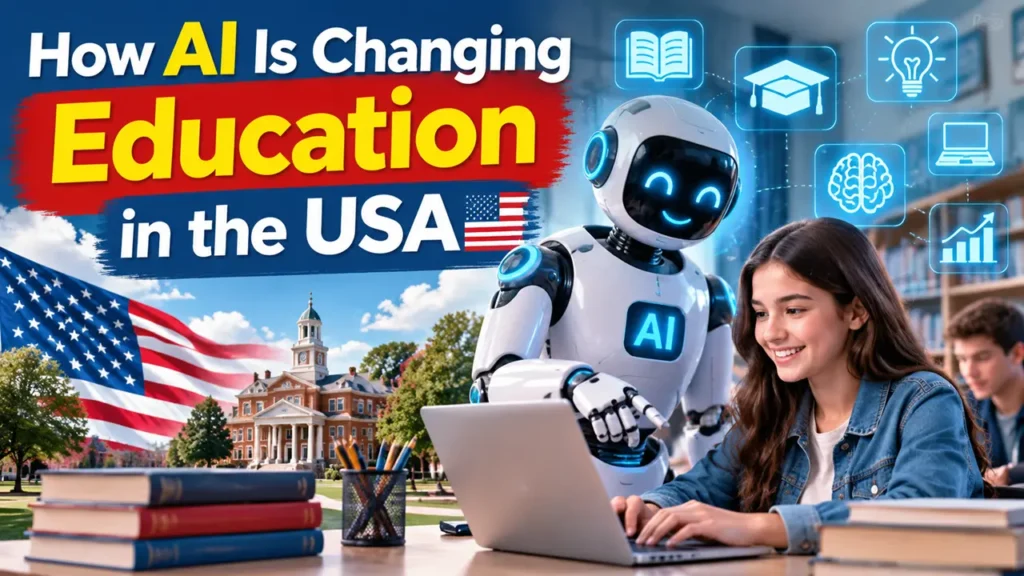
This blog explains how AI is changing education in the USA. It covers what students and teachers are doing with it, where it helps, where it causes problems, and what parents and schools should keep in mind.
What Does “AI in Education” Mean?
AI in education means using computer programs that can read, write, answer questions, and learn from patterns to support teaching and learning.
You may already see it in daily school life:
- A chatbot that explains a science topic
- A reading app that adjusts to a child’s level
- A tool that helps a teacher write a quiz
- Software that checks grammar and gives writing feedback
- A system that tells a school which students may need extra help
Some of these tools are new. Others have existed for years, such as spell check and adaptive learning apps. What changed is how easy and powerful they have become. A student no longer needs special software or training. A phone and an internet connection are enough.
How American Students Are Using AI
Students were among the first to try these tools, often before schools had any rules in place.
Surveys from groups like Pew Research Center have shown that the share of US teens using AI chatbots for schoolwork has grown quickly since 2023. Many students use them in simple, everyday ways:
To understand hard topics. A student reading about the American Revolution can ask, “Explain this like I’m 12.” If the first answer is confusing, they can ask again.
To get unstuck. Many students use AI to see the first step of a problem, then try the rest on their own.
To study. Students ask AI to make practice questions, flashcards, or summaries of their notes.
To improve writing. Some paste a paragraph and ask for feedback on clarity or grammar.
To learn English. Students who speak another language at home use AI to practice conversation and check sentences. This matters in a country where millions of students are still learning English.
Of course, some students also use AI to get the whole assignment done for them. That is a real problem, and we will come to it later in this article.
Personalized Learning: The Biggest Promise
A teacher with 28 students cannot give each child a different lesson. Some students are ahead, some are behind, and most are somewhere in the middle. Teachers do their best, but time is limited.
AI offers a way to give each student more personal attention.
A good AI learning tool can:
- Notice which questions a student gets wrong
- Find the pattern behind the mistakes
- Give an easier explanation or a harder challenge
- Let the student move at their own speed
Khan Academy’s tutor, called Khanmigo, is a well-known example in the US. It is designed to guide students with questions instead of just handing over answers. If a student asks for the answer to an algebra problem, it asks what they have tried so far.
This style of learning is close to one-on-one tutoring, which research has long shown to be very effective. The problem has always been cost. Private tutors are expensive, and many families cannot afford them. AI tutoring could make a version of this help available to far more students, though it is still early and it does not replace a caring human teacher.
How Teachers Are Using AI
Teachers in the US often work long hours, and a large part of that time goes to tasks outside the classroom: planning lessons, writing tests, grading, sending emails, and filling out forms.
Many teachers now use AI to save time. A 2025 survey by Gallup and the Walton Family Foundation found that teachers who use AI tools every week save about six hours a week. That is almost a full working day each month.
Common uses include:
- Lesson planning. A teacher can ask for a lesson outline on fractions for fourth graders and then edit it to fit their class.
- Making materials. Worksheets, quizzes, and reading passages at different levels can be created in minutes.
- Differentiation. A teacher can ask for the same reading text rewritten at an easier level for students who struggle.
- Feedback on writing. Some tools give a first round of comments so the teacher can focus on deeper feedback.
- Parent communication. AI can help draft clear, polite emails and newsletters.
Most teachers say they still check and change what AI produces. It makes mistakes, and it does not know their students. The teacher remains the one who decides what is right for the classroom.
AI Tools Used in American Schools
Here are some of the better-known tools in use today:
- Khanmigo (Khan Academy): an AI tutor and teaching assistant
- ChatGPT, Claude, and Gemini: general chatbots used by students and teachers
- Duolingo: uses AI for language practice and conversation
- Grammarly: writing help for grammar, tone, and clarity
- MagicSchool and similar tools: built for teachers to plan lessons and make materials
- Turnitin: a tool many schools use to check student writing, which now also offers AI detection
Schools and districts often choose their own approved tools, partly because of privacy rules for children. Some districts have signed deals with specific companies, while others leave the choice to teachers.
Changes in Colleges and Universities
Higher education has been affected just as much, and in some ways more.
Research and writing. Graduate students and professors use AI to summarize papers, organize notes, and check code. Many universities now have guidelines on when this is allowed.
Virtual teaching assistants. Georgia Tech’s “Jill Watson” project became well known for using an AI assistant to answer student questions in an online course. Since then, many colleges have tried similar ideas.
Student support. Some universities use chatbots to answer questions about admissions, financial aid, and deadlines at any time of day. This helps students who work or live far from campus.
Early warning systems. Colleges look at data like missed classes and low grades to find students who may drop out, so advisors can reach out sooner. This can help, but it needs careful handling so students are not unfairly labeled.
New courses. Many US colleges now teach classes on AI itself, and some require students to learn how to use it responsibly in their field, whether that is business, nursing, law, or art.
Helping Students with Disabilities
One of the most useful changes is in accessibility.
AI tools can:
- Turn speech into text for students who are deaf or hard of hearing
- Read text aloud for students with vision problems or dyslexia
- Break long, hard passages into simpler language
- Help students who have trouble organizing their thoughts plan an essay
- Describe images for blind students
For many students, these tools make it possible to take part in class on equal terms. A student who once needed a person to read every page can now get support on their own time. Schools still need to follow disability laws and make sure the tools work well, but the potential here is large.
The Cheating Problem
Let us be honest about the hard part. When a chatbot can write a decent essay in ten seconds, some students will use it to avoid the work.
This has pushed schools into a tough position. Early on, some districts reacted with bans. New York City public schools blocked ChatGPT in January 2023, then reversed the decision a few months later after hearing from teachers and experts who felt a ban was not realistic.
Many schools have now moved from “ban it” to “teach it and set clear rules.” Here is what that looks like in practice:
- Clear policies. Teachers state when AI is allowed, when it is not, and how to give credit if it is used.
- More in-class work. Handwritten essays, oral presentations, and class discussions are making a comeback.
- Process-based grading. Students may need to show drafts, notes, and their thinking, not just the final paper.
- Different kinds of assignments. Questions that ask for personal opinion, local examples, or class discussion are harder to answer with a chatbot.
AI detection tools exist, but they are not fully reliable. They can flag honest students by mistake, and they can miss AI-written text. Many educators warn that these tools should never be the only proof used to accuse a student. A better approach is to talk to the student and look at their past work.
Privacy, Bias, and Fairness
AI also brings real risks, especially for children.
Student privacy. Schools collect a lot of information about students. When a student types into an AI tool, where does that data go? US laws like FERPA and COPPA protect student information, but many parents and teachers are not sure how well AI companies follow these rules. Schools need to read the fine print before approving any tool.
Wrong answers. AI can sound confident and still be wrong. It may invent facts, quotes, or sources. Students who trust everything it says can end up learning mistakes.
Bias. AI learns from large amounts of text written by people, and that text includes unfair ideas. An AI tool may treat some names, accents, or writing styles differently. Teachers need to watch for this.
The digital divide. Not every student has a good laptop or fast internet at home. If AI becomes a major part of learning, students without access may fall further behind. Rural areas and low-income communities are most at risk.
Too much reliance. If students use AI to skip the struggle, they may not build skills like thinking, writing, and problem solving. Learning often needs effort. A tool that removes all effort may remove the learning too.
What Government and Schools Are Doing
There is no single national rule for AI in American classrooms, because education in the US is mostly run by states and local districts.
Still, there has been movement at the top. In April 2025, the White House signed an executive order focused on bringing AI education to American youth, with goals like teacher training and helping students learn AI skills early. The US Department of Education has also shared guidance on using AI in schools.
At the state level, many education departments have released their own guidelines, and the number keeps growing. Most of them share a few ideas: keep a human in charge, protect student data, teach students how AI works, and train teachers before putting tools in the classroom.
Teacher training is a key gap. Many teachers say they want to use AI well but have not had enough guidance. Training programs are growing, but they are still catching up.
What Skills Do Students Need Now?
If AI can write, summarize, and solve many problems, what should students learn?
Most education experts say the answer is not “less learning.” It is a different mix of skills:
Critical thinking. Students must learn to question what they read, including what AI tells them.
Fact-checking. They need to check claims against reliable sources.
Clear writing and speaking. These skills still matter, because a person must know what they want to say before they can ask a machine to help.
Asking good questions. The quality of an AI answer depends a lot on the quality of the question.
Creativity and judgment. AI can produce options, but people decide which one is right, fair, and useful.
Honesty. Students need to understand why handing in AI work as their own is a form of lying, and what it costs them in the long run.
The basics still matter too. A student who never learns to do math or write a paragraph will not be able to tell whether an AI answer is good.
What Parents Can Do
Parents do not need to be tech experts to help. A few simple steps go a long way:
- Ask your child how they use AI. Stay curious instead of angry. You will learn more.
- Read the school’s AI policy. Know what is allowed and what is not.
- Encourage “try first, then ask.” Have your child attempt the work before asking AI for help.
- Check the answers together. Pick one AI answer and verify it with a trusted source. This builds a good habit.
- Talk about honesty. Explain that learning is the goal, not just finishing the task.
- Watch privacy. Remind your child not to share full names, addresses, or personal details with any chatbot.
- Stay in touch with teachers. If you have concerns, ask the school what tools they use and how student data is handled.
What Comes Next?
No one can say exactly how this will look in ten years, but a few trends seem likely.
AI tutors will get better and will be used more widely, especially for homework help and practice. Teachers will spend less time on paperwork and more time with students, if schools use the tools well. Assessment will change, with more focus on projects, discussions, and showing how you think. Rules about privacy and safety will become stricter as lawmakers and parents ask harder questions. And AI skills will become part of the normal school curriculum, much like computer skills did a generation ago.
The biggest question is not about technology. It is about choices. Schools can use AI to help every child learn better, or they can let it widen gaps and weaken basic skills. The result will depend on training, clear rules, fair access, and keeping teachers at the center of learning.
Conclusion
AI is already changing education in the USA. Students are using it to study, teachers are using it to save time, and colleges are rethinking how they teach and test. The benefits are real: personal help, better access for students with disabilities, and less paperwork for teachers.
The risks are real too. Cheating, wrong information, privacy problems, and unequal access all need attention. The schools that do well will be the ones that set clear rules, train their teachers, protect their students, and remember that technology is a tool, not a replacement for good teaching.
If you are a student, use AI to learn, not to skip learning. If you are a teacher, try it in small ways and keep your own judgment. If you are a parent, stay involved and keep asking questions. The tools will keep changing, but the goal stays the same: helping young people think well, learn deeply, and grow.
Frequently Asked Questions
Is AI allowed in American schools?
It depends on the state, district, and even the teacher. Many schools now allow AI for some tasks, like brainstorming or studying, and ban it for others, like writing a final essay. Always check the class rules.
Will AI replace teachers?
Most experts say no. AI can help with tasks like planning and practice, but teaching also needs care, patience, and understanding of each student. Those are human strengths.
Can teachers tell if a student used AI?
Sometimes, but not always. AI detection tools are not fully accurate, so many teachers rely on class discussions, drafts, and knowing a student’s usual writing style.
Is AI safe for children to use?
It can be, with limits. Parents and schools should choose tools made for students, check privacy settings, and teach children not to share personal information.
What is the best way for students to use AI?
Use it as a helper, not a shortcut. Try the work first, use AI to explain or give feedback, check the facts, and always be honest about when you used it.

StudentsTalk.in, is an education-focused platform dedicated to helping students stay informed about the latest academic updates, scholarships, entrance exams, career opportunities, government schemes, and study resources. With a passion for education and student success, she creates informative, easy-to-understand content.