If you have passed Class 10 and are now studying in Class 11, Class 12, a diploma course, a degree course, or even a postgraduate course, then the Post Matric Scholarship can help you a lot. This scholarship is given by the Government of India, and by many state governments too, to support students who need financial help to continue their studies. In this blog, we will explain everything about the Post Matric Scholarship 2026–27 in very simple words, so that any student can understand it easily. We will talk about who can apply, what documents are needed, how to fill the application form, the last date to apply, and how to check your application status.
What is the Post Matric Scholarship?
The Post Matric Scholarship (PMS) is a scholarship scheme for students who have completed their matriculation, which means Class 10. “Post Matric” simply means “after matric.” So this scholarship is for students studying from Class 11 onwards, including:
- Class 11 and Class 12 (Intermediate)
- Diploma and Polytechnic courses
- ITI courses
- Undergraduate (UG) degree courses like B.A., B.Sc., B.Com, B.Tech, MBBS, and more
- Postgraduate (PG) courses like M.A., M.Sc., M.Tech, MBA, and more
- PhD and other research programmes
This scholarship helps students pay their tuition fees, hostel charges, and other study-related expenses. The main aim is that no student should stop their studies just because of money problems.
Who Manages the Post Matric Scholarship?
Most Post Matric Scholarships in India are managed through one common online platform called the National Scholarship Portal (NSP). This portal is run by the Government of India and brings together scholarships from different ministries and departments, such as the Ministry of Social Justice and Empowerment, the Ministry of Tribal Affairs, the Ministry of Minority Affairs, and various state governments.
You can visit the official National Scholarship Portal here: scholarships.gov.in
Apart from the central scheme, many states also run their own Post Matric Scholarship schemes with their own portals. For example, Karnataka has the SSP portal, Chhattisgarh has its own scholarship portal, and Odisha has a separate scholarship website. We will talk about a few of these later in this blog.
Why is This Scholarship Important?
Higher education can be expensive. Tuition fees, hostel fees, books, and other costs can become a burden for families with low income. The Post Matric Scholarship reduces this burden by giving financial help directly to students. It also encourages students from Scheduled Castes (SC), Scheduled Tribes (ST), Other Backward Classes (OBC), Economically Backward Classes (EBC), minority communities, and students with disabilities to continue their studies without worrying too much about money. This scholarship supports two main things: your tuition fee (or a big part of it) and your daily living or maintenance expenses while you study.
Post Matric Scholarship 2026–27: Key Highlights
Before we go deeper, here is a quick summary of the scholarship for this academic year.
- Scheme name: Post Matric Scholarship (PMS) 2026–27
- Managed by: National Scholarship Portal (NSP) and respective state scholarship portals
- Who can apply: SC, ST, OBC, EBC, minority community students, students with disabilities, and other eligible categories, studying from Class 11 onwards
- Application mode: Fully online
- Application type: Fresh application (for new applicants) and renewal application (for students who already received the scholarship last year and want to continue it)
- Portal opened on: 1 June 2026 for the central scheme
- Last date: Different for each scheme and state, generally between August 2026 and January 2027 (we have shared a full table below)
Eligibility Criteria for Post Matric Scholarship 2026–27
Eligibility rules can be slightly different depending on your state and your category, but the general rules are almost the same everywhere. Let us go through them one by one.
1. Educational Qualification
You must have passed Class 10 (matriculation) and should currently be studying in Class 11 or above. This includes school, junior college, polytechnic, ITI, undergraduate college, or postgraduate college. The scholarship is valid for one academic year at a time, and if you fail a class or have to repeat a year, you will usually not get the scholarship again for that repeated year.
2. Category-wise Eligibility
- SC and ST students: Students belonging to Scheduled Caste or Scheduled Tribe communities, with a valid caste certificate, are eligible under the SC/ST Post Matric Scholarship schemes.
- OBC and EBC students: Students from Other Backward Classes or Economically Backward Classes can apply under the OBC/EBC scholarship schemes, with a valid OBC/EBC certificate.
- Minority community students: Students belonging to Muslim, Christian, Sikh, Buddhist, Jain, or Parsi (Zoroastrian) communities can apply under minority scholarship schemes.
- Students with disabilities: Students with at least 40% disability, along with a valid disability certificate, can apply under the Post Matric Scholarship for Students with Disabilities.
So, the first thing you need to check is which category you fall under, because the application form, the department, and sometimes the income limit will depend on your category.
3. Family Income Limit
Every Post Matric Scholarship scheme has an income limit. This means your parents’ or guardians’ total yearly income from all sources (salary, business, agriculture, and so on) should not be more than the limit set for your scheme. Here is a general idea of the income limits (please always check your exact scheme for the correct number, as it can differ by state):
| Category | Usual Income Ceiling (per year) |
| SC / ST students (Central schemes) | Up to ₹2,50,000 |
| OBC / EBC students (Central schemes) | Up to ₹1,00,000 (may vary by state) |
| Minority community students | Up to ₹2,00,000 – ₹2,50,000 (scheme-wise) |
| Students with disabilities | Up to ₹2,50,000 |
If your course lasts for more than one year, you will usually need to submit a fresh income certificate for each year, or as instructed by your scheme.
4. Type of Institution and Course
You should be studying in a recognised school, college, or institute. This includes government institutions, government-aided institutions, and many private recognised institutions. Distance education, correspondence courses, and online degree programmes recognised by the University Grants Commission (UGC) are also generally eligible.
5. Aadhaar and Bank Account
You must have an Aadhaar number. This is compulsory for almost all scholarship schemes now, because the scholarship money is sent directly to your bank account through a system called Direct Benefit Transfer (DBT). Your bank account must be linked with your Aadhar number, otherwise your scholarship payment may fail even after your application is approved.
6. Number of Scholarships
Usually, a family can get the benefit of this scholarship for a limited number of children studying at the same time (commonly up to two children, though rules vary by scheme). Also, if you are receiving another central government scholarship at the same time, you may have to choose only one, as double benefit is usually not allowed.
Documents Required for Post Matric Scholarship
Keep these documents ready before you start filling the form, so that your application does not get delayed or rejected.
- Aadhaar card
- Caste/category certificate (SC/ST/OBC/EBC, as applicable)
- Income certificate of parents or guardian
- Domicile or residence certificate
- Mark sheet of the last qualifying examination (for example, your Class 10 or Class 12 mark sheet)
- Bank passbook or a cancelled cheque, showing your account number and IFSC code (account should be Aadhaar-linked)
- Passport-size photograph
- Fee receipt or fee structure given by your college/institute
- Disability certificate (only for students with disabilities)
- Previous year’s mark sheet (for renewal applications)
Documents usually need to be uploaded in PDF or JPEG format, and each file should be small in size (commonly under 200 KB to 500 KB, depending on the portal). It is a good idea to scan your documents clearly in advance so you are not in a hurry near the last date.
Scholarship Amount and Benefits
The scholarship amount is different for every course and every state, but it usually has two parts:
- Maintenance allowance: A monthly or yearly amount given to cover your daily study and living expenses, such as food, stationery, and transport. This can range from a few hundred rupees to a few thousand rupees per month, depending on your course and whether you stay in a hostel or at home.
- Reimbursement of fees: Your compulsory, non-refundable college fees (like tuition fee, admission fee, and exam fee) may be reimbursed either partly or fully, depending on your scheme and category.
Some schemes also give extra support like book allowance, thesis or project allowance for research students, and additional support for students with disabilities. Because the exact amount depends on your state, category, and course, it is always best to check the details on your scheme’s official page before you apply.
How to Apply for Post Matric Scholarship 2026–27: Step-by-Step Process
The application process is almost fully online now. Here is a simple step-by-step guide.
Step 1: Complete Your One Time Registration (OTR)
Before applying for any scholarship on the National Scholarship Portal, you need to complete a One Time Registration (OTR). This gives you a unique 14-digit OTR number linked to your Aadhaar, which you will use for your entire student life, not just for one year.
- Visit the official website
- Click on “New Registration” or “OTR Registration”.
- Enter your Aadhaar number or Aadhaar Enrolment ID.
- Fill in your basic details such as name, date of birth, gender, and mobile number.
- Complete the Aadhaar-based verification (this may involve an OTP or biometric/face authentication).
- After successful registration, you will get your OTR number. Save this number safely.
Step 2: Log In and Choose Your Scholarship Scheme
- Log in to the portal using your OTR number and password.
- From the list of available schemes, select the Post Matric Scholarship scheme that matches your category (SC, ST, OBC, minority, or disability).
- Choose whether you are a fresh applicant (applying for the first time) or a renewal applicant (already received the scholarship earlier and continuing your course).
Step 3: Fill in Your Personal and Academic Details
- Enter your personal details, such as address, parents’ names, and contact information.
- Enter your academic details, including your school/college name, course, year of study, and marks obtained in the last exam.
- Enter your family income and upload the income certificate.
Step 4: Enter Bank Details
- Enter your bank account number and IFSC code carefully.
- Make sure your name in the bank account matches your name in Aadhaar and in your certificates, to avoid payment failure later.
Step 5: Upload Documents
- Upload all the required documents in the correct format and size mentioned on the portal.
- Double-check that the documents are clear and readable before uploading.
Step 6: Verify and Submit
- Carefully check every detail you have entered. A small mistake, like a wrong account number, can delay your scholarship.
- Submit the application and note down your application ID or reference number.
- Take a printout or screenshot of the submitted form for your own record.
Step 7: Institution Verification
After you submit your application, it does not get approved immediately. Your college or institute will first check and verify your application and documents. After that, it moves to the district, state, or central department for further verification. Only after all these levels approve your application, the scholarship amount is released to your bank account through DBT.
Important Dates for Post Matric Scholarship 2026–27
Dates can be extended by the government, so please always confirm the latest date on the official portal before the deadline. Based on the information available at the time of writing, here are some important dates:
| Event | Date / Status (2026-27) |
| NSP Portal opens for OTR & fresh/renewal applications | 1 June 2026 |
| Central Sector Post Matric Scholarship (Students with Disabilities) – application start | 1 June 2026 |
| Central Sector Post Matric Scholarship (Students with Disabilities) – last date | 31 October 2026 |
| Bihar Post Matric Scholarship portal opening | 15 July 2026 (as notified) |
| Chhattisgarh Post Matric Scholarship – renewal window | 20 June 2026 – 30 December 2026 |
| Chhattisgarh Post Matric Scholarship – fresh applications | 1 August 2026 – 30 December 2026 |
| Karnataka SSP – BCWD & Tribal Welfare Department | Closes 31 August 2026 |
| Karnataka SSP – Minority Welfare Department | Closes 30 September 2026 |
| Karnataka SSP – Social Welfare Department | Closes 31 January 2027 |
| Odisha Post Matric Scholarship – expected opening | Last week of November 2026 |
Because dates differ from state to state, and because they are sometimes extended, it is always safer to apply early rather than waiting until the last few days. Applying early also gives you time to fix any mistake if your application gets marked as “defective.”
How to Check Your Post Matric Scholarship Application Status
Once you have submitted your application, you will naturally want to know what is happening with it. Here is how you can check your status.
Checking Application Status on NSP
- Visit the official National Scholarship Portal.
- Click on “Student Login” or “Track Application Status.”
- Enter your Application ID (or OTR number), your name, and the captcha code.
- Submit the form to see your current status.
Your status may show as one of the following: Under Verification, Defective, Approved, Sent to PFMS, or Payment Disbursed. If your status shows “Defective,” it means there is some problem in your application, such as a missing document or a wrong certificate. In that case, log in again, read the remark carefully, correct the mistake, and resubmit your form before the correction window closes.
Checking Payment Status on PFMS
After your scholarship is approved, the payment is processed through a system called PFMS (Public Financial Management System). You can check whether your payment has been sent successfully by visiting the PFMS portal and entering your bank details or your NSP application ID along with the captcha code. This will show whether your payment is successful, still processing, or has failed.
Common Reasons Why Applications Get Rejected or Delayed
Many students lose their scholarship simply because of small, avoidable mistakes. Here are the most common problems you should watch out for:
- Aadhaar number not linked with the bank account, which blocks the DBT payment
- Mismatch between the name on Aadhaar, bank account, and certificates
- Incorrect or outdated income certificate
- Blurry or unclear scanned documents
- Wrong IFSC code or bank account number
- Missing the last date for submission or institution verification
- Not completing renewal on time, even though it is usually simpler than a fresh application
- Application stuck at the institute verification stage due to no follow-up with the college scholarship office
Tips for a Smooth Application
- Apply as early as possible; do not wait for the last date.
- Keep all documents scanned and saved on your computer or phone before you start filling the form.
- Double-check your bank account details and make sure it is Aadhaar-linked.
- Make sure your name is spelled exactly the same way in Aadhaar, bank passbook, and certificates.
- After submission, regularly check your application status so you can fix any “defective” remarks quickly.
- If your application is stuck at the college level, visit your college scholarship office and politely ask them to verify it.
- Save your OTR number, application ID, and password safely, as you will need them every year.
- For renewal students, remember that you generally should not have any backlog or failed subject from the previous year.
Central Scheme vs State Scheme: What is the Difference?
Many students get confused between the central Post Matric Scholarship and the state Post Matric Scholarship. Both are important, and in some cases you may even be eligible for only one of them, so it helps to understand the difference clearly.
The central scheme is run by the Government of India through various central ministries, such as the Ministry of Social Justice and Empowerment (for SC students), the Ministry of Tribal Affairs (for ST students), and the Ministry of Minority Affairs (for minority community students). These schemes apply across the whole country and are accessed through the National Scholarship Portal.
The state scheme, on the other hand, is run by an individual state government for students who belong to that state, usually based on their domicile or residence certificate. For example, Karnataka runs its own Post Matric Scholarship through the SSP (Students Scholarship Portal), Chhattisgarh runs its scheme through its own dedicated portal, and Odisha has its own separate scholarship website. These state schemes may have their own eligibility rules, their own income limits, their own list of documents, and their own last dates, which can be different from the central scheme.
In many cases, if a central scheme covers your category and course, you may not need to apply separately to a state scheme, because your application on the National Scholarship Portal itself routes to the right department. However, some benefits, especially for OBC and general category students, are only available through state-run schemes. This is why it is very important to check your own state’s official scholarship website in addition to the National Scholarship Portal, so that you do not miss out on any scheme you are eligible for.
A Quick Look at a Few State Post Matric Scholarship Schemes
Since India is a large country and each state manages its own scholarship system slightly differently, let us look at a few examples so you get a general idea of how state schemes usually work. Please remember that these details can change, so always check your own state’s official portal for the latest information.
Karnataka SSP Post Matric Scholarship
In Karnataka, the Post Matric Scholarship is managed through the SSP (Students Scholarship Portal). This scheme is open to students studying in Class 11/PUC and above, including PUC, diploma, ITI, degree, engineering, medical, nursing, B.Ed, and postgraduate courses. The scheme is run by different departments, such as Social Welfare, Tribal Welfare, Backward Classes Welfare, and Minority Welfare, and each department has its own last date. Karnataka also requires students under certain departments to complete an OTR (One Time Registration) on the SSP portal itself, which is separate from the national-level OTR.
Chhattisgarh Post Matric Scholarship
Chhattisgarh runs its Post Matric Scholarship for SC, ST, and OBC students through its own portal. Students who have a domicile certificate of Chhattisgarh, whether studying inside or outside the state, can apply. The scheme requires students to complete OTR on the National Scholarship Portal first, since this OTR is linked to their Chhattisgarh scholarship profile as well. Both fresh and renewal applications are accepted, with slightly different opening dates for each.
Odisha Post Matric Scholarship
In Odisha, the Post Matric Scholarship is applied for through a dedicated state portal. Students need to register, fill in their personal, course, college, bank, and income details, and then upload scanned documents. After submission, the application moves through institute-level verification, and students are advised to apply early, ideally as soon as the portal opens, to avoid last-minute technical issues.
Bihar Post Matric Scholarship
Bihar’s Education Department also runs a Post Matric Scholarship (PMS) scheme for SC, ST, BC, and EBC students studying beyond Class 10. Depending on the year, students studying in more reputed or higher-ranked institutions may receive a higher scholarship amount compared to other institutions. As with other states, applications are submitted online, and students must keep their category and income certificates ready.
As you can see, while the overall idea is the same everywhere, the exact process, portal, and dates can differ quite a lot from state to state. So always start by checking two things: the National Scholarship Portal for central schemes, and your own state’s official scholarship website for state-specific schemes.
Common Terms You Should Know
While reading about the Post Matric Scholarship, you will come across a few short forms and terms again and again. Here is a simple explanation of each, so that you never feel confused.
- NSP: National Scholarship Portal, the main website where most central and many state scholarships are applied for.
- OTR: One Time Registration, a unique 14-digit number linked to your Aadhaar that you register only once and use for your entire student life.
- DBT: Direct Benefit Transfer, the system through which your scholarship money is sent directly into your bank account, instead of through cash or cheque.
- PFMS: Public Financial Management System, the government system that processes and tracks the actual payment of your scholarship after it is approved.
- eKYC: Electronic Know Your Customer, a process where your identity is verified using your Aadhaar, usually through an OTP or biometric/face authentication.
- Fresh application: An application submitted by a student who is applying for the Post Matric Scholarship for the first time, or for a new course.
- Renewal application: An application submitted by a student who already received the scholarship in a previous year and wants to continue receiving it for the next year of the same course.
- Institute verification: The step where your own school, college, or institute checks and confirms your application details and documents before they are sent for further approval.
Fresh Application vs Renewal Application: What is the Difference?
Since this comes up so often, let us understand it a bit more clearly. If this is your first time applying for the Post Matric Scholarship, either because you have just joined Class 11 or you have just started a new diploma, degree, or postgraduate course, then you will apply as a fresh applicant. You will need to fill in all your personal, academic, income, and bank details from scratch and upload all your documents.
If you already received the Post Matric Scholarship last year for the same course, and you are simply moving to the next year of that same course (for example, from first year to second year of your degree), then you will apply as a renewal applicant. In a renewal application, many of your earlier details are already saved in the system, so you mainly need to update your current year of study, your latest marks, and confirm that your income and bank details are still correct. Renewal is usually a shorter and quicker process, but you must still complete it every single year; the scholarship does not continue automatically on its own.
One important condition for renewal is that you should not have any pending backlog or failed subject from the previous year, and you should not have repeated the same class or year, since the scholarship is generally not given twice for the same year of study.
What Happens After You Receive the Scholarship?
Once your scholarship amount is credited to your bank account, your work is not fully over. Here are a few things to keep in mind for a smooth experience in the following years:
- Keep a copy of your sanction letter or payment confirmation for your own records.
- Continue attending your classes regularly, since some schemes may ask for an attendance certificate.
- Try to avoid any backlog or failed subject, as this can affect your renewal eligibility for the next year.
- Keep your Aadhaar, bank account, and mobile number active and linked, since you may need them again for renewal or for further verification.
- Apply for renewal as soon as the portal opens for the next academic year, instead of waiting until the last date.
How Parents and Teachers Can Help
Filling an online scholarship form can feel a little confusing, especially for a student who is doing it for the first time. Parents and teachers can play a big role in making this process smoother. Parents can help by keeping all family documents, such as the income certificate, caste certificate, and Aadhaar card, in one folder so they are easy to find every year. They can also double-check bank details before submission, since even one wrong digit in an account number can cause the payment to fail.
Teachers and school or college staff can help by guiding first-time applicants through the OTR process, explaining which category and scheme applies to them, and reminding students about upcoming deadlines. Many schools and colleges also appoint a scholarship in-charge or nodal officer, and students should not hesitate to reach out to this person if they face any difficulty with the online form, document upload, or institute verification stage.
Why You Should Not Wait Until the Last Date
Every year, thousands of students face last-minute problems, such as the portal running slowly because too many students are trying to log in at the same time, wrong documents being uploaded in a hurry, or a small technical error that could not be fixed because the deadline had already passed. These problems are easy to avoid if you apply early.
When you apply early, you get enough time to correct any mistake if your application is marked as “Defective.” You also give your school or college enough time to complete institute verification calmly, instead of rushing through hundreds of applications in the last few days. Most importantly, applying early means your scholarship money is likely to reach your bank account sooner, which can genuinely help you manage your study expenses on time, such as paying hostel fees or buying books before the semester starts.
Conclusion
The Post Matric Scholarship 2026–27 is a valuable support system for lakhs of students across India who want to continue their education after Class 10 but face financial difficulties. Whether you are joining Class 11, starting a diploma, or pursuing a postgraduate degree, this scholarship can genuinely reduce your financial burden. The key to a successful application is simple: check your eligibility, keep your documents ready, apply early, fill the form carefully, and keep checking your application status regularly. Do not let a small mistake or a missed deadline stop you from getting the support you deserve.
Frequently Asked Questions (FAQs)
1. Who can apply for the Post Matric Scholarship 2026–27?
Students who have passed Class 10 and are currently studying in Class 11 or above, and who belong to eligible categories such as SC, ST, OBC, EBC, minority communities, or students with disabilities, and whose family income is within the prescribed limit, can apply.
2. What is the last date to apply?
The last date is different for each scheme and state. Central schemes generally close between October 2026 and January 2027, while some state schemes have earlier or later deadlines. Please check the exact date table above and always confirm on the official portal.
3. Can I apply if I am studying through distance or online education?
Yes, students studying through recognised distance, correspondence, or online education programmes are generally eligible, as long as the course and institute are recognised.
4. What happens if my scholarship status shows “Defective”?
It means some information or document in your application needs correction. Log in to the portal, read the remark, fix the issue, and resubmit within the given correction window.
5. How long does it take to receive the scholarship money?
Once your application is approved at all levels, the amount is usually credited to your bank account within a few weeks through Direct Benefit Transfer, though the exact time can vary.
6. Do I need to apply again every year?
You need to complete OTR only once in your student life. However, you must apply for renewal every year (as long as you meet the eligibility conditions) to continue receiving the scholarship for your current course.
7. Can I get both a central scholarship and a state scholarship at the same time?
Usually no. Most scholarship rules do not allow you to receive two central government scholarships together, and in many cases a central and a state scholarship also cannot be combined for the same purpose. If you are selected for more than one scheme, you will generally be asked to choose only one.
8. What should I do if my scholarship payment shows “failed” on PFMS?
A failed payment is usually due to a bank account problem, such as the account being closed, dormant, not linked with Aadhaar, or an incorrect IFSC code. Visit your bank branch with your PFMS payment reference ID, fix the account issue, and then check with your scholarship office to have the payment reprocessed.
9. My application is stuck at the institute verification stage. What can I do?
This is a very common issue. The best step is to visit your college or school’s scholarship section in person or send them a polite email, and ask them to check and verify your application on the portal. Many applications simply get delayed because the institute has not logged in and completed its part yet.
10. Is there any application fee for the Post Matric Scholarship?
No, applying for the Post Matric Scholarship is completely free of cost on the official National Scholarship Portal and on state scholarship portals. You should never pay any person or website to fill this form for you.
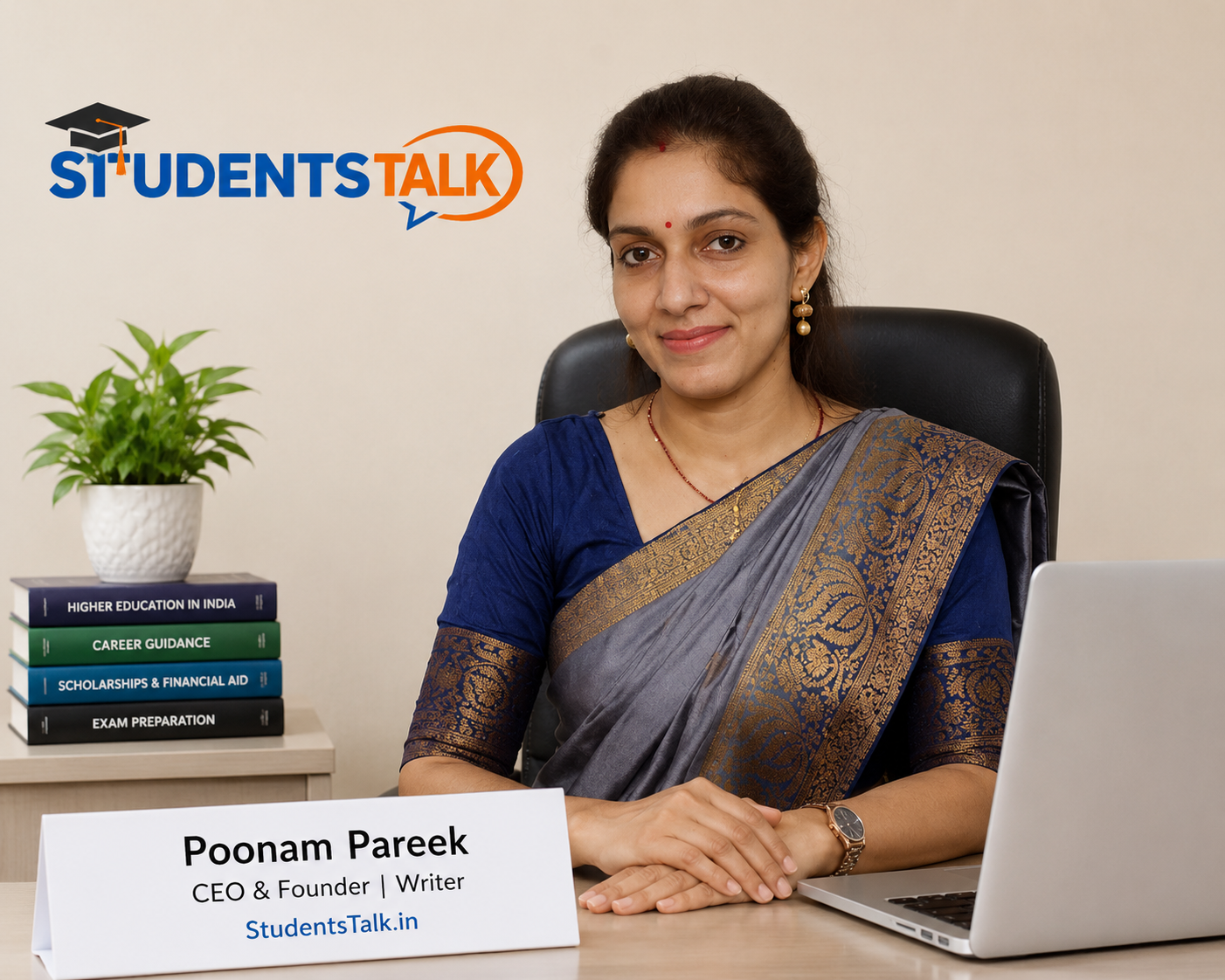
Poonam Pareek is the Founder, CEO, and Lead Writer of StudentsTalk.in, an education-focused platform dedicated to helping students stay informed about the latest academic updates, scholarships, entrance exams, career opportunities, government schemes, and study resources. With a passion for education and student success, she creates informative, easy-to-understand content.