
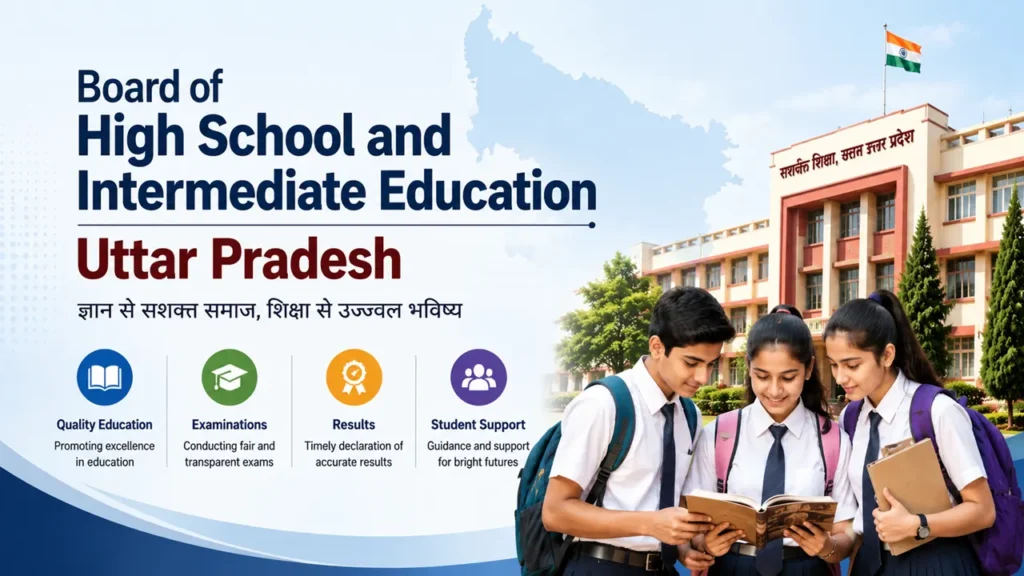
If you are a student studying in Class 10 or Class 12 in Uttar Pradesh, then there is one name you must know very well — the Board of High School and Intermediate Education Uttar Pradesh, which is commonly called UPMSP or just UP Board. This is the board that takes your exam, gives your marks, and gives you your certificate when you pass. Without this board, there would be no proper system for millions of students in UP to study and grow.
In this blog, we will talk about everything related to UP Board — its history, how it works, what exams it conducts, how to check results, and many more useful things that every student must know.
What is UP Board?
UP Board is a government education board. Its full name is Board of High School and Intermediate Education Uttar Pradesh. It is located in Prayagraj (which was earlier called Allahabad). This board is responsible for conducting Class 10 (High School) and Class 12 (Intermediate) examinations across the entire state of Uttar Pradesh.
In simple words — if you study in a government or UP Board school in UP, then UP Board is the body that makes your question papers, conducts your exams, checks your answer sheets, gives your marks, and provides your marksheet and certificate.
UP Board is one of the largest education boards in the entire world when it comes to the number of students. Every year, crores (millions) of students appear for UP Board exams. This is not a small thing. It means UP Board plays a very big role in the future of students across the state.
History of UP Board
UP Board was established in 1921. That means it is more than 100 years old. It was set up during the British time in India. At that time, very few students used to study, and the board was much smaller. But over the decades, as more and more schools were built and more children started going to school, the board grew bigger and bigger.
Today, UP Board is recognised by the Government of Uttar Pradesh and it follows the rules and guidelines set by the state government. It also coordinates with NCERT (National Council of Educational Research and Training) for syllabus updates.
Over the years, UP Board has made many changes to improve the quality of education. For example, in 2018, it made strict rules to stop cheating in exams. Many changes in the syllabus have also been made so that students can learn better.
How Many Students Appear in UP Board Exams?
This is something that surprises many people. UP Board exams are considered the largest single school exam in the world. In recent years, around 50 to 60 lakh students (5 to 6 million students) appear for UP Board Class 10 and Class 12 exams together. In some years, this number has even crossed 1 crore.
To manage so many students, the board sets up thousands of exam centres across all the 75 districts of Uttar Pradesh. This is a massive task and requires a lot of planning and organisation.
What Exams Does UP Board Conduct?
UP Board mainly conducts two major exams:
1. High School Examination (Class 10)
This exam is for students who are in Class 10. After passing this exam, students get a High School Certificate. This certificate is very important because it is used in many places — for getting jobs, for applying to schools, for identity proof, and for higher education.
The Class 10 exam usually has subjects like Hindi, English, Mathematics, Science, Social Science, and optional subjects. Students have to appear in all the subjects assigned to them.
2. Intermediate Examination (Class 12)
This exam is for students who are in Class 12. After passing, students get an Intermediate Certificate. Based on the stream a student has chosen — Arts, Science, or Commerce — they have different subjects to study and appear in.
For example:
- Science students have Physics, Chemistry, Biology or Mathematics
- Commerce students have Accountancy, Economics, Business Studies
- Arts students have History, Geography, Civics, Hindi Literature, and more
Both exams — Class 10 and Class 12 — are very important in a student’s life. The marks and certificates from these exams are used for admissions to colleges and universities.
UP Board Syllabus
The syllabus of UP Board is prepared by the board itself, but it takes reference from NCERT books. In recent years, UP Board has aligned its syllabus more closely with NCERT, which is a very good step. This means that if you study NCERT books properly, you will be well-prepared for UP Board exams.
The syllabus is updated from time to time. Students should always check the official website to see if any changes have been made in the current year.
It is important to understand that UP Board syllabus covers all the basic and important topics that are needed for a good education. The board also sets the marks scheme, which tells students how many marks each question carries.
How UP Board Exam is Conducted
The exam is generally held in February and March every year. The timetable is released a few months before the exam so that students can prepare well. Each subject exam is held on a different day, and students go to their assigned exam centre to write the paper.
The exam centre is a school or college nearby your area. You must carry your admit card to the exam centre. Without an admit card, you will not be allowed to enter.
The papers are printed by the board and are kept very secret. After the exam, the answer sheets are collected and sent to different teachers across the state who check them.
In recent years, UP Board has taken very strict steps to prevent cheating. CCTV cameras are installed in exam centres, police officers are present, and anyone found cheating is immediately removed. These steps have helped make the exams more fair and honest.
UP Board Result
After the exam is done, everyone waits for the result. UP Board results are usually declared in April or May. In some years, results have come out even earlier.
The result is announced officially on the UP Board’s website. Here are the two official websites where you can check your result:
- upmsp.edu.in — This is the official website of UP Board
- upresults.nic.in — Another official site for results
To check your result, you need your Roll Number. This roll number is printed on your admit card. Enter your roll number on the website, and your result will appear on the screen.
Your result will show:
- Your marks in each subject
- Whether you have passed or failed
- Your total marks and percentage
- Your division (First Division, Second Division, Third Division)
If you get 60% or more, it is First Division. If you get between 45% and 59%, it is Second Division. If you get between 33% and 44%, it is Third Division. Below 33% means you have failed.
Marksheet and Certificate
After the result is declared, students who pass can collect their original marksheet from their school. This marksheet is very important. Keep it safe and make multiple photocopies.
After a few months, the final certificate is also distributed. This certificate has the official stamp of UP Board and is accepted everywhere — colleges, universities, government offices, banks, and more.
If you lose your original marksheet or certificate, you can apply for a duplicate copy through the official UP Board website. There is a small fee for this.
Roll Number and Admit Card
Every student who registers for UP Board exams gets a unique Roll Number. This number is very important. It is used to:
- Enter the exam hall
- Check your result
- Download your marksheet
- Apply for corrections in your details
Your Admit Card is the official slip that allows you to enter the exam centre. It has your name, roll number, photo, subject names, exam centre details, and exam dates. You must download your admit card from the UP Board website before the exams.
If there are any mistakes in your admit card — like your name is spelled wrong or your date of birth is wrong — you must inform your school immediately so that corrections can be made.
UP Board Registration
Before appearing for Class 10 or Class 12 exams, every student must get registered with UP Board. This is done through your school. Your school collects your details, your photo, your signature, and submits them to the board.
After successful registration, you are given a Registration Number. This number is important and is used in your marksheet and certificate.
Registration usually happens when you are in Class 9 (for Class 10 exam) and when you are in Class 11 (for Class 12 exam). So if you are a younger student, do not worry — your school will take care of this process.
How to Prepare for UP Board Exams
Many students feel nervous about board exams. But if you prepare well, you can do very well. Here are some simple tips:
Read NCERT books carefully. UP Board syllabus is now very close to NCERT, so NCERT books are the best resource.
Practice previous year papers. Old question papers help you understand what kind of questions come in the exam. You can get these from your school, a nearby bookshop, or online.
Make short notes. When you study, write down important points in your own words. This helps you remember better.
Revise regularly. Do not study everything at once in the last few days. Study a little every day throughout the year.
Manage your time. In the exam hall, read all questions first, then decide how much time to give to each question. Do not spend too long on one question.
Stay healthy. Eat well, sleep properly, and take small breaks when studying. A healthy body helps the brain work better.
Compartment and Improvement Exam
If a student fails in one or two subjects, they may get a chance to appear in the Compartment Exam (also called Back Paper). In this exam, you only appear for the subject or subjects in which you have failed. If you pass the compartment exam, you will be considered passed in the full exam.
If you want to improve your marks, you can also appear in Improvement Exams in the next year. This gives you a chance to try to get better marks in subjects where you were not happy with your performance.
Online Services by UP Board
UP Board has improved a lot in terms of online services. You can now do many things online without going to the board office. Some of the things you can do online include:
- Checking your result
- Downloading your admit card
- Applying for duplicate certificates or marksheets
- Checking school affiliation status
- Downloading the syllabus and timetable
The official website is upmsp.edu.in. Students and parents should regularly visit this website to stay updated about important dates and news.
UP Board and NCERT — The Connection
Many students ask — should I study from UP Board books or NCERT books? The answer is simple. In recent years, UP Board has adopted NCERT books for most subjects. So you should primarily study from NCERT books.
However, UP Board also publishes its own books through Uttar Pradesh Madhyamik Shiksha Parishad. These books are written based on the UP Board syllabus. For some subjects, especially Hindi literature or regional topics, the UP Board books may have some extra content.
The safest approach is — study NCERT books as your main source and also look at UP Board books for any extra topics.
Number of Schools Affiliated to UP Board
UP Board has an enormous number of schools affiliated to it. There are more than 27,000 affiliated schools across Uttar Pradesh. These schools range from small rural schools in villages to large schools in cities. All of them follow the UP Board syllabus and send their students to appear in UP Board exams.
To be affiliated with UP Board, a school has to apply and meet certain standards. The board checks the facilities, teachers, and other things before granting affiliation.
Strict Steps Against Cheating
In the past, UP Board exams were sometimes affected by cheating. Some students used to get help from others during the exam, which was very unfair to honest students. But in recent years, especially from 2017 onwards, the Government of Uttar Pradesh has taken very strict action against cheating.
Now, CCTV cameras are placed in every exam room. Police officers stand outside and inside exam centres. Flying squads visit different centres to do surprise checks. If anyone is caught cheating, they are immediately disqualified and may even be banned from future exams.
Because of these steps, the number of students appearing for exams has actually gone down compared to earlier years — but the quality and honesty of the exam has gone up greatly. Honest students no longer have to feel unfairly treated.
Career After UP Board
Passing UP Board Class 10 and Class 12 is just the beginning of your journey. After Class 10, you choose your stream — Arts, Science, or Commerce — for Class 11 and 12. After Class 12, you can:
- Apply for college admissions in Uttar Pradesh or other states
- Appear for entrance exams like JEE (for engineering), NEET (for medical), CLAT (for law), and many others
- Apply for government jobs where Class 12 is the minimum qualification
- Do diploma or certificate courses
Your UP Board marksheet and certificate will be needed for all these next steps. So always keep your documents safe.
Important Contact Information
If you have any problem related to UP Board — like wrong marks, wrong name on certificate, or any other issue — you can contact the board directly.
Official Website: upmsp.edu.in
Board Office Address: Board of High School and Intermediate Education Uttar Pradesh, Prayagraj (Allahabad), Uttar Pradesh
You can also contact through your school. The school principal or clerk can help you reach the board for official matters.
Final Words
UP Board is not just a board that conducts exams. It is a system that helps millions of students get proper education and a certificate that opens doors for their future. Whether you are in a small village in eastern UP or a big city like Lucknow, the UP Board exam gives you an equal chance to show your talent and hard work.
As a student, your job is simple — study honestly, prepare well, and give your best in the exam. The board will take care of the rest. Your hard work will not go to waste. Every mark you earn honestly is a step forward in your life.

StudentsTalk.in, is an education-focused platform dedicated to helping students stay informed about the latest academic updates, scholarships, entrance exams, career opportunities, government schemes, and study resources. With a passion for education and student success, she creates informative, easy-to-understand content.