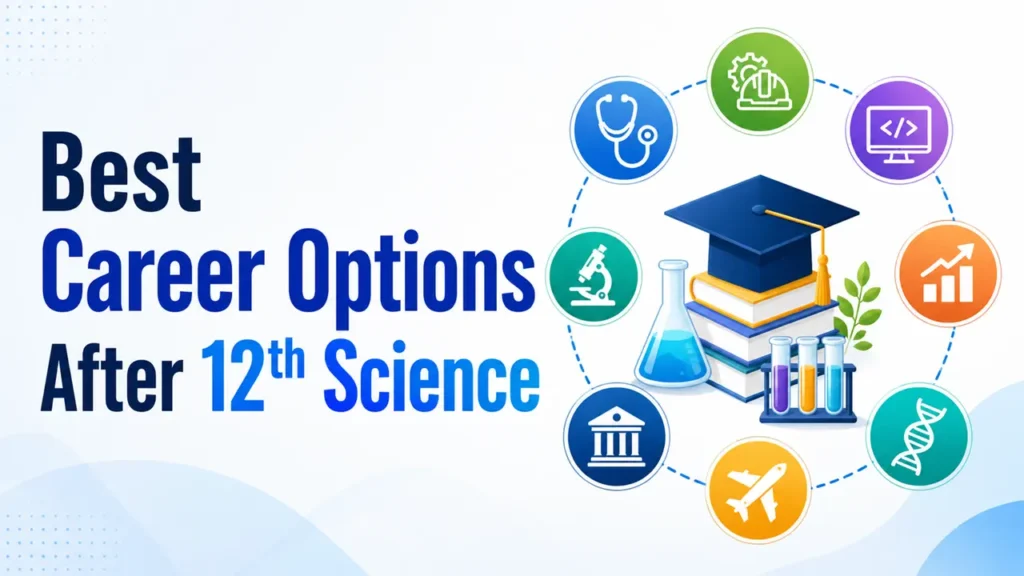
Finishing your Class 12 board exams with a Science stream is a milestone that opens more doors than almost any other academic achievement at that stage of life. Yet, for millions of students across India and the world, the months that follow are also among the most confusing and anxiety-ridden of their young lives. Questions like “Which course should I choose?” and “Will this career pay well?” keep students — and their parents — awake at night. That is exactly why understanding the best career options after 12th Science is so important before you make any decision.
Whether you studied Physics, Chemistry, Mathematics (PCM) or Physics, Chemistry, Biology (PCB), or even the full combination of PCMB, this comprehensive guide will walk you through every meaningful career path available to you — from traditional routes like engineering and medicine to newer, high-growth fields like data science, cybersecurity, aviation, and biotechnology. By the end of this article, you will have a clear picture of which direction aligns with your strengths, interests, and long-term goals.
Let us dive deep into the most comprehensive breakdown of the best career options after 12th Science that you will find anywhere.
Why Choosing the Right Career Path After 12th Science Matters
The Science stream is often considered the most demanding and competitive academic path at the high school level, and for good reason. It equips students with analytical thinking, problem-solving abilities, and a logical mindset that are valued across virtually every industry. However, the sheer number of best career options after 12th Science can be overwhelming rather than empowering if you do not approach the decision methodically.
Research consistently shows that students who make informed, interest-aligned career choices tend to perform better academically, experience less burnout, and achieve greater professional satisfaction. A career chosen under peer pressure or parental expectation — without aligning with personal aptitude — often leads to mid-career switches, financial setbacks, and emotional stress.
Before you explore the full list of options, ask yourself three key questions:
- Do I enjoy working with numbers, machines, and systems — or with living organisms, nature, and health?
- Am I drawn more toward creative problem-solving and innovation, or toward research and discovery?
- Do I want to enter the workforce quickly (diploma/degree in 3–4 years), or am I willing to invest in longer postgraduate education for higher returns?
Your answers will guide which section of this guide deserves the most attention.
Best Career Options After 12th Science (PCM) — For Mathematics Students
If you studied PCM, you have a natural inclination toward calculations, logic, and structures. The best career options after 12th Science for PCM students are dominated by engineering, technology, and finance — some of the highest-paying sectors globally.
1. Engineering — The Classic and Ever-Evolving Choice
Engineering remains the single most popular career path chosen by PCM students, and it continues to be among the best career options after 12th Science for very valid reasons. The field is extraordinarily broad, covering dozens of specialisations that touch every aspect of modern civilisation — from the chips inside your smartphone to the bridges you cross every day.
Top Engineering Specialisations in 2026:
- Computer Science and Engineering (CSE) — Leads to software development, AI/ML, cybersecurity, and cloud computing roles. Average starting salaries in India range from ₹6–18 LPA; globally, fresh graduates from top institutions earn $80,000–$130,000.
- Mechanical Engineering — Covers design, manufacturing, robotics, and automotive industries. With the EV revolution booming, mechanical engineers are now integral to battery design and drivetrain engineering.
- Civil Engineering — Infrastructure development, smart cities, and sustainable construction make this field perennially relevant. India’s ₹111 lakh crore National Infrastructure Pipeline ensures massive demand.
- Electrical and Electronics Engineering (EEE) — Powers everything from power grids to consumer electronics and embedded systems.
- Aerospace Engineering — Designing aircraft, spacecraft, and drones. ISRO, HAL, Boeing, and Airbus are key recruiters in India and globally.
- Chemical Engineering — Bridges chemistry and engineering for pharmaceuticals, petrochemicals, and material science industries.
- Biomedical Engineering — A growing interdisciplinary field combining medicine, biology, and engineering to develop life-saving medical devices.
Admission to top engineering colleges in India happens through JEE Main and JEE Advanced. Globally, the SAT/ACT and university-specific applications are required. A B.Tech or B.E. degree typically takes four years and can be followed by an M.Tech, MBA, or direct entry into the job market.
2. Data Science and Artificial Intelligence
Among the best career options after 12th Science in the 21st century, Data Science and Artificial Intelligence stand in a category of their own. The World Economic Forum’s Future of Jobs Report consistently ranks AI and data-related roles among the top ten fastest-growing professions globally. India alone is expected to face a shortage of over 2 million data professionals by 2026.
Students with a strong mathematics and statistics background thrive in this field. Degrees like B.Sc. Data Science, B.Tech AI, or even a B.Tech CSE followed by a specialisation in machine learning provide solid entry points. Core skills include Python programming, statistical modelling, neural networks, natural language processing, and data visualisation.
Career roles include Data Analyst, Machine Learning Engineer, AI Research Scientist, Business Intelligence Analyst, and NLP Engineer — all offering some of the highest-paying salaries in the technology sector.
3. Architecture and Urban Planning
Architecture beautifully blends artistic creativity with scientific precision — making it one of the most unique best career options after 12th Science for students who love both design and mathematics. A B.Arch degree (five years in India, accessed via NATA exam) trains students in structural design, environmental planning, interior architecture, and urban development.
With India’s rapid urbanisation and the global push for green buildings and sustainable cities, architects and urban planners are expected to remain in strong demand through 2040 and beyond.
4. Actuarial Science and Finance
Actuaries use mathematics and statistics to assess financial risk in insurance and investment sectors. It is one of the highest-paying and least-talked-about best career options after 12th Science for PCM students. Actuarial Science professionals in India with full fellowship certification earn between ₹30–80 LPA, while counterparts in the US and UK can earn well over $150,000 annually.
You can pursue a B.Sc. in Actuarial Science or take the Institute and Faculty of Actuaries (IFoA) or Institute of Actuaries of India (IAI) examinations alongside any mathematics degree.
Best Career Options After 12th Science (PCB) — For Biology Students
Biology students are often passionate about understanding life itself — how organisms function, how diseases arise and are cured, and how ecosystems sustain our planet. The best career options after 12th Science for PCB students are centred around healthcare, life sciences, and environmental fields — all of which are witnessing unprecedented growth in funding and innovation.
5. Medicine and Surgery (MBBS)
Medicine is, for many PCB students, the gold standard career aspiration. An MBBS degree remains one of the most prestigious and impactful best career options after 12th Science available. In India, admission is through NEET UG, where competition is fierce — over 2 million students appear annually for roughly 100,000 government seats.
The MBBS course takes 5.5 years (including internship), after which students can specialise through MD, MS, or MCh degrees. Specialisations like Cardiology, Neurosurgery, Oncology, and Radiology are among the highest-earning medical specialties. Beyond India, MBBS graduates can practice internationally after clearing licensing exams like USMLE (USA), PLAB (UK), or AMC (Australia).
6. Pharmacy
Pharmacy is one of the most versatile best career options after 12th Science, offering pathways in clinical practice, drug formulation research, hospital settings, and the pharmaceutical industry. The B.Pharm degree (four years) or D.Pharm (two years) provides entry-level qualifications, while a Pharm.D. (six years) equips students for advanced clinical pharmacy roles.
India’s pharmaceutical industry is the world’s third-largest by volume and generates consistent demand for pharmacy professionals in quality control, regulatory affairs, clinical research, and drug marketing.
7. Biotechnology
Biotechnology sits at the intersection of biology and technology, offering solutions to some of humanity’s greatest challenges — from antibiotic resistance and cancer treatment to agricultural sustainability and biofuels. It is increasingly recognised as one of the most forward-looking best career options after 12th Science.
B.Sc. or B.Tech in Biotechnology leads to careers in genetic engineering, vaccine development, bioinformatics, fermentation technology, and food biotechnology. With the global biotech market projected to exceed $3.4 trillion by 2030, the career prospects are extraordinary. Top recruiters include Biocon, Dr. Reddy’s Laboratories, Serum Institute, and global giants like Pfizer and Moderna.
8. Nursing and Allied Health Sciences
Nursing continues to be one of the most critical and globally in-demand healthcare professions. A B.Sc. Nursing degree (four years) opens doors to hospital practice, community health, research, and teaching. Countries like Canada, Australia, Germany, and the UK have ongoing shortages of qualified nurses, making this one of the best career options after 12th Science for students considering international mobility.
Allied health sciences include Physiotherapy (BPT), Occupational Therapy, Radiography, Medical Lab Technology, Optometry, and Nutrition & Dietetics — each offering strong employment prospects as healthcare systems worldwide expand their service delivery models.
Emerging and Cross-Stream Career Paths After 12th Science
One of the most exciting developments in modern career planning is the breakdown of rigid stream boundaries. Many of the best career options after 12th Science today are interdisciplinary — drawing on biology, technology, mathematics, and even humanities simultaneously. Here are the most promising emerging paths.
9. Environmental Science and Sustainability
Climate change, biodiversity loss, and resource depletion have created massive demand for environmental professionals. B.Sc. Environmental Science, Environmental Engineering, or Ecology degrees lead to careers in environmental consulting, policy, renewable energy project management, carbon credit verification, and conservation. International organisations like UNEP, WWF, and Greenpeace actively recruit environmental scientists, as do governments and private companies navigating new sustainability regulations.
10. Cybersecurity and Ethical Hacking
With cybercrime costing the global economy over $8 trillion annually (as of 2023), cybersecurity has become a national security priority for countries worldwide. For PCM students comfortable with computer science, this is one of the fastest-growing best career options after 12th Science, with a global shortage of over 3.4 million cybersecurity professionals.
Entry pathways include B.Tech CSE with cybersecurity specialisation, B.Sc. Cybersecurity, or certifications like CEH (Certified Ethical Hacker), CompTIA Security+, and CISSP after a basic degree. Career roles include Penetration Tester, Security Analyst, Chief Information Security Officer (CISO), and Digital Forensics Analyst.
11. Aviation — Pilot and Aeronautical Engineering
Aviation is a dream career for many Science students, and it is entirely achievable with the right preparation. Commercial Pilot training requires PCM background (Physics and Mathematics are mandatory), a Class 1 medical certificate, and training at a DGCA-approved Flying School. The total investment typically ranges from ₹30–50 lakhs for a CPL (Commercial Pilot Licence) in India.
With Indian aviation projected to become the third-largest market globally by 2026, and airlines like IndiGo, Air India, and Akasa Air expanding fleets aggressively, qualified pilots are in very high demand. Starting salaries for First Officers range from ₹1.5–3 LPA (training period) to ₹40–80 LPA once fully rated on wide-body aircraft.
12. Forensic Science
Forensic Science combines biology, chemistry, and criminal justice in a uniquely compelling way. B.Sc. Forensic Science graduates can work with police departments, central and state forensic science laboratories, the CBI, and private legal consultancies. Specialisations include forensic toxicology, DNA analysis, digital forensics, handwriting analysis, and ballistics.
India’s National Forensic Sciences University (NFSU) in Gandhinagar is the world’s first university dedicated entirely to forensic sciences and offers undergraduate programmes that are considered among the finest in Asia.
Non-Conventional Yet High-Value Careers for Science Graduates
Many students are unaware that a Science background also qualifies them for some surprising and highly rewarding career directions. Here are some often-overlooked best career options after 12th Science that deserve serious consideration.
13. Defence Services — Army, Navy, Air Force
Joining the Indian Armed Forces or other national defence services is a career that combines patriotism, purpose, stability, and excellent benefits. Science students can join through NDA (National Defence Academy) examination after 12th, which is conducted by UPSC. The NDA trains officers for the Indian Army, Navy, and Air Force over a three-year programme.
Beyond NDA, B.Tech graduates can apply for entry as Technical Officers through TES (Technical Entry Scheme) or CDS (Combined Defence Services). The defence sector offers unmatched job security, housing, medical benefits, canteen facilities, and pension — making it one of the most financially stable best career options after 12th Science.
14. Law (LLB) After Science
Few students realise that a Science background can be a tremendous asset in the legal profession, particularly in fields like Patent Law, Intellectual Property Rights (IPR), Environmental Law, Pharmaceutical Regulation, and Cyber Law. An LLB (three years after graduation) or an integrated BA LLB/B.Tech LLB (five years) accessed through CLAT is the typical route.
Patent attorneys with technical backgrounds earn exceptionally well — often ₹15–40 LPA in India and over $150,000 in the US. As India’s technology and pharmaceutical sectors grow, the demand for science-trained legal professionals is increasing rapidly.
15. Pure Sciences — Physics, Chemistry, Mathematics, Biology
Pursuing pure science through B.Sc. and then M.Sc. and Ph.D. is a path for those driven by curiosity and the desire to expand human knowledge. While often undervalued in mainstream career discussions, pure science careers through prestigious institutions like IISc, IISERs, TIFR, and CSIR labs can be both intellectually fulfilling and financially rewarding through fellowships, research grants, and eventually senior research/faculty positions.
The DST-INSPIRE scholarship, KVPY fellowship (now INSPIRE-SHE), and various CSIR-UGC NET fellowships provide substantial financial support for science researchers in India.
Digital Age Career Options — Technology Meets Science
The digital transformation of industries has created an entirely new category of best career options after 12th Science. These roles did not exist a decade ago, yet today they represent some of the most sought-after and well-compensated positions in the global job market.
16. Game Design and Development
India’s gaming industry is projected to reach $8.6 billion by 2027. Game Development combines programming, physics, mathematics, and creative design — making it a natural fit for Science students. B.Sc. in Game Design, or a combination of B.Tech CSE with game development specialisation, are common entry paths. Unity and Unreal Engine are the primary platforms, and proficiency in these can lead to careers with global gaming studios.
17. Robotics and Automation
Robotics is no longer science fiction — it is the backbone of modern manufacturing, surgery, logistics, and space exploration. B.Tech in Robotics and Automation, or a combination of Mechanical/Electrical Engineering with robotics electives, prepares students for a career in designing, programming, and maintaining robotic systems. The global industrial robotics market alone is valued at over $50 billion and is growing at a CAGR of over 12%.
18. Cloud Computing and DevOps
Every business today is moving its infrastructure to the cloud. Amazon Web Services (AWS), Microsoft Azure, and Google Cloud Platform are the three dominant platforms generating massive demand for certified cloud professionals. A B.Tech in Computer Science followed by AWS Solutions Architect, Google Professional Cloud Architect, or Azure Administrator certification can lead to salaries ranging from ₹8–25 LPA at entry level within two to three years.
DevOps Engineers, who bridge software development and IT operations, are among the highest-paid technology professionals globally, with experienced practitioners earning $120,000–$180,000 annually in markets like the US.
How to Choose the Best Career Option After 12th Science: A Practical Framework
With so many best career options after 12th Science available, the process of choosing can feel paralysing. Here is a practical four-step framework to make a confident, informed decision.
Step 1: Conduct a Thorough Self-Assessment
Identify your genuine interests, natural strengths, and learning style. Take standardised aptitude tests like the DMIT (Dermatoglyphics Multiple Intelligence Test) or career aptitude assessments offered by platforms like iDreamCareer, Mindler, or the Career Launcher. Your school counsellor or a certified career coach can also be invaluable here.
Step 2: Research Industry Trends and Future-Proof Fields
Not all careers have the same trajectory. Some fields like traditional manufacturing jobs and certain IT support roles are being automated. Always research how artificial intelligence, automation, and global economic shifts are expected to impact your chosen field over the next 10–20 years. Fields like healthcare, cybersecurity, renewable energy, and AI are broadly considered automation-resistant or AI-complementary.
Step 3: Explore Entrance Exams and Eligibility Requirements
Most professional science careers in India are accessed through competitive entrance examinations. Create a study plan aligned with the exams relevant to your chosen field. Key exams include JEE Main/Advanced (engineering), NEET UG (medicine), NATA (architecture), NDA (defence), CLAT (law), and university-specific entrance tests for B.Sc. programmes at institutions like DU, BHU, or Jamia.
Step 4: Talk to Professionals and Seek Mentorship
No amount of online research can substitute for a real conversation with a working professional in your target field. Use platforms like LinkedIn to connect with alumni from your school or college, attend career fairs, and join student communities in your area of interest. Hearing firsthand about the day-to-day realities of a career — the challenges as well as rewards — will give you a much more balanced perspective than any brochure.
Salary and Growth Comparison Table for Top Science Careers
The following table provides an approximate comparison of starting and mid-career salaries for major science career paths in India. These figures represent median ranges and will vary by institution, specialisation, location, and individual performance.
| Career Field | Degree Duration | Starting Salary (India) | Mid-Career (India) |
| Engineering (CSE) | 4 Years | ₹6–18 LPA | ₹20–60 LPA |
| Medicine (MBBS+PG) | 8–11 Years | ₹8–15 LPA | ₹30–150 LPA |
| Data Science / AI | 4 Years | ₹8–20 LPA | ₹25–80 LPA |
| Pharmacy | 4–6 Years | ₹3–8 LPA | ₹10–30 LPA |
| Biotechnology | 4 Years | ₹3–7 LPA | ₹10–25 LPA |
| Architecture | 5 Years | ₹4–10 LPA | ₹15–40 LPA |
| Actuarial Science | 4 Years + Exams | ₹6–12 LPA | ₹30–80 LPA |
| Commercial Pilot | 2–3 Years CPL | ₹15–30 LPA | ₹40–100 LPA |
| Cybersecurity | 4 Years | ₹5–12 LPA | ₹20–50 LPA |
| Environmental Science | 3–4 Years | ₹3–7 LPA | ₹10–25 LPA |
Government and PSU Careers for Science Graduates
Government jobs remain among the most sought-after best career options after 12th Science in India, offering job security, pension benefits, work-life balance, and social prestige. Science graduates are eligible for a wide range of government opportunities beyond the traditional civil services.
- ISRO (Indian Space Research Organisation) — Recruits engineers and scientists through ICRB exams. Working on India’s space missions is a dream for many PCM students.
- DRDO (Defence Research and Development Organisation) — Offers scientist posts across electronics, missiles, aeronautics, materials, and life sciences through CEPTAM and DRDO SET examinations.
- BARC (Bhabha Atomic Research Centre) — Conducts the GATE-based OCES/DGFS programme for recruitment of scientific officers in nuclear technology.
- Central Government Scientific Agencies — CSIR labs, DST, DBT, ICAR (agriculture), and ICMR (medical research) all recruit B.Sc. and B.Tech graduates for research assistant and scientist roles.
- PSUs through GATE — Public Sector Undertakings like NTPC, BHEL, ONGC, GAIL, and IOCL recruit engineering graduates through GATE scores for well-paying and secure technical positions.
Study Abroad Options for 12th Science Students
Pursuing higher education abroad is an increasingly viable and attractive option among the best career options after 12th Science. Countries like the USA, Canada, Germany, Australia, the UK, Singapore, and the Netherlands offer world-class undergraduate programmes in engineering, medicine, biotechnology, computer science, and more.
Key tests required for international admissions include the SAT or ACT for US universities, IELTS or TOEFL for English proficiency, and BMAT or UCAT for medical programmes in the UK. Germany offers tuition-free public university education even for international students in many states, making it a particularly attractive destination for budget-conscious students who still want European educational exposure.
Scholarships like the Fulbright Program, Chevening Scholarships, DAAD (Germany), Erasmus+, and institution-specific merit scholarships can significantly reduce the financial burden of international education for deserving students.
Entrepreneurship and Innovation — Science as a Foundation for Starting Up
An often underappreciated angle when discussing the best career options after 12th Science is the potential for entrepreneurship. India’s startup ecosystem has grown to become the third-largest globally, with over 100 unicorn companies as of 2024. Science-trained entrepreneurs have founded companies spanning healthtech, cleantech, edtech, agritech, biotech, and deeptech.
Institutions like IITs, NITs, and IISERs have thriving startup incubators and innovation labs where students are encouraged to translate their technical knowledge into real-world solutions. Government programmes like Startup India, Atal Innovation Mission, and the BIRAC (Biotechnology Industry Research Assistance Council) grants provide financial support to science-based startups.
If you have a problem-solving mindset and the drive to build something from scratch, entrepreneurship can be one of the most fulfilling — if unconventional — best career options after 12th Science.
Common Mistakes Students Make While Choosing Careers After 12th Science
- Following peer pressure: Choosing engineering or medicine simply because “everyone” is doing it is a recipe for dissatisfaction. Your career must align with your own aptitude and passion.
- Ignoring aptitude: Academic performance in 12th is not always a reliable predictor of career success. A student who scored low in Chemistry might still be a brilliant programmer or architect.
- Overlooking smaller colleges for top specialisations: Not getting into IIT or AIIMS is not the end of the road. Many tier-2 and tier-3 colleges offer excellent programmes with strong placement records in specific fields.
- Neglecting soft skills: In today’s job market, communication, leadership, teamwork, and critical thinking are just as important as technical knowledge. Invest time in extracurriculars and internships.
- Not considering cost vs return: Some career paths require heavy investment (medicine, aviation) with delayed returns. Plan your finances carefully with family support and scholarship research.
- Skipping internships: Practical exposure during undergraduate studies can radically change your career trajectory. Internships, research assistantships, and industry projects matter enormously at the time of placement.
Resources and Tools for Career Planning After 12th Science
Navigating the landscape of best career options after 12th Science is far easier when you leverage the right tools and resources. Here are some of the most trusted platforms and programmes available to Indian students:
- National Career Service Portal (NCS) — Government of India’s official career guidance platform offering aptitude tests, career information, and job listings.
- iDreamCareer — AI-powered career guidance platform offering psychometric assessments, college matching, and one-on-one counselling sessions.
- Mindler — Another comprehensive career counselling platform with professional assessments and personalised reports.
- Coursera, edX, NPTEL — Online learning platforms where you can explore courses in virtually any science-related field before committing to a full degree.
- LinkedIn Learning — Professional development courses to build industry-relevant skills alongside your formal education.
- NIELIT (National Institute of Electronics & IT) — Offers certification courses in IT and electronics for students looking to supplement their degrees.
Conclusion: Your Science Stream is Your Superpower
The best career options after 12th Science are more diverse, exciting, and well-compensated than ever before in history. From revolutionising human health through medicine and biotechnology, to building the infrastructure of smart cities, to protecting nations in cyberspace and outer space — Science graduates are at the forefront of virtually every transformative industry on the planet.
The key to making the most of these opportunities is self-awareness, thorough research, and the courage to pursue what genuinely excites you rather than what simply looks impressive on paper. Whether you choose the well-trodden path of engineering or medicine, or carve out a unique niche in forensic science, environmental law, or AI ethics — the foundation your Science education provides will serve you well.
Remember that no career decision made at age 17 or 18 is irreversible. Many successful professionals have pivoted, cross-specialised, or reinvented themselves across their careers. What matters is that you take the first step with intention, stay curious, and commit to lifelong learning.

StudentsTalk.in, is an education-focused platform dedicated to helping students stay informed about the latest academic updates, scholarships, entrance exams, career opportunities, government schemes, and study resources. With a passion for education and student success, she creates informative, easy-to-understand content.