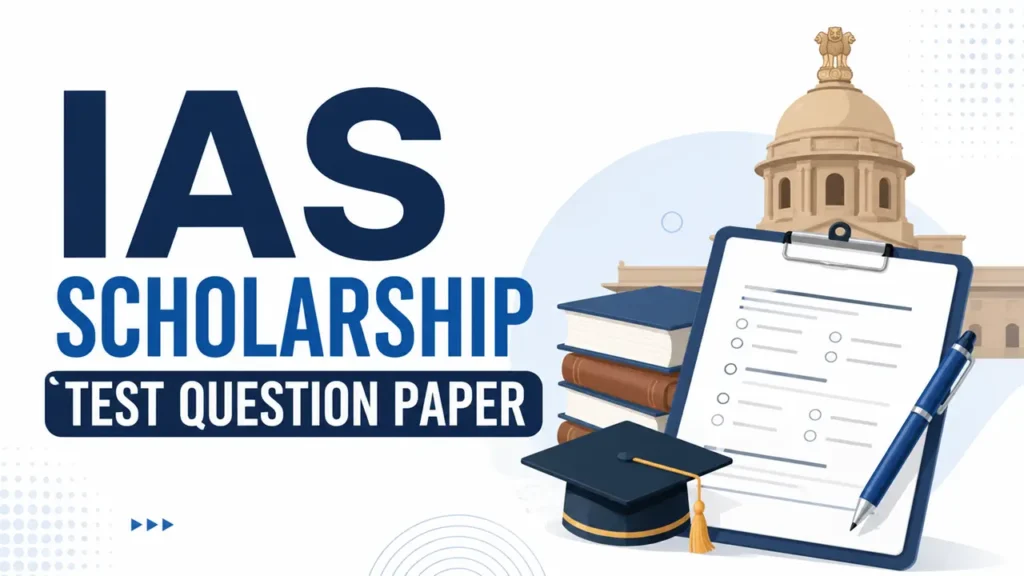
Preparing for competitive exams in India requires more than just reading textbooks. You need exposure to real exam-style questions, a clear understanding of the exam pattern, and proper practice under timed conditions. The ALS IAS scholarship test question paper is one such resource that helps aspirants understand what kind of questions are asked, how much depth of knowledge is required, and how to approach each topic smartly.
ALS IAS Institute is one of the well-known coaching centres in India for civil services exam preparation. Every year, they conduct a scholarship test to support deserving students with fee concessions and admission to their coaching programmes. This test not only helps students save money but also gives them a real taste of UPSC-style questions before their main preparation even begins.
In this blog, we have put together a detailed guide based on the ALS IAS scholarship test question paper. You will find subject-wise questions with answers, tips to prepare well, and a breakdown of important topics. Whether you are a beginner or have already started your UPSC preparation, this guide will help you understand what to expect and how to perform better.
What is the ALS IAS Scholarship Test?
ALS IAS conducts a scholarship test for students who wish to join their classroom or online coaching programmes. The test is designed to assess the general knowledge, analytical ability, and subject understanding of the applicants. Students who perform well in this test are given scholarships that can range from partial to full fee waivers.
The test is open to graduates and final-year students who are planning to appear for the UPSC Civil Services Examination. The difficulty level of the test is generally in line with the UPSC Prelims paper, which makes it a very useful practice opportunity for all serious aspirants.
Key Details of the Scholarship Test
- Mode: Online or offline (varies by centre)
- Duration: Generally 2 hours
- Total Questions: 100 to 150 MCQs
- Subjects Covered: General Studies, Current Affairs, Aptitude, and Essay/Comprehension
- Negative Marking: Usually 1/3rd for wrong answers
- Scholarship Range: 10% to 100% fee waiver based on performance
Exam Pattern and Syllabus Overview
Before we get into the questions, it is important to understand the pattern. The ALS IAS scholarship test question paper generally follows the same broad structure as the UPSC Prelims. Here is a typical breakdown:
Paper Structure
- History of India and Indian National Movement – 15 to 20 questions
- Geography – India and World – 10 to 15 questions
- Indian Polity and Governance – 15 to 20 questions
- Economy – 10 to 15 questions
- Environment and Ecology – 8 to 10 questions
- Science and Technology – 8 to 10 questions
- Current Affairs – 15 to 20 questions
- Reasoning and Mental Ability – 10 questions
History: Sample Questions with Answers
History is one of the most important sections in any UPSC-based exam. Questions from ancient, medieval, and modern Indian history are regularly asked. Let us look at some practice questions based on the format of the ALS IAS scholarship test question paper.
Q1. Which of the following was the first dynasty to rule the Magadha empire?
(A) Nanda dynasty
(B) Haryanka dynasty
(C) Shishunaga dynasty
(D) Maurya dynasty
Answer: (B) Haryanka dynasty
Explanation: The Haryanka dynasty was the first ruling dynasty of Magadha. Bimbisara is considered the founder of this dynasty. Later, the Shishunaga dynasty replaced them, followed by the Nandas and then the Mauryas.
Q2. The Battle of Plassey in 1757 was fought between the British and which Nawab of Bengal?
(A) Alivardi Khan
(B) Mir Qasim
(C) Siraj-ud-Daulah
(D) Mir Jafar
Answer: (C) Siraj-ud-Daulah
Explanation: The Battle of Plassey was fought between the British East India Company and Siraj-ud-Daulah, the Nawab of Bengal. The British won this battle due to the betrayal of Mir Jafar. This battle laid the foundation of British political power in India.
Q3. Who was the founder of the Brahmo Samaj in 1828?
(A) Swami Vivekananda
(B) Dayanand Saraswati
(C) Ram Mohan Roy
(D) Ishwar Chandra Vidyasagar
Answer: (C) Ram Mohan Roy
Explanation: Ram Mohan Roy founded the Brahmo Samaj in Calcutta in 1828. It was a socio-religious reform movement that opposed idol worship, the caste system, and child marriage. It played a major role in shaping modern Indian society.
Q4. The Rowlatt Act of 1919 was passed by the British to:
(A) Give voting rights to Indians
(B) Allow detention without trial
(C) Establish provincial legislatures
(D) Promote Indian education
Answer: (B) Allow detention without trial
Explanation: The Rowlatt Act allowed the British government to imprison any person suspected of revolutionary activities without trial. It was strongly opposed by Indian nationalists including Mahatma Gandhi, who launched the Non-Cooperation Movement as a response.
Q5. The Indian National Congress was established in which year?
(A) 1880
(B) 1885
(C) 1890
(D) 1905
Answer: (B) 1885
Explanation: The Indian National Congress was founded in 1885 by A.O. Hume, along with Dadabhai Naoroji and Dinshaw Wacha. Its first session was held in Bombay. It became the leading organisation in the Indian independence movement.
Q6. Which Mughal emperor issued the Farman of 1717 allowing the English East India Company to trade in India?
(A) Aurangzeb
(B) Bahadur Shah I
(C) Farrukhsiyar
(D) Muhammad Shah
Answer: (C) Farrukhsiyar
Explanation: Farrukhsiyar issued a royal farman in 1717 that gave the English East India Company extensive trading privileges in India, including the right to trade in Bengal without paying customs duties. This was a key step in consolidating British commercial power in India.
Geography: Sample Questions with Answers
Geography covers both physical and human geography. Questions on rivers, mountains, climate, agriculture, and world map are common in the ALS IAS scholarship test question paper. Here are some examples:
Q7. Which is the longest river in India?
(A) Godavari
(B) Ganga
(C) Brahmaputra
(D) Yamuna
Answer: (B) Ganga
Explanation: The Ganga is the longest river in India with a length of approximately 2,525 km. It originates from the Gangotri Glacier in Uttarakhand and flows into the Bay of Bengal. The Ganga is also considered the most sacred river in Hinduism.
Q8. Which layer of the atmosphere is closest to Earth’s surface?
(A) Stratosphere
(B) Mesosphere
(C) Troposphere
(D) Thermosphere
Answer: (C) Troposphere
Explanation: The Troposphere is the lowest layer of the atmosphere. It extends from the surface to about 12 km above the ground. All weather phenomena including clouds, rain, and storms occur in this layer. The temperature decreases as altitude increases in this layer.
Q9. The Deccan Plateau is bounded on the west by which mountain range?
(A) Eastern Ghats
(B) Aravalli Hills
(C) Western Ghats
(D) Satpura Range
Answer: (C) Western Ghats
Explanation: The Deccan Plateau is bounded on the west by the Western Ghats and on the east by the Eastern Ghats. The plateau covers most of the peninsular India and is one of the oldest land masses in the world.
Q10. The Tropic of Cancer does NOT pass through which of the following Indian states?
(A) Rajasthan
(B) Chhattisgarh
(C) Odisha
(D) Gujarat
Answer: (C) Odisha
Explanation: The Tropic of Cancer passes through 8 Indian states: Rajasthan, Gujarat, Madhya Pradesh, Chhattisgarh, Jharkhand, West Bengal, Tripura, and Mizoram. Odisha is not among them as it lies south of the Tropic of Cancer.
Q11. Which ocean current keeps the climate of Western Europe warm?
(A) California Current
(B) Canaries Current
(C) Gulf Stream
(D) Labrador Current
Answer: (C) Gulf Stream
Explanation: The Gulf Stream is a warm Atlantic Ocean current that originates in the Gulf of Mexico and moves northward. It keeps the climate of Western Europe much warmer than it would otherwise be at those latitudes.
Indian Polity and Governance: Sample Questions
Polity is a high-scoring area and questions are often direct. Understanding the constitution and government functioning is key.
Q12. Which article of the Indian Constitution abolishes untouchability?
(A) Article 14
(B) Article 15
(C) Article 17
(D) Article 19
Answer: (C) Article 17
Explanation: Article 17 of the Indian Constitution abolishes untouchability and forbids its practice in any form. The practice of untouchability is made a punishable offence under this article. It falls under the category of Fundamental Rights.
Q13. The Rajya Sabha was established in which year?
(A) 1947
(B) 1950
(C) 1952
(D) 1954
Answer: (C) 1952
Explanation: The Rajya Sabha, also known as the Council of States, was first constituted on April 3, 1952. It is the upper house of the Indian Parliament. Unlike the Lok Sabha, the Rajya Sabha is a permanent body and is not subject to dissolution.
Q14. Which schedule of the Indian Constitution deals with the distribution of powers between the Union and States?
(A) Fifth Schedule
(B) Sixth Schedule
(C) Seventh Schedule
(D) Eighth Schedule
Answer: (C) Seventh Schedule
Explanation: The Seventh Schedule of the Indian Constitution contains three lists: Union List, State List, and Concurrent List. These lists define the powers of the central government and state governments respectively.
Q15. Who appoints the Chairman of the Union Public Service Commission (UPSC)?
(A) Prime Minister
(B) Speaker of Lok Sabha
(C) President of India
(D) Chief Justice of India
Answer: (C) President of India
Explanation: The Chairman and members of the Union Public Service Commission are appointed by the President of India. The UPSC is a constitutional body and its independence is protected by provisions in the Constitution.
Q16. Which of the following is NOT a Fundamental Duty under Article 51A of the Indian Constitution?
(A) To protect the national flag
(B) To vote in elections
(C) To protect the environment
(D) To develop scientific temper
Answer: (B) To vote in elections
Explanation: Voting in elections is not a Fundamental Duty under Article 51A. Fundamental Duties include protecting the flag, defending the country, protecting the environment, developing scientific temper, and promoting harmony, among others. Voting is a right and a civic responsibility, but not listed as a Fundamental Duty.
Indian Economy: Sample Questions
Economy questions test your understanding of basic concepts in economics, financial institutions, and government schemes.
Q17. Which institution publishes the Human Development Index (HDI) every year?
(A) World Bank
(B) IMF
(C) UNDP
(D) UNESCO
Answer: (C) UNDP
Explanation: The Human Development Index is published by the United Nations Development Programme (UNDP) as part of its annual Human Development Report. The HDI measures a country’s development based on three dimensions: life expectancy, education, and per capita income.
Q18. What does SEBI stand for?
(A) Securities and Exchange Board of India
(B) State Economy Bureau of India
(C) Securities Evaluation Body of India
(D) Stock Exchange Board of India
Answer: (A) Securities and Exchange Board of India
Explanation: SEBI stands for the Securities and Exchange Board of India. It was established in 1988 and given statutory powers through the SEBI Act of 1992. SEBI regulates the securities market in India and protects investor interests.
Q19. Which Five-Year Plan focused on the concept of Inclusive Growth in India?
(A) 9th Five-Year Plan
(B) 10th Five-Year Plan
(C) 11th Five-Year Plan
(D) 12th Five-Year Plan
Answer: (C) 11th Five-Year Plan
Explanation: The 11th Five-Year Plan (2007-2012) had Inclusive Growth as its main theme. It aimed at bringing the benefits of economic growth to all sections of society, especially the poor, rural populations, and marginalised communities.
Q20. Which bank is known as the banker of all banks in India?
(A) State Bank of India
(B) Reserve Bank of India
(C) NABARD
(D) Punjab National Bank
Answer: (B) Reserve Bank of India
Explanation: The Reserve Bank of India (RBI) is the central bank of India and acts as the banker of all banks. It was established on April 1, 1935. RBI controls monetary policy, issues currency, manages foreign exchange reserves, and regulates commercial banks.
Environment and Ecology: Sample Questions
Q21. Which gas is primarily responsible for the greenhouse effect on Earth?
(A) Oxygen
(B) Nitrogen
(C) Carbon Dioxide
(D) Hydrogen
Answer: (C) Carbon Dioxide
Explanation: Carbon Dioxide (CO2) is one of the primary greenhouse gases responsible for warming the Earth’s atmosphere. Other significant greenhouse gases include methane, nitrous oxide, and water vapour. Human activities, especially burning fossil fuels, have significantly increased CO2 levels.
Q22. Which international agreement aims to phase out ozone-depleting substances?
(A) Kyoto Protocol
(B) Montreal Protocol
(C) Paris Agreement
(D) Basel Convention
Answer: (B) Montreal Protocol
Explanation: The Montreal Protocol, signed in 1987, aims to phase out the production and use of substances that deplete the ozone layer, such as chlorofluorocarbons (CFCs). It is considered one of the most successful environmental agreements in history.
Q23. Project Tiger was launched in India in which year?
(A) 1970
(B) 1972
(C) 1973
(D) 1975
Answer: (C) 1973
Explanation: Project Tiger was launched by the Government of India in 1973 under Prime Minister Indira Gandhi. It was started with the aim of protecting the Bengal Tiger from extinction. It began with 9 tiger reserves and has now expanded to over 50 reserves across India.
Q24. Which of the following biomes receives the least amount of rainfall annually?
(A) Tropical Rainforest
(B) Savanna
(C) Temperate Grassland
(D) Desert
Answer: (D) Desert
Explanation: Deserts receive the least rainfall among all biomes, generally less than 250 mm per year. They can be hot or cold and are characterised by sparse vegetation and extreme temperatures. Examples include the Sahara Desert and the Thar Desert.
Science and Technology: Sample Questions
Q25. Which is the first Indian satellite launched into space?
(A) Bhaskara
(B) Rohini
(C) Aryabhata
(D) INSAT-1A
Answer: (C) Aryabhata
Explanation: Aryabhata was India’s first satellite, launched on April 19, 1975, by the Soviet Union from Kapustin Yar. It was built by ISRO and named after the ancient Indian mathematician and astronomer Aryabhata. It was designed to conduct experiments in X-ray astronomy.
Q26. What is the full form of DNA?
(A) Deoxyribonucleic Acid
(B) Deoxyribose Nitrogen Acid
(C) Deoxyribonuclear Acid
(D) Dynamic Nucleic Acid
Answer: (A) Deoxyribonucleic Acid
Explanation: DNA stands for Deoxyribonucleic Acid. It is the hereditary material found in all living organisms. DNA carries genetic information and is responsible for the development, functioning, and reproduction of organisms. Its double helix structure was discovered by Watson and Crick in 1953.
Q27. Which planet in our solar system has the most moons?
(A) Jupiter
(B) Saturn
(C) Uranus
(D) Neptune
Answer: (B) Saturn
Explanation: As of recent astronomical discoveries, Saturn holds the record for the most moons in the solar system with over 140 confirmed moons, surpassing Jupiter. Titan is Saturn’s largest moon and is notable for being the only moon in the solar system with a dense atmosphere.
Reasoning and Aptitude: Sample Questions
Reasoning questions test your logical thinking and problem-solving ability. These are often straightforward but require careful reading.
Q28. If ROSE is coded as 6821 and CHAIR is coded as 73456, how isEARCH coded?
(A) 25678
(B) 21673
(C) 25673
(D) 21678
Answer: (C) 25673
Explanation: By matching the letters to the numbers given: E=2, A=5, R=6, C=7, H=3, I=4, O=8, S=1. SoEARCH = E(2), A(5), R(6), C(7), H(3) = 25673.
Q29. A man walks 5 km towards North, then turns right and walks 3 km, then turns right and walks 5 km. In which direction is he now from the starting point?
(A) North
(B) South
(C) East
(D) West
Answer: (C) East
Explanation: Starting point: Walk 5 km North, turn right (East) and walk 3 km, turn right again (South) and walk 5 km. The man is now at a point 3 km East of the starting point. So he is to the East of the starting point.
Q30. Find the odd one out: 2, 3, 5, 7, 9, 11
(A) 2
(B) 9
(C) 11
(D) 3
Answer: (B) 9
Explanation: All the other numbers – 2, 3, 5, 7, 11 – are prime numbers. 9 is not a prime number because it is divisible by 3. Hence 9 is the odd one out.
Current Affairs Section: What to Study
Current affairs form a significant part of any scholarship test. The questions usually cover events from the last 12 months. Here are the key areas you must focus on:
Top Areas for Current Affairs
- National politics: Cabinet changes, new bills and acts passed by Parliament
- International affairs: India’s bilateral relations, treaties, and summits
- Economy: Union Budget highlights, new schemes, GDP and inflation updates
- Awards and honours: National and international awards in science, literature, sports
- Sports: Major international events, Indian team performance, record-breakers
- Environment: Climate conferences, wildlife news, disaster events
- Science and tech: New ISRO missions, defence technology, AI developments
- Important appointments: Governor, CBI Director, SEBI Chairman, and similar posts
How to Prepare for the ALS IAS Scholarship Test
Now that you have seen the type of questions asked in the ALS IAS scholarship test question paper, let us talk about how to prepare for it in a smart and effective way.
Step 1: Understand the Syllabus Completely
Go through the ALS IAS website or contact their office to get the official syllabus. While it broadly matches the UPSC Prelims pattern, knowing the exact topics will help you focus better. Do not waste time on topics that are not in the syllabus.
Step 2: Build a Study Schedule
Divide your available time across all subjects. Give more time to subjects where you are weak. A typical weekly schedule might include two days each for History and Polity, one day each for Geography, Economy, and Science, and one day for current affairs and mock tests.
Step 3: Use the Right Books
- History: NCERT Class 6 to 12, Spectrum Modern India by Rajiv Ahir
- Geography: NCERT Class 11 and 12, Certificate Physical and Human Geography by G.C. Leong
- Polity: Indian Polity by M. Laxmikanth
- Economy: Indian Economy by Ramesh Singh or NCERT Class 11-12
- Environment: Shankar IAS Environment book
- Current Affairs: Monthly magazines like Vision IAS PT365, or The Hindu newspaper
Step 4: Practise with Mock Tests
The best way to prepare for a scholarship test is to take full-length mock tests under actual exam conditions. Set a timer, sit in a quiet place, and attempt the paper without any help. After each test, review your answers carefully and understand why you got questions wrong.
Step 5: Revise Regularly
Make short notes for each topic after you study it. Revise these notes every week. The more you revise, the better your retention will be. For current affairs, maintain a diary where you write one or two important news items every day in your own words.
Step 6: Focus on Accuracy, Not Speed
Since there is negative marking in the test, it is better to leave a question if you are not sure rather than guessing blindly. However, if you can eliminate two or three wrong options, it is usually a good idea to attempt the question. With practice, your accuracy will improve and your speed will naturally follow.
Common Mistakes to Avoid
Many students underperform in scholarship tests because of avoidable mistakes. Here are some things you should NOT do:
- Do not skip reading comprehension and essay sections even if they seem easy. These can be tricky.
- Do not attempt questions you are completely unsure about. Negative marking can reduce your score significantly.
- Do not ignore current affairs. They often carry 15 to 20 per cent of the total marks.
- Do not study from too many books. Stick to a few reliable sources and master them.
- Do not skip revision. Even if you have studied a topic thoroughly, revise it before the exam.
- Do not underestimate the reasoning section. A few weeks of practice can help you score full marks here.
Benefits of Winning the ALS IAS Scholarship
Scoring well in the ALS IAS scholarship test question paper does not just help you get a fee waiver. It opens up many opportunities for serious aspirants:
- Fee concession from 10% to 100% based on rank and performance
- Access to quality study material provided by ALS IAS
- Mentorship from experienced faculty members
- Regular mock tests and performance analysis
- Doubt-clearing sessions and individual guidance
- Opportunity to study alongside other serious UPSC aspirants
- Free or discounted access to online lectures and recorded sessions
Who Should Appear for the ALS IAS Scholarship Test?
This test is suitable for:
- Students who have just graduated and want to start UPSC preparation
- Working professionals who want to switch to civil services
- Students from economically weaker backgrounds who need financial support
- Students who want to test their current level of preparation
- Anyone who wants quality coaching at a reduced cost
Even if you do not get a scholarship, appearing for the test is a great way to benchmark your knowledge and identify your weak areas before you begin full-time preparation.
Final Words: Making the Most of This Opportunity
The ALS IAS scholarship test question paper is not just a gateway to financial support. It is a real test of how ready you are for the UPSC journey. Taking this test seriously means you are already treating your preparation with the dedication it deserves.
The questions we have covered in this blog represent the kind of depth and variety you can expect. From history to ecology, from economy to reasoning, every section demands a different kind of thinking. Make sure you study broadly and revise consistently.
Remember, cracking the UPSC exam is a long journey. The scholarship test is one small but important step on this path. Use it as a starting point, not an endpoint. Stay consistent, stay focused, and let your hard work speak for itself.

StudentsTalk.in, is an education-focused platform dedicated to helping students stay informed about the latest academic updates, scholarships, entrance exams, career opportunities, government schemes, and study resources. With a passion for education and student success, she creates informative, easy-to-understand content.