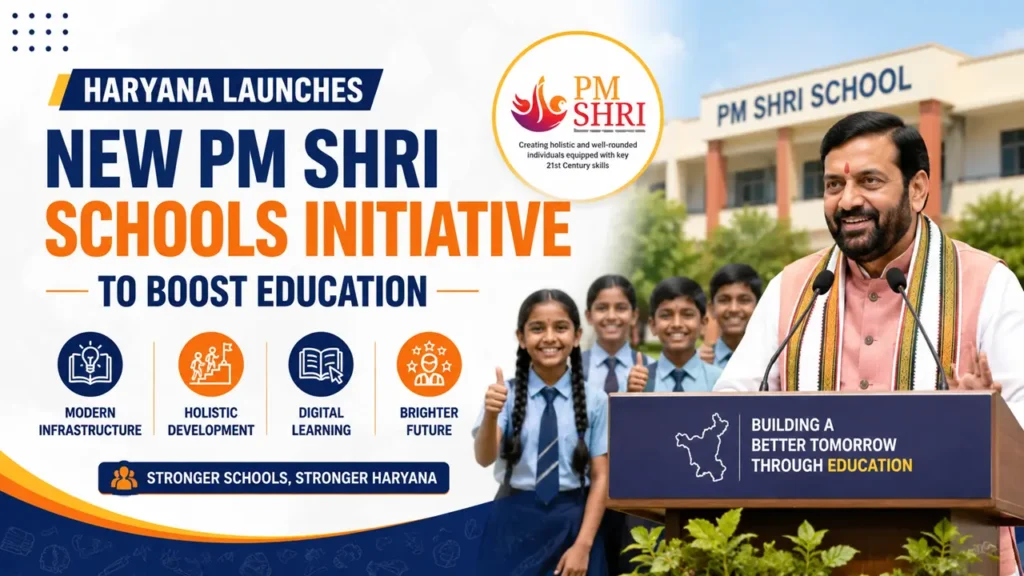
Haryana Launches New PM Shri Schools Initiative to Boost Education is one of the biggest education news stories in Haryana today, June 13, 2026. Students, parents, and teachers across the state are talking about this big update. The Haryana government has been working hard to bring the central government’s PM Shri Schools scheme to life, and now this initiative is moving into a new and exciting phase. If you are a student in Haryana, or a parent who wants to know how your child’s school is changing for the better, this blog will explain everything in very simple words. We will look at what the PM Shri Schools scheme is, how Haryana is using it, what new things are coming to schools, and how it can help students like you build a brighter future.
Education is changing fast all over India, and Haryana wants to be one of the leading states in this change. That is why this news is so important for everyone connected to schools in the state. Let us go step by step and understand this story in an easy way.
It is also worth remembering that change in schools usually happens in phases rather than overnight. A school may first get a new digital classroom, then a few months later receive upgraded lab equipment, and later still see improvements in its library or sports ground. Students should not feel discouraged if every change does not appear at once. The important thing is that a clear plan is in place, funds have been allocated, and the direction of change is towards better facilities and better teaching, which is good news for everyone studying in these schools today and in the coming years.
What Is the PM Shri Schools Scheme?
PM Shri stands for “Pradhan Mantri Schools for Rising India”. It is a scheme started by the central government in September 2022. The main goal of this scheme is simple: take some schools across the country and turn them into model schools. These model schools are supposed to show what a good, modern school should look like under the National Education Policy 2020, also called NEP 2020.
A PM Shri school is not a brand-new school built from scratch. Instead, the government picks existing government schools and upgrades them. These schools get better buildings, smart classrooms, science and computer labs, libraries, sports facilities, and clean drinking water and toilets. The teachers in these schools also get special training so they can teach in new and better ways. The whole idea is that these PM Shri schools become “mentor schools” for other schools nearby, sharing good practices and helping every child get quality education.
This scheme also focuses on a few important things: foundational literacy and numeracy (which means making sure young children can read, write, and do basic math well), 21st century skills like critical thinking and digital skills, and the overall growth of every student, not just marks in exams. With this background in mind, it becomes much easier to understand why the news about Haryana Launches New PM Shri Schools Initiative to Boost Education is creating so much excitement in the state.
Haryana’s Big Step: 250 Schools Selected
One of the most important updates this year is that Haryana has now selected all 250 schools that will be part of the PM Shri scheme in the state. This means that 250 government schools across different districts of Haryana are getting a major upgrade. These schools will slowly turn into green campuses with eco-friendly buildings, solar lights, rainwater harvesting, and proper waste management systems.
Along with green campuses, these 250 schools are also being equipped with digital classrooms. A digital classroom usually has a smart board or projector, internet access, and computers or tablets for students. This helps teachers explain difficult topics with videos, pictures, and animations, which makes learning much more interesting compared to only reading from textbooks.
Senior officers in the Haryana government have said that they are happy with how fast this work is moving. According to officials, Haryana is among the top performing states in implementing NEP 2020, and the selection of all 250 PM Shri schools is a clear proof of this progress. For students studying in these schools, this is great news because it means better facilities, better teaching methods, and a learning environment that feels closer to a private school, but completely free.
What Will Change Inside the Classroom?
Many students wonder what this scheme actually means for their daily school life. The answer is that quite a lot can change, step by step, over the coming months and years. First, classrooms in PM Shri schools are being upgraded with smart boards, projectors, and better seating arrangements. This makes lessons more interactive, since teachers can show videos, diagrams, and interesting examples instead of only writing on a blackboard.
Second, science and computer labs are being improved so that students can do more practical work. Instead of just reading about an experiment in a textbook, students will get more chances to actually try things out, which helps them understand concepts much better. Libraries are also getting new books, including story books, reference books, and material for competitive exams, so students who cannot afford expensive books at home can still read good material in school.
Third, sports facilities are being added or improved in many of these schools. This is important because NEP 2020 says that sports and physical activity are just as important as classroom subjects for the overall development of a child. Along with all this, schools are also focusing on cleanliness, with better toilets and drinking water systems, which directly affects the health and attendance of students, especially girls.
New CM Shri Schools: Haryana’s Own Version
While the central PM Shri scheme covers 250 schools, the Haryana government has decided to go one step further. The state’s Education Minister has announced that Haryana will soon start its own “CM Shri Schools”, inspired directly by the PM Shri Schools model. This announcement was made during a session of the Haryana Vidhan Sabha, in answer to a question raised by a member of the assembly.
The big difference is that these new CM Shri Schools will follow the CBSE pattern, which is the same education board followed by many top private schools in India. This is a major step because it means government school students in Haryana will get access to a curriculum and exam pattern that is recognised and respected across the country. For students who may want to move to other states for higher studies or jobs in the future, studying under a CBSE-pattern school can be a big advantage.
This is exactly why people are talking so much about Haryana Launches New PM Shri Schools Initiative to Boost Education, because it shows that Haryana is not just copying the central scheme, but also building its own model on top of it. With both PM Shri schools and the upcoming CM Shri schools, the number of “model schools” in the state is set to grow even more in the coming years, giving more students access to high quality education close to their homes.
Better Trained Teachers for Better Learning
A school is only as good as its teachers, and the Haryana government clearly understands this. As part of the PM Shri scheme, new rules have been introduced for how teachers are selected and placed in these schools. Earlier, teachers could get a posting in any school mainly based on seniority, which is how long they had been working. Now, for PM Shri schools, there is a new screening process.
This screening test checks a teacher’s understanding of NEP 2020 ideas, such as foundational literacy and numeracy, their comfort with digital tools like online portals and smart classroom equipment, and their depth of knowledge in the subject they teach. Teachers who clear this screening are called “screened teachers” and are considered specially trained for PM Shri schools.
There are also new rules about how long a teacher must stay in a PM Shri school once they are posted there, which helps in keeping some stability so that students do not face too many changes in their teachers within a short time. The goal behind all this is simple: if these schools are supposed to be “exemplar” or model schools, then they also need teachers who are well prepared and motivated to teach in new ways. For students, this means a better chance of getting teachers who are updated with the latest teaching methods and technology.
Support for Economically Weaker Students
Along with upgrading government schools, the Haryana government is also working to make sure that students from poorer families get a chance to study in good private schools. Under the Right to Education Act, also known as RTE, 25 percent of seats in the entry-level classes of private schools are reserved for children belonging to Economically Weaker Sections and Disadvantaged Groups.
According to information shared by the Education Minister, during the last academic session, more than fourteen thousand applications were received under this RTE provision, and over eleven thousand students were successfully given seats in private schools. To be eligible under this rule, a family’s yearly income must be less than one lakh eighty thousand rupees.
This shows that the state’s education plans are not only about big, modern buildings, but also about fairness and equal opportunity. When PM Shri schools, CM Shri schools, and the RTE quota in private schools all work together, the overall effect is that more students, no matter their family’s income, get a real chance at quality education. This is one more reason why news about Haryana Launches New PM Shri Schools Initiative to Boost Education matters to so many families across the state.
Awards and Recognition for Top Schools
To encourage healthy competition and motivate schools to perform even better, the Haryana government has also announced a plan to recognise top performing schools. The top three best performing PM Shri schools in the state, along with three Model Sanskriti Schools, will be honoured on August 15, which is India’s Independence Day.
These awards will look at different areas such as innovative teaching practices, which means how creatively teachers are using new methods to make lessons easier to understand, infrastructure development, which means how well a school has used its funds to build labs, libraries, and other facilities, and academic excellence, which means how students from that school are performing in exams and other learning activities.
For students and teachers, this kind of recognition can be a big motivation. When a school knows that its hard work might be celebrated on a national occasion like Independence Day, it pushes everyone, from the principal to the smallest student, to give their best. Over time, this friendly competition between schools can help raise the overall standard of education across many districts in Haryana.
Why This News Matters for Students
If you are a student reading this, you might be asking: how does all this affect me directly? The truth is, these changes are designed with students at the centre. First, if your school is one of the 250 PM Shri schools, you can expect new facilities to slowly arrive, such as smart classrooms, better labs, and improved libraries.
Second, even if your school is not a PM Shri school right now, the idea is that these schools will act as mentor schools for nearby schools. This means good practices, teaching methods, and sometimes even resources can slowly spread to other schools in the area. So, the benefits are not limited only to the selected 250 schools.
Third, with the upcoming CM Shri schools following the CBSE pattern, students who are currently studying under the Haryana Board may, in the future, get a chance to study in schools that follow CBSE rules and exam patterns. This can be useful for students who want to prepare for competitive exams that are often based on the CBSE syllabus, such as many entrance exams for engineering, medical, and other professional courses.
Finally, better trained teachers, improved sports facilities, and a stronger focus on overall development mean that school will not just be about textbooks and exams. Students can also get more chances to explore sports, arts, digital skills, and other activities that help build confidence and life skills.
How Parents Can Stay Informed
Parents often want to know how they can keep track of these changes and understand if their child’s school is part of this plan. The best way is to talk directly to the school principal or teachers, since schools usually get official information from the Education Department about whether they are part of the PM Shri list or any new scheme.
Parents can also check official websites of the Haryana Education Department from time to time, as important notices, lists of selected schools, and updates about new programmes are usually published there. Local newspapers and news channels in Haryana have also been covering this topic regularly, since it is seen as a major step for the state’s education system.
Being aware of these changes can help parents support their children better. For example, if a school is getting new computer labs or digital classrooms, parents can encourage their children to make full use of these facilities, ask questions, and explore new subjects like coding or digital tools, which can be very useful for their future careers.
Linking This to the National Education Policy 2020
To fully understand why Haryana is putting so much effort into this, it helps to remember the bigger picture: the National Education Policy 2020. NEP 2020 is a major policy document that aims to completely reshape how India approaches education, from preschool to higher education.
Some of the key ideas in NEP 2020 include focusing on foundational literacy and numeracy for young children, making sure that every child can read, write, and do basic maths by a certain age, reducing the heavy focus on rote learning, which means simply memorising facts without truly understanding them, and instead encouraging critical thinking, creativity, and practical skills.
PM Shri schools are designed to be living examples of these ideas in action. When Haryana says it is among the top performing states in implementing NEP 2020, it means that the state is trying its best to turn these big ideas from paper into real classrooms, real teachers, and real benefits for real students. This is the deeper reason behind Haryana Launches New PM Shri Schools Initiative to Boost Education, because it connects local school improvements with a much larger national vision for education.
Challenges That Still Need Attention
While the news sounds very positive, it is also important to be realistic. Big plans like this usually face some challenges along the way. One challenge is making sure that new infrastructure, like smart classrooms and labs, is not just built but also properly maintained over the years. Equipment can break down, and if there is no proper system for repairs, the benefits can slowly fade.
Another challenge is training enough teachers in a short time. Since the new screening process for PM Shri schools is still being rolled out, it may take time before every school has a full team of “screened” teachers who are completely comfortable with digital tools and new teaching methods.
There is also the challenge of making sure that schools in remote or rural areas get the same quality of facilities as those in cities. Sometimes, big announcements reach urban areas faster than villages. For the scheme to truly succeed, it is important that the benefits of PM Shri and the upcoming CM Shri schools reach every district of Haryana, including small towns and villages, in a fair and balanced way.
Funding and timely release of money is another factor that can affect how fast these changes happen. Building new labs, buying smart boards, and training teachers all require money, and sometimes there can be delays between when a plan is announced and when it is fully carried out on the ground. Keeping track of progress, through regular reviews by the Education Department and reports shared with the public, can help make sure that the scheme stays on track and that any delays are noticed and fixed early.
What the Future May Look Like
Looking ahead, it seems clear that Haryana plans to keep building on this momentum. With all 250 PM Shri schools selected and being upgraded, the focus will likely shift towards making sure these schools actually start functioning as model institutions, with smart classrooms running smoothly, labs being used regularly, and trained teachers settling into their new roles.
At the same time, the announcement of CM Shri schools on the CBSE pattern suggests that more government schools may be added to this list of “model schools” in the coming years. If this expands successfully, it could mean that a much larger number of students across Haryana, not just in the original 250 schools, get access to CBSE-pattern education along with modern facilities.
The yearly recognition of top schools, starting around Independence Day, is also likely to continue, which could create a positive cycle where schools keep improving year after year to be among the best. For students currently in school, this means that the environment around them is likely to keep getting better during their school years, rather than staying the same.
The Growing Role of Digital Education
One of the most exciting parts of this whole change is how digital tools are becoming a normal part of school life. In the past, computers were often kept in a separate room and used only once or twice a week, if at all. With the upgrades happening under the PM Shri scheme, more classrooms are getting smart boards, projectors, and internet connections, which means digital learning can become part of everyday teaching, not just a special activity.
Digital tools can help in many ways. For subjects like Science, teachers can show short videos of experiments that may be too difficult, costly, or dangerous to perform in a normal classroom. For subjects like History and Geography, maps, timelines, and images can make lessons feel more real and easier to remember. For Mathematics, animations can help students see how shapes, graphs, and formulas actually work, instead of just memorising steps.
Teachers are also being trained to use online portals for attendance, records, and even for getting new teaching material. This might sound like something only adults need to worry about, but it actually benefits students too, because teachers who are comfortable with technology can plan lessons better, track which students need extra help, and share useful study material more easily. Over time, students themselves may also get more chances to use computers and tablets for projects, practice tests, and learning new skills like basic coding or typing, which can be very useful later in life.
How Haryana Compares with Other States
The PM Shri Schools scheme is not only for Haryana. It is a central government scheme, which means many states across India are selecting their own group of schools to be upgraded under this plan. For example, other states like Gujarat have also been adding new PM Shri schools in their districts, with similar goals of smart classrooms, modern labs, and digital libraries.
What makes the news of Haryana Launches New PM Shri Schools Initiative to Boost Education stand out is the speed and the extra steps Haryana is taking. Completing the selection of all 250 schools shows that the state has moved quickly compared to many others. On top of that, the decision to start CM Shri schools on the CBSE pattern is something that goes beyond what the central scheme alone asks for. This shows that Haryana is not simply doing the minimum required, but is trying to build an even stronger system on top of the central framework.
For students and parents, this kind of healthy competition between states can actually be a good thing. When one state takes a strong step forward, it often encourages other states to also improve their own systems, so that students do not feel left behind. In the long run, this can help raise the overall standard of school education across the whole country, with Haryana hoping to be seen as one of the leaders in this race.
Simple Tips for Students to Make the Most of These Changes
New facilities and better teaching methods are wonderful, but students themselves play the biggest role in turning these opportunities into real success. Here are some simple ways students can make the most of the changes coming through PM Shri schools and the wider plans connected to Haryana Launches New PM Shri Schools Initiative to Boost Education.
First, be curious and ask questions. If a teacher uses a smart board to show a video or a diagram, do not just watch quietly. Ask questions if something is not clear. New tools work best when students actively use them to understand topics better, not just to pass time.
Second, use the library more often. With new books arriving in many schools, students should try to read beyond their textbooks. Story books, general knowledge books, and material related to competitive exams can all help build a stronger base for future studies, whether that means board exams, entrance exams, or simply becoming a more confident reader.
Third, take part in sports and other activities. Many schools are improving their sports facilities, and NEP 2020 itself says that activities outside the classroom are important for growth. Taking part in sports, cultural programmes, or science exhibitions can help build confidence, teamwork, and skills that are useful far beyond school.
Finally, stay regular and stay informed. Attending school regularly helps students benefit fully from new labs, digital classrooms, and trained teachers. Staying informed about updates like Haryana Launches New PM Shri Schools Initiative to Boost Education can help students and parents understand what new opportunities might be coming their way, so they are ready to make the most of them.
Frequently Asked Questions
What is the PM Shri Schools scheme in simple words?
It is a central government plan that picks some existing government schools and upgrades them with better buildings, smart classrooms, labs, libraries, and trained teachers, so that they become model schools following the ideas of NEP 2020.
How many schools in Haryana are part of this scheme?
According to recent updates, Haryana has selected all 250 schools under the PM Shri scheme, and these schools are being developed as green campuses with digital classrooms and modern facilities.
What are CM Shri Schools?
CM Shri Schools are a new idea announced by the Haryana government, inspired by PM Shri Schools. These schools will follow the CBSE pattern, which is the same pattern followed by many private schools across India.
How does the RTE quota help students?
Under the Right to Education Act, 25 percent of entry-level seats in private schools are kept for children from Economically Weaker Sections and Disadvantaged Groups, giving them a chance to study in good private schools at low or no cost, as long as their family income meets the set limit.
Will every government school in Haryana become a PM Shri school?
Not immediately. Right now, 250 schools are part of the PM Shri list, and these are meant to act as mentor schools for others nearby. However, with the addition of CM Shri schools and continued investment in education, more schools may get similar upgrades over time.
Connection with Higher Education and Career Preparation
School education is the foundation for everything that comes after, including college, university, and careers. When schools improve, the effect is often seen years later, when students step out into the world of higher education and jobs. This is another important angle to understand when looking at the changes happening through PM Shri schools and the upcoming CM Shri schools.
Many entrance exams for engineering, medical, law, and other professional courses are based on the CBSE syllabus or similar national level patterns. If CM Shri schools in Haryana follow the CBSE pattern, students from these schools may find it easier to prepare for such exams, because their regular classroom learning will already be closer to what these exams expect. This can reduce the gap between what is taught in school and what is needed for competitive exams, which is a problem many students currently face.
In addition, with better labs, libraries, and digital classrooms, students get more exposure to practical learning and self-study resources from an early age. This can help build habits like reading regularly, doing experiments, and using digital tools for research, all of which are very useful once a student reaches college. Career guidance is also becoming a bigger part of school programmes, with more schools trying to inform students about different career paths, scholarships, and skill-based courses, not just traditional options like becoming a doctor or engineer.
For students in classes 9 to 12 especially, these changes can be very meaningful. A well-equipped lab can make subjects like Physics, Chemistry, and Biology much easier to understand through real experiments. A well-stocked library can support students preparing for board exams as well as competitive exams. And exposure to digital tools can help students become more comfortable with online learning platforms, which are now a normal part of higher education and even many jobs.
Role of Parents, Teachers, and the Local Community
No government scheme, however well planned, can succeed completely on its own. The support of parents, teachers, and the local community plays a very important role in making sure that new facilities and programmes actually benefit students in the way they are meant to.
Parents can help by staying in touch with the school, attending parent-teacher meetings, and showing interest in what their children are learning. Even simple questions like “What new things did you learn today?” or “Did you get to use the computer lab this week?” can encourage children to engage more with new facilities and share their experiences at home.
Teachers, on their part, have the responsibility of using new tools and training in ways that truly help students, rather than just for show. A smart classroom is only useful if it is used regularly and thoughtfully. Teachers who attend training sessions related to NEP 2020 and digital tools can pass on these benefits directly to their students through more engaging lessons.
The local community, including school management committees, alumni, and even local businesses, can also play a part by supporting schools in small but meaningful ways, such as helping maintain facilities, donating books, or organising extra learning sessions during holidays. When families, teachers, and the community work together with the support of government schemes, the overall impact on students tends to be much stronger and longer lasting.
It also helps to remember that good education is built over many years, not just one announcement or one news update. The steps being taken now, from selecting 250 PM Shri schools to planning CM Shri schools on the CBSE pattern, from training teachers in new ways to reserving seats for economically weaker students, all add up over time. A student who joins school today may see the full benefit of these changes by the time they reach their senior classes, with smart classrooms, well-stocked libraries, working labs, and trained teachers becoming a normal part of their everyday school life rather than something new and unusual.
Final Thoughts
To sum up, Haryana Launches New PM Shri Schools Initiative to Boost Education is more than just a single news headline. It represents a bigger journey that Haryana is on, where the state is trying to combine the central government’s PM Shri Schools scheme with its own ideas, like the upcoming CM Shri schools on the CBSE pattern, better trained teachers, RTE seats for poorer students, and yearly awards for top performing schools.
For students, this means classrooms that are slowly becoming more digital, more interactive, and more focused on overall growth, not just exam marks. For parents, it means more reasons to feel hopeful about the quality of education available in government schools close to home. And for the state as a whole, it is a step towards becoming one of the leading education hubs in the country.
As these changes continue to roll out across schools, it is a good idea for students and parents to stay updated, ask questions at their own schools, and make full use of any new facility or opportunity that comes their way. Big changes in education usually take time to show their full effect, but with steps like these, the future of school education in Haryana does look brighter than before.

StudentsTalk.in, is an education-focused platform dedicated to helping students stay informed about the latest academic updates, scholarships, entrance exams, career opportunities, government schemes, and study resources. With a passion for education and student success, she creates informative, easy-to-understand content.