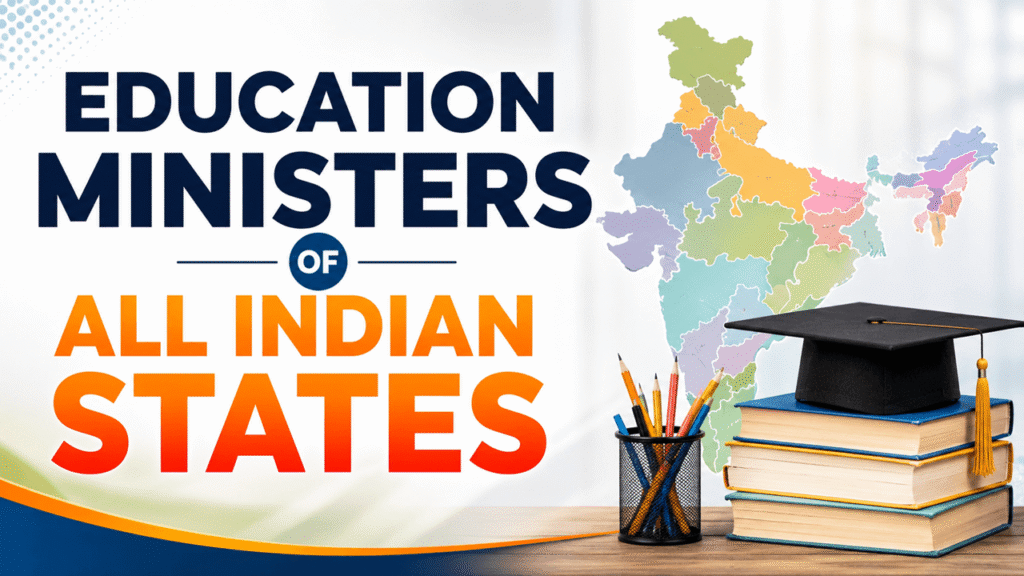
India is a land of over 1.4 billion people. More than 260 million students go to schools and colleges every day. That is one of the biggest student populations in the whole world. To manage this huge system, every state and union territory in India has its own Education Minister. These ministers work hard every day to make sure that children get good quality education, teachers are well trained, and schools have everything they need.
In May 2026, the political map of India has seen some big changes. The Bharatiya Janata Party (BJP) now leads or is part of the ruling alliance in more states than ever before. A historic election in West Bengal brought the BJP to power for the first time in May 2026. Bihar also saw a change, with the NDA strengthening its hold. Meanwhile, states like Kerala, Tamil Nadu, Karnataka, and Telangana are still governed by non-NDA parties.
In this blog, we will look at the Education Minister of every Indian state and union territory as of May 2026. We will tell you their name, which party they belong to, and what major work they are doing for education. This blog is useful for students, parents, teachers, and anyone preparing for competitive exams.
The Union Education Minister of India 2026
Before we look at state-level ministers, let us first understand who leads education at the national level.
Shri Dharmendra Pradhan — Union Minister of Education
Dharmendra Pradhan is the Education Minister of India as of May 2026. He belongs to the Bharatiya Janata Party (BJP) and has been holding this post since July 7, 2021. He is a member of the Rajya Sabha from Madhya Pradesh. Before becoming Education Minister, he served as the Union Minister for Petroleum and Natural Gas, and Skill Development.
Under his leadership, the National Education Policy (NEP) 2020 is being implemented across India. This is a very big step because NEP 2020 is the first major change in India’s education system after 1986. His two Ministers of State are:
- Sukanta Majumdar — Minister of State for Education
- Shri Jayant Chaudhary — Minister of State for Education
Key goals of the central ministry in 2026 include teaching children in their mother tongue up to Grade 5, promoting digital learning, building more schools and colleges in rural areas, and helping poor students with scholarships.
Complete List: Education Ministers of All Indian States (May 2026)
The table below gives you a full list of Education Ministers of all 28 states and 8 union territories in India as of May 2026. Some states have two education ministers — one for school education and one for higher education. Union territories that are directly managed by the Central Government do not have separate state education ministers.
| S.No | State / UT | Education Minister | Party | Ruling Alliance / Coalition |
| 1 | Uttar Pradesh | Yogendra Upadhyay (Higher Edu) & Sandeep Singh (Basic Edu) | BJP | NDA |
| 2 | Uttarakhand | Dhan Singh Rawat | BJP | NDA |
| 3 | Himachal Pradesh | Rohit Thakur | INC | INC Government |
| 4 | Haryana | Mahipal Dhanda | BJP | NDA |
| 5 | Punjab | Harjot Singh Bains | AAP | AAP Government |
| 6 | Rajasthan | Madan Dilawar | BJP | NDA |
| 7 | Delhi (NCT) | Raaj Kumar Anand | AAP | AAP Government |
| 8 | West Bengal | Suvendu Adhikari (CM) | BJP | NDA (New BJP Govt, May 2026) |
| 9 | Bihar | Sunil Kumar | BJP | NDA Coalition |
| 10 | Jharkhand | Irshadul Haque | JMM | JMM-INC Alliance |
| 11 | Odisha | Nityananda Gond | BJP | NDA |
| 12 | Assam | Ranoj Pegu | BJP | NDA |
| 13 | Arunachal Pradesh | Taba Tedir | BJP | NDA |
| 14 | Manipur | T. Basanta Kumar Singh | BJP | NDA |
| 15 | Meghalaya | Rakkam A. Sangma | NPP | NPP-led coalition |
| 16 | Mizoram | Lalchhandama Ralte | ZPM | ZPM Government |
| 17 | Nagaland | Temjen Imna Along | NDPP | NDPP-BJP Alliance |
| 18 | Sikkim | Kunga Nima Lepcha | SKM | SKM Government |
| 19 | Tripura | Ratan Lal Nath | BJP | NDA |
| 20 | Andhra Pradesh | Nara Lokesh | TDP | NDA (TDP-BJP-JSP) |
| 21 | Telangana | Sabitha Indra Reddy | INC | INC Government |
| 22 | Karnataka | Madhu Bangarappa | INC | INC Government |
| 23 | Kerala | V. Sivankutty | CPI(M) | LDF Government |
| 24 | Tamil Nadu | Anbil Mahesh Poyyamozhi | DMK | DMK-INC Alliance |
| 25 | Gujarat | Kuberbhai Dindor | BJP | NDA |
| 26 | Maharashtra | Deepak Kesarkar | Shiv Sena (Shinde) | Maha Yuti (BJP-SS-NCP) |
| 27 | Goa | Atanasio Monserrate | BJP | NDA |
| 28 | Chhattisgarh | Brijmohan Agrawal | BJP | NDA |
| 29 | Madhya Pradesh | Inder Singh Parmar | BJP | NDA |
| 30 | Puducherry | A. Namassivayam | BJP | NDA Coalition |
| 31 | Jammu & Kashmir | Sakina Masood Itoo | INC | NC-INC Coalition |
| 32 | Ladakh | Central Govt (LG) | — | Centrally Administered |
| 33 | Andaman & Nicobar | Central Govt (LG) | — | Centrally Administered |
| 34 | Chandigarh | Central Govt (Admin) | — | Centrally Administered |
| 35 | Lakshadweep | Central Govt (Admin) | — | Centrally Administered |
| 36 | Dadra & Nagar Haveli | Central Govt (Admin) | — | Centrally Administered |
| 37 | Daman & Diu | Central Govt (Admin) | — | Centrally Administered |
* Data as of May 2026. Some portfolios may be subject to change with cabinet reshuffles.
State-by-State Overview: What Are Education Ministers Doing?
Let us now look at each region of India and understand what the education ministers are focused on in 2026.
1. North India
Uttar Pradesh (UP) is India’s most populated state with over 240 million people. It has two education ministers — Yogendra Upadhyay for Higher Education and Sandeep Singh (Minister of State with Independent Charge) for Basic Education. Both belong to the BJP and serve under Chief Minister Yogi Adityanath. Major focus areas include reducing school dropouts, improving government school infrastructure, and implementing NEP 2020. UP has also been working on teaching in Hindi and other local languages at the primary level.
Himachal Pradesh
Rohit Thakur of the Indian National Congress (INC) is the Education Minister of Himachal Pradesh. He serves in the Sukhvinder Singh Sukhu-led Congress government. Himachal Pradesh is known for its good literacy rate and quality government schools. Thakur is focused on improving higher education institutions and providing better facilities in remote mountain schools where access is difficult.
Punjab
Harjot Singh Bains of the Aam Aadmi Party (AAP) holds the education portfolio in Punjab under Chief Minister Bhagwant Mann. Punjab made national headlines for its ‘Schools of Eminence’ project and the opening of new model schools. Bains is known for his energetic approach and has been working to improve government school infrastructure, introduce smart classrooms, and reduce the dependence on private coaching.
Rajasthan
Madan Dilawar of the BJP is the Education Minister of Rajasthan under Chief Minister Bhajan Lal Sharma. The BJP won Rajasthan in December 2023 and since then, the focus has been on improving attendance, curbing corruption in teacher recruitment, and upgrading school buildings across the state.
2. East India
West Bengal — Historic Political Change in May 2026
West Bengal saw one of the biggest political changes in Indian history in 2026. The BJP, led by Suvendu Adhikari, won 206 out of 294 Assembly seats and ended 15 years of Trinamool Congress rule under Mamata Banerjee. Adhikari was sworn in as Chief Minister on May 9, 2026, becoming the first-ever BJP Chief Minister of West Bengal.
In the initial cabinet, since a full council of ministers was still being formed, the Education Department has been held by Chief Minister Suvendu Adhikari himself. The new government has announced it will implement major central education schemes in West Bengal, including PM SHRI schools, which were previously rejected by the Trinamool Congress government.
Bihar
Bihar’s education minister Sunil Kumar belongs to the BJP and is part of the NDA coalition government. Bihar has faced significant challenges in education, including high dropout rates and teacher vacancies. The government has been working on teacher recruitment and improving Mid-Day Meal delivery.
Jharkhand
Irshadul Haque of the Jharkhand Mukti Morcha (JMM) is the Education Minister in the Hemant Soren-led government. The state faces challenges of tribal education and has been working on bringing children from remote Adivasi areas into mainstream schooling.
Odisha
After the BJP’s historic win in Odisha in 2024, ending Naveen Patnaik’s 24-year rule, Nityananda Gond became the Education Minister. The new government has focused on upgrading Odisha’s well-known Navodaya-style schools and improving higher education standards.
3. Northeast India
The Northeast is a diverse region with eight states, each having its own culture, language, and education challenges. Here is a quick look:
- Assam: Ranoj Pegu (BJP) — focus on Assamese language education and infrastructure in tea garden areas.
- Arunachal Pradesh: Taba Tedir (BJP) — works to expand school access in remote Himalayan areas.
- Manipur: T. Basanta Kumar Singh (BJP) — deals with education amid ongoing ethnic tensions.
- Meghalaya: Rakkam A. Sangma (NPP) — focus on improving literacy among tribal communities.
- Mizoram: Lalchhandama Ralte (ZPM) — leads education under the new Zoram People’s Movement government.
- Nagaland: Temjen Imna Along (NDPP) — popular social media figure; promotes modern education.
- Sikkim: Kunga Nima Lepcha (SKM) — focus on quality higher education in this small Himalayan state.
- Tripura: Ratan Lal Nath (BJP) — works to modernise schools and improve Bengali and Kokborok medium education.
4. South India
Kerala
- Sivankutty of CPI(M) (the Left Democratic Front) is the Education Minister of Kerala under Chief Minister Pinarayi Vijayan. Kerala is consistently ranked as India’s most literate state with a literacy rate of over 96%. The state is known for innovative education programs and public school excellence. Sivankutty has focused on expanding the Hi-Tech school program, making all government schools digitally equipped, and strengthening the higher secondary system.
Tamil Nadu
Anbil Mahesh Poyyamozhi of the DMK (Dravida Munnetra Kazhagam) is the Education Minister of Tamil Nadu under Chief Minister M.K. Stalin. Tamil Nadu is known for its strong government school system and high enrollment rates. The minister has been working on the Illam Thedi Kalvi (Learning at Doorstep) program and free noon meals for students. Tamil Nadu has also opposed certain aspects of the Central NEP 2020, particularly regarding Hindi as a medium of instruction.
Karnataka
Madhu Bangarappa of the INC holds the education portfolio in Karnataka under Chief Minister Siddaramaiah. Karnataka is home to many top engineering colleges and IITs, but the government school system still needs improvement. The minister has been working on improving Kannada-medium schools, providing free textbooks, and strengthening the state’s scholarship programs for backward classes.
Andhra Pradesh
Nara Lokesh of the Telugu Desam Party (TDP) is the Education Minister of Andhra Pradesh under his father, Chief Minister N. Chandrababu Naidu. Lokesh is well-known for his ‘Yuva Galam’ campaign and is tech-savvy. He also holds the IT portfolio. The government has launched a major school makeover program and focuses on skill development and English-medium education in government schools.
Telangana
Sabitha Indra Reddy of the INC is the Education Minister of Telangana under Chief Minister Revanth Reddy. After the Congress party came to power in December 2023 ending BRS’s rule, the focus has been on reviving the state’s school system, filling teacher vacancies, and improving mid-day meal quality.
5. West & Central India
Gujarat
Kuberbhai Dindor of the BJP holds the education portfolio in Gujarat under Chief Minister Bhupendra Patel. Gujarat has always been a BJP stronghold. The state is focusing on NEP 2020 implementation, vocational training in schools, and expanding digital classrooms.
Maharashtra
Deepak Kesarkar of the Shiv Sena (Eknath Shinde faction) is the Education Minister of Maharashtra in the Maha Yuti (Grand Alliance) government led by Chief Minister Devendra Fadnavis. Maharashtra has a large number of both government and private schools. The minister has been working on improving learning outcomes, reducing dropout rates in rural Maharashtra, and addressing the teacher shortage.
Madhya Pradesh
Inder Singh Parmar of the BJP is the Education Minister of Madhya Pradesh under Chief Minister Mohan Yadav. MP has been working on implementing NEP 2020, especially the mother tongue instruction model. The CM Schools of Excellence program and CM Rise Schools are flagship projects.
Political Landscape: Which Party Controls Education in India? (May 2026)
As of May 2026, here is how the political control of states looks in terms of education:
- BJP / NDA governs: Uttar Pradesh, Uttarakhand, Haryana, Rajasthan, Gujarat, Madhya Pradesh, Chhattisgarh, Goa, Maharashtra (Maha Yuti), Bihar, Odisha, West Bengal (new, May 2026), Assam, Tripura, Arunachal Pradesh, Manipur, Nagaland, Sikkim, and Puducherry.
- INC / Congress governs: Himachal Pradesh, Karnataka, Telangana, and Jammu & Kashmir (in coalition with NC).
- AAP governs: Punjab and Delhi (NCT).
- Regional parties govern: Kerala (LDF/CPI-M), Tamil Nadu (DMK), Andhra Pradesh (TDP-BJP-JSP), Meghalaya (NPP), Mizoram (ZPM), Jharkhand (JMM-INC coalition).
This means that a large majority of India’s states are now under NDA (BJP-led) governance. This has led to faster implementation of NEP 2020 and centrally sponsored schemes like PM SHRI, Samagra Shiksha, and Beti Bachao Beti Padhao in most states.
Key Education Initiatives Across Indian States in 2026
National Education Policy (NEP) 2020
NEP 2020 is the biggest education reform in India in 34 years. It was introduced by the Modi government and replaces the old 1986 education policy. Most BJP-ruled states are now actively implementing it. Key features include teaching in mother tongue up to Grade 5, a new 5+3+3+4 school structure, focus on skill development, and four-year undergraduate programs.
PM SHRI Schools
PM SHRI (Prime Minister Schools for Rising India) is a Central Government scheme to upgrade 14,500 old government schools into model schools with better infrastructure, digital facilities, and modern teaching methods. Most BJP-ruled states have adopted this scheme. West Bengal, under the new BJP government, has also agreed to implement PM SHRI.
Samagra Shiksha Abhiyan
This is India’s main centrally sponsored scheme for school education. It covers all schools from pre-primary to Class 12, and focuses on teacher training, school infrastructure, gender equality, and digital learning. Education ministers in all states are responsible for using these central funds properly.
Digital India in Schools
States like Kerala, Punjab, Gujarat, and Andhra Pradesh are leading in digital education. Smart classrooms, tablets for students, and online learning platforms are being expanded. Post-COVID, digital learning has become a priority across all states.
Challenges Faced by Education Ministers in India
Being an Education Minister in India is not easy. Here are some major challenges:
- Teacher Shortage
India has over 10 lakh (1 million) teacher vacancies in government schools. States like Bihar, Uttar Pradesh, and Jharkhand are badly affected. Education ministers are working on recruitment, but the process is slow due to legal challenges and budget limits.
- Dropout Rates
Many children, especially girls, tribal students, and children from poor families, drop out before completing Class 10. States like Rajasthan, Madhya Pradesh, and Bihar are working hard to reduce these numbers through mid-day meals, free uniforms, scholarships, and girl-friendly infrastructure.
- Learning Quality
The ASER (Annual Status of Education Report) 2023 found that only 25% of Class 5 students could read a Class 2 level text. This shows that even though enrollment is high, the quality of learning remains low. Education ministers must focus not just on getting children to school but making sure they actually learn.
- Digital Divide
Not all students have smartphones, internet access, or electricity at home. The gap between urban and rural students widened after COVID-19. Education ministers are working with central schemes to bridge this gap, but it remains a serious challenge.
- Infrastructure Gaps
Many government schools still lack proper toilets, drinking water, playgrounds, and libraries. This especially affects girls’ attendance. Infrastructure development is a major responsibility of state education ministers.
Conclusion: Education Ministers as Agents of Change
India’s education ministers, both at the central and state level, play one of the most important roles in shaping the future of our country. They are responsible for more than 260 million students who depend on the government system for their education and future opportunities.
In May 2026, India is at an interesting crossroads. With the BJP now in power in most states, there is a strong push to implement NEP 2020 uniformly. At the same time, states like Kerala and Tamil Nadu continue with their own strong education models that have proven to be very effective.
The good news is that education is one area where most political parties agree — more investment, better teachers, and better schools are needed. With leaders like V. Sivankutty in Kerala, Anbil Mahesh Poyyamozhi in Tamil Nadu, Harjot Singh Bains in Punjab, and Dharmendra Pradhan at the national level, there are real efforts being made to change the ground situation.
Whether it is the PM SHRI scheme, digital classrooms, the NEP 2020 rollout, or mid-day meals, the work happening in education departments across India gives hope for a brighter, more educated future for every Indian child.
Poonam Pareek is the Founder, CEO, and Lead Writer of StudentsTalk.in, an education-focused platform dedicated to helping students stay informed about the latest academic updates, scholarships, entrance exams, career opportunities, government schemes, and study resources. With a passion for education and student success, she creates informative, easy-to-understand content.