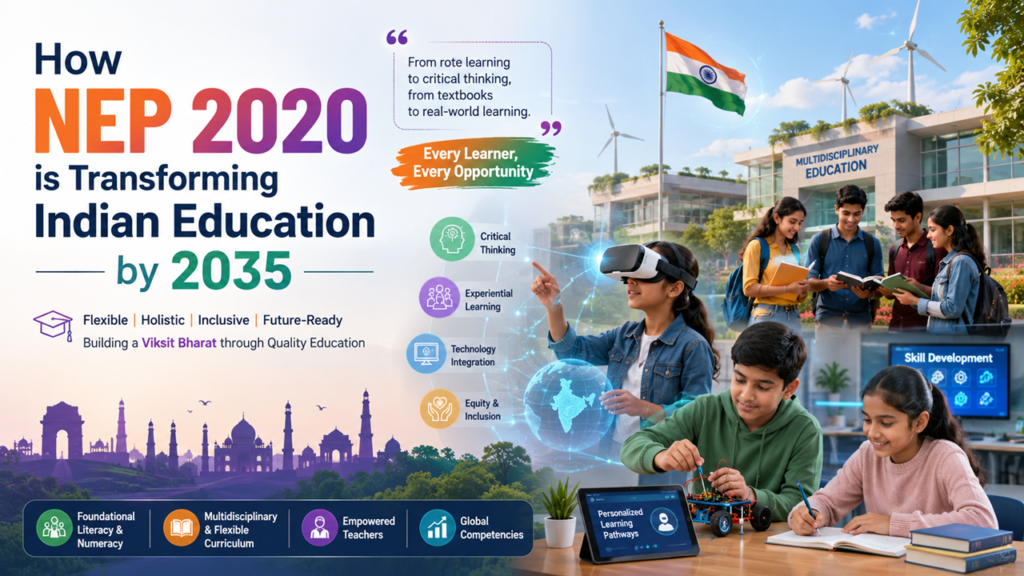
India made history on July 29, 2020, when the Union Cabinet approved the National Education Policy 2020, or NEP 2020. It was the first time in 34 years that India had completely rewritten its education policy. The last one was from 1986. A lot had changed in the world since then — the internet arrived, smartphones changed how people work and communicate, and millions of new jobs appeared that did not even exist before. India needed a new plan, and NEP 2020 is that plan.
But what exactly is NEP 2020? Who does it affect? And why do people say it will transform India by 2035? This blog breaks everything down in simple language. Whether you are a student, a parent, a teacher, or someone curious about India’s future, this guide is for you.
What Is NEP 2020? The Big Picture
NEP 2020 is a national plan for education in India. It covers everything — from how a three-year-old child learns to play in a government-run nursery school, all the way to how a PhD student does research at a university. The policy was written after years of work. A committee of experts, led by space scientist Dr. K. Kasturirangan, studied the Indian education system for several years and prepared a detailed report. That report became the foundation of NEP 2020.
The government’s main goal is simple: by 2035, at least 50 percent of young people in India should have access to higher education. Right now, that number is about 27 percent. To reach 50 percent, India needs to fix problems at every level of education — school, college, and university.
You can read the full text of NEP 2020 directly on the official government website: NEP 2020 – Ministry of Education.
The policy does not force anyone to do anything overnight. Instead, it sets a direction. States and institutions are expected to follow the policy and make changes over time. The target year for full implementation is 2035.
Why India Needed a New Education Policy
To understand why NEP 2020 matters, it helps to look at the problems in India’s old education system.
The Exam-Centric Problem
For decades, Indian schools and colleges put too much pressure on exams. Students memorised facts to pass tests and forgot everything after the exam was over. There was very little focus on actually understanding a subject, thinking creatively, or solving real problems. Teachers taught for exams, not for life.
The Language Gap
Millions of children in India study in a language that is not their mother tongue. A child who speaks Bhojpuri at home may be expected to learn in Hindi or English at school. This creates confusion. Research shows that children learn much better in their first language, especially in the early years. NEP 2020 addresses this directly.
The Dropout Problem
India has a serious problem with children dropping out of school. Many students leave between Grade 5 and Grade 8, before they even finish primary education. Some of the reasons are poverty, lack of toilets at school, distance from home, and the pressure of helping families earn money. NEP 2020 tries to fix this by making education more flexible and relevant.
The Rigid Structure
The old system had a fixed 10+2 structure — ten years of school followed by two years of higher secondary. This meant students had to choose a career path, like science or arts, very early. There was no flexibility. A student who wanted to study both music and mathematics found it almost impossible. NEP 2020 changes this completely.
The Skills Gap
Many graduates in India could not find jobs because they lacked practical skills. They had degrees but no hands-on experience. Companies kept saying that fresh graduates needed months of training before they could actually work. This gap between education and employment was a major problem.
The 5+3+3+4 Structure: A New Way to Think About School
One of the most talked-about changes in NEP 2020 is the new school structure. The old 10+2 system has been replaced with a 5+3+3+4 structure. Here is what each part means:
Foundational Stage (5 Years: Ages 3 to 8)
This stage includes three years of pre-primary school (or Anganwadi) plus Grades 1 and 2. These are the years from age 3 to age 8. The focus here is on play-based learning. Children learn through games, stories, and activities. There is no pressure of exams or grades. The goal is to build a love for learning early.
This is a big shift. Before NEP 2020, early childhood education was not formally part of the school system. It was treated as an optional extra. Now it is officially part of education, and the government is committed to providing quality early learning to every child in India — including those in remote villages.
Preparatory Stage (3 Years: Ages 8 to 11, Grades 3 to 5)
In this stage, children move from play-based learning to more structured learning. They begin reading, writing, and doing basic mathematics more seriously. But the style is still interactive and activity-based. Teachers use stories, experiments, and projects. Rote learning is discouraged.
Middle Stage (3 Years: Ages 11 to 14, Grades 6 to 8)
This is where things get interesting. NEP 2020 says that from Grade 6 onwards, students should start getting hands-on experience with different subjects, including coding, vocational training, and local arts. A student in Grade 6 might spend a few weeks working with a local carpenter, potter, or farmer as part of their education. This is called “bagless days” — days when students go out and learn practical skills from their community.
Secondary Stage (4 Years: Ages 14 to 18, Grades 9 to 12)
This is the most flexible part of the new system. Students no longer have to choose rigid streams like Science, Commerce, or Arts. They can mix subjects. A student can study Physics and History together. Another can study Biology along with Music. The goal is to let students follow their interests, not be forced into boxes.
Board exams in Grade 10 and Grade 12 will also change. Instead of one big exam at the end of the year, students will take shorter, modular exams. The format will test understanding and reasoning, not just memory.
Mother Tongue Education: Teaching in the Language Children Understand
This is one of the most important and, for some people, most debated parts of NEP 2020. The policy says that children should be taught in their mother tongue or local language up to Grade 5. Ideally, this should continue until Grade 8 and beyond.
The reason is clear and backed by research. When young children learn in a language they speak at home, they understand things faster, ask more questions, and feel more confident. A child from Tamil Nadu who speaks Tamil at home will grasp mathematics much better if it is explained in Tamil, not in English or Hindi.
NEP 2020 does not ban English or any other language. It simply says that the first language of instruction should be the language the child knows best. English and other languages will be taught as separate subjects.
The Three Language Formula is also part of this. Students will learn three languages: their mother tongue, a regional or state language, and English. No language is compulsory at the national level. States and students can choose their third language. This was a careful approach to avoid the Hindi versus non-Hindi debate that has existed in India for decades.
To understand more about language policy in India’s schools, the UNICEF India report on early learning in mother tongue is a helpful read: UNICEF India – Early Childhood.
Vocational Education: Skills That Actually Matter
For too long, vocational skills — like farming, carpentry, cooking, electrical work, or plumbing — were seen as inferior to academic subjects. NEP 2020 challenges this idea head on.
From Grade 6 onwards, students will be introduced to vocational skills as part of the regular curriculum. The policy aims to make sure that at least 50 percent of students have exposure to vocational education by 2025. By 2035, it should be integrated into every school.
This matters because India needs skilled workers. A country cannot run on software engineers and doctors alone. It needs electricians, plumbers, mechanics, cooks, farmers, and craftspeople. NEP 2020 acknowledges this and gives these skills the respect they deserve.
The way it works is simple. Schools will partner with local artisans, craftspeople, and businesses. Students will spend time learning from these people during school hours. It will be part of their education, not an after-school extra.
Higher Education Transformed: Universities in the New Era
The changes in higher education under NEP 2020 are just as big as the changes in schools, if not bigger. Here are the key changes:
The Four-Year Undergraduate Programme
One of the most discussed changes is the move to a four-year undergraduate degree. Previously, most bachelor’s degrees in India were three years long. Under NEP 2020, they will be four years.
But here is the clever part — the four-year programme has multiple exit points. This means:
- After 1 year, you get a Certificate.
- After 2 years, you get a Diploma.
- After 3 years, you get a Bachelor’s degree.
- After 4 years, you get a Bachelor’s degree with Honours or Research.
This is designed for flexibility. If a student has to leave college early due to financial or personal reasons, they still walk away with a recognised qualification. If they want to go deeper into research, the fourth year gives them that option. If someone leaves after two years and decides to come back five years later, they can continue from where they left off. This is called Academic Bank of Credits, explained below.
Academic Bank of Credits (ABC)
The Academic Bank of Credits is one of the most innovative ideas in NEP 2020. Think of it like a bank account, but instead of money, you store academic credits. Every course you complete earns you credits. These credits are stored in your account digitally.
If you take a break from college and return later, your old credits are still there. You can use them to complete your degree. You can also transfer credits between colleges. If you study at one university and then move to another city, you do not have to start over.
The government has already launched the ABC portal at abc.gov.in, where students can register and track their credits.
Multidisciplinary Education
The old system in India had a very strict separation between arts, science, commerce, engineering, law, and medicine. You could not mix subjects across these streams at the university level.
NEP 2020 breaks these walls. Universities are being asked to become multidisciplinary institutions. A student studying engineering will be encouraged to also take courses in philosophy, history, or music. A law student can take courses in sociology or economics. The idea is to produce graduates who think broadly and creatively, not just as specialists in one narrow field.
Research and Innovation
India has always produced brilliant scientists and thinkers. But the research environment in Indian universities has been weak. There is not enough funding, not enough collaboration between institutions, and too much bureaucracy.
NEP 2020 calls for the creation of a new body called the National Research Foundation (NRF) to fund research across all subjects — science, social science, arts, and humanities. The NRF will give grants to universities and researchers and build a culture of inquiry and discovery in Indian academia.
For the latest updates on the National Research Foundation, you can visit anusandhan.gov.in.
Technology in Education: The Digital Classroom
NEP 2020 was approved in July 2020 — right in the middle of the COVID-19 pandemic, when millions of students were locked at home and schools had shut down. This gave the policy an urgent push toward digital education.
DIKSHA and SWAYAM
The government had already built digital learning platforms before NEP 2020. DIKSHA is a platform for school students and teachers. It has thousands of video lessons, textbooks, quizzes, and educational resources in multiple Indian languages. SWAYAM is the platform for higher education, offering free online courses from the country’s top universities and institutions.
NEP 2020 strengthens both platforms and pushes for their use in every school and college in India. Teachers are being trained to create digital content and use online tools in their classrooms.
You can explore courses on the government’s free platform at swayam.gov.in.
Blended Learning
NEP 2020 talks about blended learning — a mix of offline classroom teaching and online resources. This model became very important during the pandemic and will continue to be part of Indian education going forward. The idea is that not every lesson needs to happen in a physical classroom. Students can watch a lesson online and then come to class to discuss and apply what they learned.
Coding for Children
From Grade 6 onwards, students will be taught computational thinking and coding. This does not mean every child will become a programmer. It means every child will understand how technology works and how to use logical thinking to solve problems. In a world where technology touches every profession, this is a valuable skill.
Teachers: The Heart of NEP 2020
NEP 2020 makes a clear statement: no education reform can succeed without good teachers. For years, India’s teachers have been underpaid, undertrained, and undervalued. NEP 2020 aims to change that.
The Four-Year Integrated B.Ed.
To become a school teacher in India, you currently need a B.Ed. (Bachelor of Education) degree, which is usually a one or two-year course taken after a regular degree. NEP 2020 proposes replacing this with a four-year integrated B.Ed. programme. This means students will spend all four years combining subject knowledge with teaching skills. By the time they graduate, they will be ready to teach from day one.
Continuous Professional Development
NEP 2020 also says that teachers should never stop learning. Just like doctors do refresher courses and engineers update their skills, teachers should have ongoing training throughout their careers. The government is building systems to provide regular training, workshops, and mentorship programmes for teachers.
Better Pay and Status
One of the goals of NEP 2020 is to raise the social status of the teaching profession. This means better salaries, better working conditions, and more public respect for teachers. The idea is inspired by countries like Finland, where teaching is one of the most admired and competitive professions.
Inclusivity: Education for Every Child
NEP 2020 places a strong focus on including children who have been left out of the education system for too long.
Children With Disabilities
The policy calls for inclusive education where children with disabilities learn alongside other children. Special educators will be trained. Schools will be made accessible. Teaching materials will be available in Braille and sign language. The goal is to make sure every child, regardless of ability, has access to quality education.
Girls’ Education
India still has a gender gap in education. More boys than girls complete school and go to college. NEP 2020 addresses this by promoting girls’ education in every policy area. From safe school infrastructure to special scholarships for girls in higher education, the policy makes girls’ participation a priority.
Socioeconomically Disadvantaged Groups
Children from poor families, tribal communities, migrant families, and scheduled castes and tribes face extra barriers to education. NEP 2020 calls for special attention and resources for these groups. It uses the term Special Education Zones for areas with high concentrations of disadvantaged children, where extra support will be provided.
Assessment Reform: Moving Beyond the Mark Sheet
Ask any Indian student what they remember most about school, and many will say the fear of exams. NEP 2020 wants to change how students are assessed so that exams become a tool for learning, not a source of fear.
360-Degree Assessment
NEP 2020 talks about holistic assessment. This means looking at a student’s overall development — not just how they scored in an exam. Things like their ability to work in a team, their curiosity, their creativity, and their physical health should all be considered when assessing their progress.
No High-Stakes Exams Before Grade 3
The policy says there should be no formal, high-stakes exams before Grade 3. Young children should not be measured by their ability to take tests. They should be observed over time, and their learning should be assessed through activities and conversations.
PARAKH
A new national body called PARAKH (Performance Assessment, Review, and Analysis of Knowledge for Holistic Development) has been set up to guide how students are assessed across India. PARAKH will develop guidelines for schools and advise on how to make assessments more fair, comprehensive, and useful.
Learn more about PARAKH at parakh.education.gov.in.
Internationalization: India on the Global Education Map
For a long time, Indian students had to go abroad to access world-class education. NEP 2020 wants to change this in two ways: bringing the world to India and sending Indian expertise to the world.
Foreign Universities in India
Under NEP 2020, top-ranked foreign universities are allowed to set up campuses in India. This means a student from a small town in Bihar or Rajasthan could potentially study at a world-class institution without leaving India. The University Grants Commission (UGC) has started the process of inviting foreign universities to apply for permission to set up campuses.
Indian Students Going Global
NEP 2020 also encourages Indian universities to develop international partnerships. Indian students will find it easier to do exchange programmes, collaborative research, and dual degree programmes with universities in other countries.
Indian Universities Abroad
The policy also encourages Indian institutions to set up campuses abroad — particularly in countries where there are large Indian diaspora communities. This is a bold vision that positions India as an education exporter, not just an importer.
The Role of States: One Policy, Many Implementations
India is a vast and diverse country. What works in Kerala may not work in Uttar Pradesh. What is appropriate in a city school in Mumbai may not suit a tribal school in Jharkhand. NEP 2020 understands this.
Education in India is a concurrent subject, meaning both the central government and state governments have a say in it. NEP 2020 lays out the vision and framework, but states have the freedom to adapt it to their own context.
Some states have moved quickly. Karnataka, Andhra Pradesh, and Maharashtra have already started rolling out changes. Other states are taking more time. This uneven implementation is one of the policy’s biggest challenges, but also one of its strengths — it allows for flexibility and learning from what works.
Challenges and Criticism: What Are the Concerns?
No policy is perfect, and NEP 2020 has its critics. Here are some of the common concerns:
Implementation Gap
India has a history of good policies that are not properly implemented. There is a fear that NEP 2020 could face the same fate. Changing how millions of teachers teach, how thousands of institutions are structured, and how hundreds of millions of students are assessed is an enormous task. It requires money, training, political will, and time.
Infrastructure Challenges
Many government schools in India still lack basic infrastructure — clean toilets, electricity, libraries, and internet connectivity. For NEP 2020 to work, especially the parts about digital learning and vocational education, schools need to be properly equipped. This is a massive challenge in rural and tribal areas.
Language Concerns
The emphasis on mother tongue education has been welcomed by many educators. But some parents, especially in urban areas, are worried that their children will fall behind in English. English continues to be the language of opportunity in India’s professional world, and parents fear that delaying English instruction will put their children at a disadvantage.
Teacher Readiness
NEP 2020 sets high expectations for teachers. They are asked to teach in new ways, use technology, assess students holistically, and take on mentoring roles. But many teachers were trained in the old system and are not yet ready for these changes. Retraining millions of teachers takes enormous resources and years of effort.
Funding Questions
NEP 2020 recommends that India spend six percent of its GDP on education. Currently, India spends about four to four and a half percent. Reaching six percent would require a significant increase in education spending, which depends on political decisions and economic growth.
Progress So Far: What Has Changed Since 2020?
It is now several years since NEP 2020 was approved. Some changes have already begun:
- The National Curriculum Framework for the Foundational Stage (NCF-FS) was released, guiding early childhood education in India.
- The Academic Bank of Credits portal has been launched and is operational.
- Many universities have introduced the four-year undergraduate programme.
- New teacher education programmes are being designed.
- PARAKH has been set up and is actively working on assessment reforms.
- Several IITs and top universities have started offering more interdisciplinary courses.
- The number of Anganwadi centres being upgraded to provide quality early learning has increased.
The changes are slow and uneven across states, but they are real. The direction of travel is clear.
The Vision for 2035: What India Could Look Like
Let us imagine India’s education system in 2035 if NEP 2020 is successfully implemented:
A child born in a village in Chhattisgarh starts her education at age three in a well-equipped Anganwadi centre. She learns in her mother tongue through songs, stories, and games. By the time she reaches Grade 1, she can read, count, and thinks of learning as fun.
In Grade 6, she spends a few days learning to weave with the local artisan in her village — this is part of her school programme. She also learns basic coding and works on a group project with her classmates. In Grade 10, she decides she wants to study both Biology and Classical Music. Under NEP 2020, this is possible.
She goes to a local university and chooses a four-year programme in Biotechnology with a minor in Music. After two years, life gets hard and she has to take a break. Her credits are stored safely in the Academic Bank of Credits. Three years later, she returns and picks up where she left off. She completes her degree, goes on to do research, and eventually joins a biotech startup.
This story — of flexibility, dignity, access, and opportunity — is what NEP 2020 is trying to make possible for every Indian child, not just those born into privilege.
What Parents and Students Can Do Right Now
If you are a parent or student trying to navigate the changing education landscape, here are a few practical things to keep in mind:
- Check whether your school or college has adopted NEP 2020 guidelines and what changes are being introduced.
- If your child is in early primary school, look for schools that use activity-based and mother tongue instruction methods.
- For higher education students, check if your university has joined the Academic Bank of Credits system.
- Explore free courses on SWAYAM, especially if you want to add skills to your portfolio.
- If you are interested in vocational skills, look for schools and colleges that offer hands-on learning programmes with local businesses.
- Stay informed about changes to board exam formats, as these are being updated across different states.
Conclusion: A Long Road, But the Right One
NEP 2020 is not a magic wand. It cannot fix decades of under-investment and neglect overnight. But it is a thoughtful, ambitious, and genuinely transformative vision for what Indian education could become.
It recognises that children are not just vessels for information to be poured into. They are curious, creative, and capable human beings who learn best when they feel safe, understood, and inspired. It acknowledges that India’s diversity — in languages, cultures, livelihoods, and geographies — is a strength, not a problem to be managed.
By 2035, if the policy is implemented well, India could have an education system that the world looks at with admiration — not despite its size and complexity, but because of how it chose to embrace them.

StudentsTalk.in, is an education-focused platform dedicated to helping students stay informed about the latest academic updates, scholarships, entrance exams, career opportunities, government schemes, and study resources. With a passion for education and student success, she creates informative, easy-to-understand content.