Every year, millions of students in India finish their graduation and start looking for a good job. Some want to work in private companies, some want to start a business, and many want a stable government job. Among all the government job options in India, one name always comes first — the State Bank of India, or SBI.
SBI is not just a bank. It is the largest public sector bank in the whole country. It has more than 22,000 branches across India and serves crores of customers every day. When a student gets a job in SBI, it is considered a big achievement — not just for that person, but for the entire family.
But why do so many students want to join SBI? The reasons are simple. SBI offers a steady income, good salary, job security, medical benefits, pension, and a chance to grow in a respected career. If you work hard and stay dedicated, SBI can take you from a junior officer to a senior manager over the years.
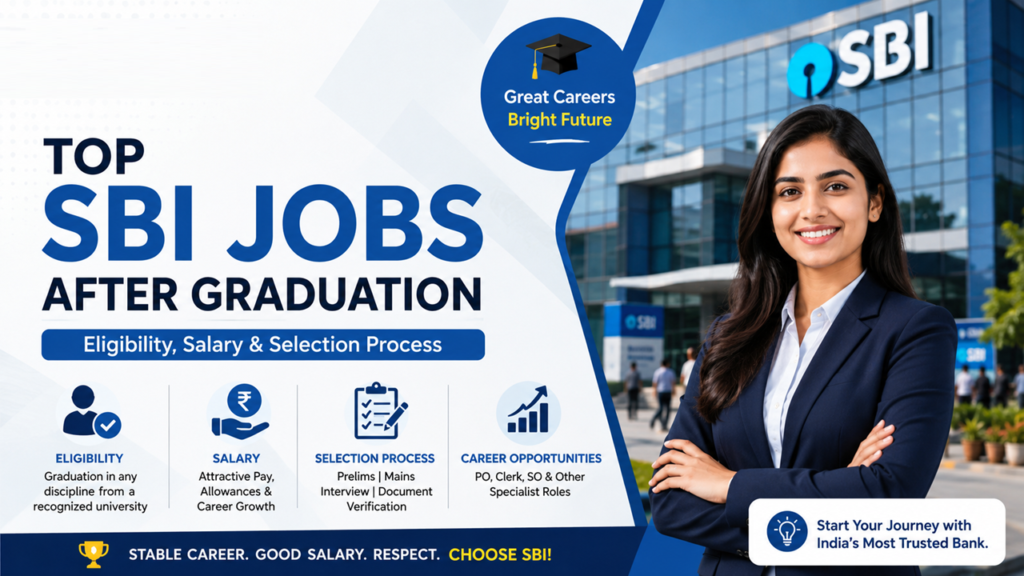
In this blog, we will explain everything about SBI Careers in very simple language. We will cover the top jobs available after graduation, who can apply for them, what the salary looks like, how the selection process works, and some useful tips to help you prepare. Whether you are a final-year student or a recent graduate, this guide is for you.
What is SBI and Why Should You Care?
The State Bank of India was established in 1955. It is owned by the Government of India and is headquartered in Mumbai. SBI has over 500 million customers and is one of the biggest banks in the world by number of customers.
SBI offers services like savings accounts, loans, insurance, credit cards, investment products, and much more. To run all these services, SBI needs thousands of employees every year. That is where fresh graduates like you come in.
Here are a few reasons why SBI jobs are so popular:
- Job Security: Once you join SBI, your job is very stable. There is no risk of sudden layoff.
- Good Salary: SBI salaries are competitive and grow every year.
- Benefits: You get medical insurance, house rent allowance, travel allowance, and pension.
- Growth: SBI promotes employees based on performance and experience.
- Respect: Working in SBI gives you social respect and trust in society.
- Transfer Policy: SBI transfers employees across India, giving them a chance to explore different cities.
So if you are a graduate and want a stable, well-paying, and respected job, exploring SBI Careers is one of the smartest decisions you can make.
Top SBI Jobs Available After Graduation
SBI hires employees for many different roles. Below are the most popular and common positions that a fresh graduate can apply for:
1. SBI Probationary Officer (PO)
The SBI PO is the most popular and sought-after position in SBI. A Probationary Officer is like a management trainee. After joining, a PO goes through a training period and learns all the important banking operations. After training, they become an Assistant Manager.
The SBI PO exam is conducted every year and lakhs of students appear for it. It is a highly competitive exam but also very rewarding.
2. SBI Clerk (Junior Associates)
The SBI Clerk position is also known as Junior Associate. This is an entry-level job where the employee handles basic banking tasks at the branch counter. This includes cash handling, account opening, customer service, and data entry.
SBI releases thousands of clerk vacancies every year. The competition is tough but the exam is slightly easier compared to the PO exam.
3. SBI Specialist Officers (SO)
SBI also hires specialists for specific departments like IT, HR, Law, Finance, Marketing, and Engineering. These are called Specialist Officers. If you have a specialized degree or skill, you can apply for the Specialist Officer role.
4. SBI Junior Associates (Customer Support and Sales)
This role is slightly different from the regular clerk role. Junior Associates focus on customer support and sales. They help customers with queries, promote banking products, and assist in sales activities.
5. SBI Apprentice
SBI also hires apprentices under the National Apprenticeship Promotion Scheme. This is a great option for fresh graduates who want to gain banking experience and earn a stipend at the same time.
6. SBI Management Executive
SBI sometimes recruits Management Executives for specific projects and roles. This position is usually for graduates with some work experience or MBA degree holders.
Eligibility Criteria for Top SBI Jobs
Before you apply for any SBI position, you must check whether you are eligible. Below is a simple breakdown of the eligibility criteria for the main SBI roles:
| Position | Education | Age Limit | Nationality |
| SBI PO | Any graduation degree from a recognized university | 21 to 30 years | Indian Citizen |
| SBI Clerk | Any graduation degree from a recognized university | 20 to 28 years | Indian Citizen |
| Specialist Officer (IT) | B.Tech / B.E. in Computer Science or related field | 21 to 30 years | Indian Citizen |
| Specialist Officer (Law) | LLB degree with min. 2 years experience | 25 to 35 years | Indian Citizen |
| Specialist Officer (HR) | Graduate + MBA/MSW in HR | 21 to 35 years | Indian Citizen |
| SBI Apprentice | Graduation from a recognized university | 20 to 28 years | Indian Citizen |
Note: Age relaxations are provided for reserved category candidates. SC/ST candidates get 5 years of relaxation. OBC candidates get 3 years. Persons with disabilities (PwD) get 10 years of relaxation. Ex-servicemen also get special age relaxation as per government rules.
Also, most positions require a minimum of 60% marks in graduation for General category candidates. SC/ST candidates usually need 55% or as mentioned in the official notification.
SBI Salary Structure: How Much Will You Earn?
One of the most common questions students ask is — how much does SBI pay? The answer is — quite well. Let us break it down in simple terms.
SBI PO Salary
When you join as a Probationary Officer, your basic pay starts at around Rs. 36,000 per month. But your total in-hand salary includes many allowances. Let us look at the complete package:
| Pay Component | Amount (Approx.) |
| Basic Pay | Rs. 36,000 per month |
| Dearness Allowance (DA) | Based on CPI, changes quarterly |
| House Rent Allowance (HRA) | 7% to 9% of basic pay |
| City Compensatory Allowance (CCA) | Rs. 870 to Rs. 1,200 per month |
| Travel Allowance | Varies by posting location |
| Gross Salary (approx.) | Rs. 52,000 to Rs. 58,000 per month |
SBI Clerk Salary
SBI Clerk salary is also decent for a fresher. The basic pay starts at approximately Rs. 19,900 per month. Here is the complete breakdown:
| Pay Component | Amount (Approx.) |
| Basic Pay | Rs. 19,900 per month |
| Dearness Allowance | Based on CPI index |
| HRA | Depends on city — Rs. 1,000 to Rs. 3,000 |
| Medical Allowance | Rs. 600 per month |
| Special Allowance | Rs. 2,645 per month |
| Gross Salary (approx.) | Rs. 29,000 to Rs. 35,000 per month |
SBI Specialist Officer Salary
Specialist Officers are paid based on their grade. Most SO positions fall in JMGS-I (Junior Management Grade Scale I) or MMGS-II (Middle Management Grade Scale II). The basic pay ranges from Rs. 36,000 to Rs. 48,170 per month depending on the grade.
Other Benefits Across All SBI Roles
- Provident Fund and Pension: SBI provides a pension-linked retirement benefit.
- Medical Benefits: You and your family get free or subsidized medical care.
- Staff Loan: SBI employees can take home loans, car loans, and personal loans at very low interest rates.
- Leave Benefits: You get casual leave, earned leave, and sick leave.
- LFC (Leave Fare Concession): SBI pays for travel once every two years for you and your family.
- Canteen Facilities: Some large SBI offices have subsidized canteens.
- Annual Increment: Your salary increases every year based on service and performance.
Selection Process: How Does SBI Hire You?
The selection process is different for each position. But in general, SBI follows a multi-stage process that tests your knowledge, skills, and personality. Let us look at each one in detail.
SBI PO Selection Process
The SBI PO selection has three main stages:
- Stage 1 — Preliminary Exam: This is an online test with three sections. It tests your English Language, Quantitative Aptitude, and Reasoning Ability. You get 1 hour to complete 100 questions. Marks are: 30 for English, 35 for Quantitative Aptitude, and 35 for Reasoning.
- Stage 2 — Main Exam: This is a more detailed test. It includes Reasoning and Computer Aptitude, Data Analysis and Interpretation, General/Economy/Banking Awareness, English Language, and a Descriptive Paper with letter writing and essay.
- Stage 3 — Interview and Group Exercise: Shortlisted candidates are called for a Group Exercise and Personal Interview. The final selection is based on the marks scored in the Main Exam plus the GE and PI round.
| Stage | Type | Marks | Duration |
| Preliminary Exam | Online MCQ | 100 marks | 1 hour |
| Main Exam | Online MCQ + Descriptive | 250 + 50 marks | 3 hours + 30 mins |
| Group Exercise | Group Discussion | 20 marks | 20 minutes |
| Personal Interview | Face to Face Interview | 30 marks | 15 to 20 minutes |
SBI Clerk Selection Process
The SBI Clerk selection is simpler compared to the PO process:
- Stage 1 — Preliminary Exam: This is an online test with three sections — English Language (30 marks), Numerical Ability (35 marks), and Reasoning Ability (35 marks). Total marks are 100 and the duration is 1 hour.
- Stage 2 — Main Exam: This exam has four sections — General/Financial Awareness, General English, Quantitative Aptitude and Reasoning Ability, and Computer Aptitude. It has 190 questions with a total of 200 marks.
There is no interview round for the SBI Clerk position. Final selection is based on the Main Exam marks and performance in the local language test (if applicable).
SBI Specialist Officer Selection Process
- Online Written Test: Tests your knowledge in the relevant subject area.
- Shortlisting: Based on written test marks.
- Interview: A personal interview is conducted for final selection.
SBI Apprentice Selection Process
- Online Test: Tests English, Reasoning, Numerical Ability, and General Awareness.
- Local Language Test: A test to assess the candidate’s knowledge of the local language of the state they are applying for.
Key Topics to Study for SBI Exams
If you are planning to appear for any SBI exam, you must prepare well. Here are the major subjects you need to study:
English Language
- Reading Comprehension passages
- Fill in the blanks with correct words
- Error spotting in sentences
- Para jumbles (arranging sentences in correct order)
- Vocabulary — Synonyms, Antonyms, Idioms
- Cloze Test (fill in the blank paragraphs)
Quantitative Aptitude / Numerical Ability
- Number Series — finding the pattern
- Simplification and Approximation
- Percentage, Profit and Loss, Simple and Compound Interest
- Time and Work, Speed and Distance
- Data Interpretation — Tables, Bar Graphs, Pie Charts, Line Graphs
- Quadratic Equations
Reasoning Ability
- Puzzles and Seating Arrangements
- Blood Relations
- Syllogisms
- Inequalities
- Coding and Decoding
- Direction Sense
- Input-Output questions
General and Banking Awareness
- Current Affairs — last 6 months news
- Banking terms and definitions
- RBI policies and announcements
- Government schemes and programs
- Important appointments and awards
- Economic news and financial literacy
Computer Knowledge (for Clerk and some SO posts)
- Basic computer operations and shortcuts
- MS Office — Word, Excel, PowerPoint
- Internet basics and email
- Computer hardware and software
How to Apply for SBI Jobs: Step-by-Step Process
Applying for SBI jobs is done completely online. Here is the simple step-by-step process:
- Step 1 — Watch for Notifications: Keep checking the official SBI website at sbi.co.in or the SBI Careers page. Notifications are also published in leading newspapers.
- Step 2 — Check Eligibility: Before applying, read the notification carefully and confirm that you meet the eligibility criteria — age, education, marks, etc.
- Step 3 — Register Online: Go to the official application portal. Click on ‘New Registration’ and create your account using your mobile number and email ID.
- Step 4 — Fill in the Application Form: Enter all your personal details, educational qualifications, and category correctly. Make sure there are no spelling errors.
- Step 5 — Upload Documents: Upload a clear scanned copy of your photograph (passport size) and your signature. Follow the exact size and format mentioned.
- Step 6 — Pay the Application Fee: The fee for General and OBC candidates is usually Rs. 750. SC/ST and PwD candidates are often exempted. Pay using debit card, credit card, or net banking.
- Step 7 — Submit and Take Printout: After submitting, take a printout of the application form for your records. This may be needed at the exam center.
Growth and Career Path in SBI
One of the best things about SBI Careers is that there is always room to grow. When you join SBI as a Probationary Officer or Clerk, that is just the beginning. Over the years, with experience and performance, you can move up to higher positions.
Here is how the career ladder looks for an SBI PO:
| Level | Position | Years of Experience |
| Entry Level | Junior Management Grade Scale I (JMGS-I) | 0 to 3 years |
| Middle Management | Middle Management Grade Scale II (MMGS-II) | 3 to 6 years |
| Middle Management | Middle Management Grade Scale III (MMGS-III) | 6 to 10 years |
| Senior Management | Senior Management Grade Scale IV (SMGS-IV) | 10 to 15 years |
| Senior Management | Senior Management Grade Scale V (SMGS-V) | 15 to 20 years |
| Top Management | Top Executive Grade Scale VI and VII | 20+ years |
| Leadership | General Manager / Deputy MD / MD | 25+ years |
Even SBI Clerks can get promoted to PO grade through the Internal Promotion Process. SBI conducts internal exams every year and many clerks get promoted to officer level positions.
SBI Careers also offer opportunities to work in specialized departments like foreign exchange, treasury, digital banking, and risk management as you grow in seniority.
Preparation Tips to Crack SBI Exams
Cracking SBI exams requires proper planning and consistent effort. Here are some practical tips that will really help:
Start with the Basics
If you are new to banking exams, start from the very basics. Understand what the exam pattern looks like, what topics are covered, and how much time you have before the exam. Build your foundation in Mathematics and English first.
Make a Study Plan
A daily study plan is very important. Divide your time across all subjects. Give more time to your weak areas. For example, if you are weak in Quantitative Aptitude, spend at least 2 hours every day on it.
Practice Mock Tests
Mock tests are the best way to prepare. They give you a feel of the real exam. After taking a mock test, always review your mistakes. Find out why you got a question wrong and learn the correct approach.
Read Newspapers Daily
For the General Awareness section, make it a habit to read a newspaper every day. The Hindu, The Economic Times, or any national newspaper works well. Pay attention to banking news, RBI announcements, government schemes, and important events.
Use Good Study Material
There are many books available for SBI exam preparation. Popular books include those by R.S. Aggarwal for Quantitative Aptitude, Arihant and Wren and Martin for English, and monthly GK magazines for current affairs. You can also use free online resources and YouTube channels.
Work on Speed and Accuracy
In SBI exams, time is very limited. You need to answer many questions in a short time. Practice regularly to improve your speed. At the same time, be careful about negative marking. Wrong answers reduce your score, so do not guess randomly.
Stay Consistent
Consistency is more important than studying for 10 hours in one day. If you study 4 to 5 hours every day for 3 to 6 months, you will be well prepared. Avoid taking long breaks from studies.
Documents Required for SBI Exam and Interview
When you go for the exam or interview, make sure to carry all the required documents. Forgetting a document can create problems. Here is a list of documents you generally need:
- Admit Card / Hall Ticket (downloaded from the official website)
- Original photo identity proof — Aadhaar Card, Voter ID, Passport, or Driving License
- Passport size photographs (at least 3 to 4 copies)
- Graduation degree or mark sheets from all semesters
- Class 10 and Class 12 certificates
- Caste certificate (for SC/ST/OBC candidates)
- PwD certificate (if applicable)
- Ex-Servicemen certificate (if applicable)
- NOC from current employer (if you are already working somewhere)
Common Mistakes Students Make While Applying for SBI Jobs
Many students make simple mistakes that can hurt their chances. Here are the most common mistakes and how to avoid them:
- Not Reading the Official Notification: Always read the full notification before applying. Many students miss eligibility criteria or important instructions.
- Wrong Information in the Form: A simple spelling mistake in your name or wrong date of birth can cause issues later. Double check everything.
- Missing the Deadline: Application deadlines are strict. Do not wait till the last minute. The website might slow down due to heavy traffic at the end.
- Poor Photo or Signature Quality: Make sure your photo and signature are scanned clearly and are within the size limits mentioned.
- Ignoring Mock Tests: Some students only read theory and never practice with mock tests. This is a big mistake. Practice is key.
- Skipping Current Affairs: Many students ignore General Awareness. But it has a lot of marks and can be the difference between passing and failing.
SBI in the Digital Age: New Opportunities for Tech-Savvy Graduates
SBI has been investing heavily in technology and digital banking. This has opened new job opportunities for graduates who have skills in IT, data analytics, cybersecurity, and digital marketing.
SBI has launched many digital products like YONO (You Only Need One), SBI Pay, SBI Quick, and internet banking platforms. To run and improve these products, SBI needs people with technical knowledge.
If you are a Computer Science or IT graduate, you can look at Specialist Officer roles in the IT segment within SBI Careers. These roles are well-paying and offer excellent growth in the field of banking technology.
SBI also runs hackathons, innovation challenges, and partnerships with startups. Fresh graduates with strong technical skills have a great opportunity to contribute to these initiatives and make a name for themselves in the organization.
Special Provisions for Reserved Category Candidates
SBI follows the Government of India’s reservation policy in all its recruitments. Here is a simple breakdown of what reserved category candidates can expect:
| Category | Reservation % | Age Relaxation | Fee Relaxation |
| Scheduled Caste (SC) | 15% | 5 years | Full fee waiver |
| Scheduled Tribe (ST) | 7.5% | 5 years | Full fee waiver |
| Other Backward Class (OBC) | 27% | 3 years | No fee waiver (General fee) |
| Economically Weaker Section (EWS) | 10% | None | No fee waiver |
| Persons with Disability (PwD) | 4% | 10 years | Full fee waiver |
| Ex-Servicemen | As per rules | Varies | Depends on category |
Always keep updated caste or category certificates ready. These documents must be issued by the appropriate authority and within the validity period as mentioned in the notification.
Conclusion
Getting a job in SBI is not impossible. It requires hard work, proper planning, and consistent effort. Thousands of students crack SBI exams every year, and you can be one of them.
Remember — the journey starts with the right information. Now that you know about the top SBI jobs, who can apply, what salary to expect, and how the selection process works, you are one step ahead of those who do not know.
SBI Careers offer something truly special — a stable job, a good income, great benefits, and the pride of working for India’s largest public sector bank. Whether you aim to become a Clerk, a PO, or a Specialist Officer, the path is clear if you stay focused.

StudentsTalk.in, is an education-focused platform dedicated to helping students stay informed about the latest academic updates, scholarships, entrance exams, career opportunities, government schemes, and study resources. With a passion for education and student success, she creates informative, easy-to-understand content.