Quick Answer: India does not have 10 or 20 separate education policies active in 2026. There is ONE big national policy — the National Education Policy (NEP) 2020 — which is being implemented in phases. This policy covers schools, colleges, skill training, digital learning, and much more. In this blog, we explain every important part of this policy in simple language.
If you are a student, a parent, or a teacher, you must know about the education policy in India in 2026. Why? Because this policy is changing how children study, how colleges work, and what kind of jobs students will get in the future.
India has over 260 million students. That is more than the total population of many countries! So when India changes its education system, it is a very big deal. The National Education Policy (NEP) 2020 is the biggest change in Indian education in more than 34 years.
In this blog, we will explain — in very simple English — what this policy is, what has changed in 2026, and how it affects you.
What You Will Learn in This Blog
| # | Topic | What You Will Find |
| 1 | What is Education Policy? | Simple meaning, why it matters |
| 2 | History of Education Policy in India | From 1968 to today |
| 3 | NEP 2020 – The Main Policy | All key changes explained |
| 4 | 10 Big Changes in 2026 | What is new this year |
| 5 | The New 5+3+3+4 School System | How schooling has changed |
| 6 | Higher Education Reforms | College and university changes |
| 7 | Digital Learning Policies | DIKSHA, SWAYAM, AI in schools |
| 8 | Skill Development & Vocational Training | Jobs and skills focus |
| 9 | Gender & Inclusion Policies | Girls, rural students, disabled |
| 10 | Challenges & Criticism | Problems in implementation |
| 11 | FAQs | Common questions answered |
1. What is an Education Policy?
An education policy is a set of rules and plans made by the government. These rules decide:
- What students will study in school and college
- How teachers will be trained
- How much money the government will spend on education
- What language will be used for teaching
- How students will be tested and given marks
Think of it like a recipe. Just like a recipe tells you how to cook food, an education policy tells schools and colleges how to teach students.
In India, the central government makes the national education policy. But each state government can also add its own rules. For example, the language of instruction can be different in Tamil Nadu vs Rajasthan.
Important: The latest education policy in India is the National Education Policy (NEP) 2020. It was approved by the Cabinet of India on 29 July 2020. In 2026, its reforms are being actively rolled out across the country.
2. History of Education Policy in India
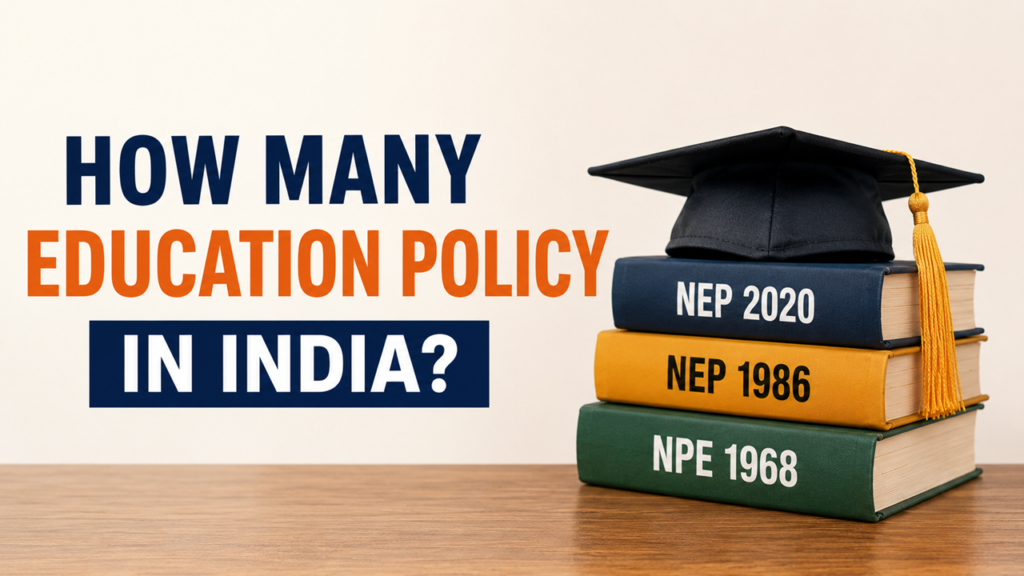
India has had three major national education policies. Let us look at each one quickly:
| Policy Name | Year | Key Focus |
| National Policy on Education (NPE) | 1968 | Free & compulsory education, 3-language formula, more budget for education |
| National Policy on Education (NPE) | 1986 (revised 1992) | Operation Blackboard, Navodaya Schools, open universities like IGNOU |
| National Education Policy (NEP) | 2020 (implemented 2021 onwards) | 5+3+3+4 system, skill learning, digital education, no-detention policy removed |
For more than 30 years (1986 to 2020), no new national policy was made. The world changed a lot in those years — computers, smartphones, the internet — but India’s education policy did not change much.
That is why the NEP 2020 is so important. It tries to bring Indian education in line with the modern world.
3. NEP 2020 – The Main Education Policy in India in 2026
The National Education Policy 2020 (NEP 2020) is the only active national education policy in India right now. In 2026, the government is in the middle of putting this policy into practice.
The NEP 2020 is built on five main ideas:
| Pillar | Meaning |
| Access | Every child, in every village and city, should be able to go to school |
| Equity | Girls, poor children, and disabled students should get equal opportunity |
| Quality | Education should be good, not just available |
| Affordability | Education should not be too expensive for families |
| Accountability | Schools and teachers should be responsible for results |
The NEP 2020 wants India to spend 6% of its total GDP (national income) on education. As of 2026, India spends around 4.6% of GDP on education. The target is still being worked towards.
4. 10 Big Education Policy Changes in India in 2026
Here are the most important changes happening in Indian education in 2026. We explain each one in simple words.
Change 1: The New School Structure (5+3+3+4)
The old system had 10 years of school + 2 years of higher secondary = 10+2. The new system is 5+3+3+4. This means:
| Stage | Age Group | Classes | Focus |
| Foundational | 3 to 8 years | Pre-school + Class 1-2 | Play-based learning, language, basic numbers |
| Preparatory | 8 to 11 years | Class 3-5 | Discovery, activity-based learning |
| Middle | 11 to 14 years | Class 6-8 | Coding, arts, vocational exposure |
| Secondary | 14 to 18 years | Class 9-12 | Critical thinking, flexible subjects |
Change 2: No More Rigid Stream System
Earlier, after Class 10, students had to choose one stream — Science, Commerce, or Arts. They could not mix subjects.
Now, students can choose any combination they like. A student can study Physics along with Music, or Economics with Biology. This gives students more freedom.
Change 3: Detention Policy Removed for Class 5 and 8
Earlier, under the ‘No Detention Policy,’ students were automatically passed to the next class even if they failed. This was seen as a problem because students did not take studies seriously.
Now, students in Class 5 and Class 8 must pass their final exam. If they fail, they get one more chance — a re-exam within two months. If they fail again, they must repeat the class.
Change 4: Teaching in Mother Tongue up to Class 5
The NEP says that children learn better in their mother tongue — the language they speak at home. So now, children will be taught in their local/regional language up to Class 5 (and in some states up to Class 8).
Hindi and English will still be taught as subjects, but the language of instruction in early years will be regional languages like Tamil, Telugu, Marathi, Bengali, etc.
Change 5: Vocational Education from Class 6
From Class 6, students will now learn practical skills like:
- Carpentry and woodwork
- Plumbing and electrical basics
- Pottery and crafts
- Gardening and farming
- Coding and computer basics
This is called vocational education. The idea is that students should know how to do real-world work, not just pass exams. Students will also do internships with local artisans and tradespeople.
Change 6: CUET for College Admissions
CUET stands for Common University Entrance Test. From 2022 onwards, this exam is used for admissions to central universities like Delhi University. By 2026, it is being expanded to cover 90% of central universities.
This means students do not need to rely only on their Class 12 board marks for college admission. CUET scores are also considered. This helps students from all over India get a fair chance.
Change 7: Four-Year Undergraduate Program
Earlier, a Bachelor’s degree was 3 years. Now, the government is pushing for a 4-year undergraduate program (FYUP).
The new system has multiple exit options:
- Leave after 1 year: Certificate
- Leave after 2 years: Diploma
- Leave after 3 years: Bachelor’s degree (pass)
- Complete 4 years: Bachelor’s degree with Research / Honours
This is called the Academic Bank of Credits (ABC). Students can save their credits and come back to complete their degree later — even after taking a break for work.
Change 8: Digital Education Expansion
In 2026, the government is expanding digital learning tools in schools and colleges. Key platforms include:
| Platform | What It Does | Who Can Use It |
| DIKSHA | Digital textbooks, videos, practice questions | School students and teachers |
| SWAYAM | Free online courses from top professors | College students and adults |
| NDEAR | National Digital Education Architecture – connects all digital tools | Schools and colleges across India |
| PM eVIDYA | TV-based and radio-based education for areas with no internet | Rural students |
| iGOT Diksha | Training platform for government employees and teachers | Teachers and officials |
Target for 2026-27: Smart classrooms in 50% of all government schools. This includes projectors, tablets, and internet access to help students learn better.
Change 9: New Higher Education Commission (HECI)
Earlier, different bodies controlled different types of colleges:
- UGC (University Grants Commission) for general colleges
- AICTE (All India Council for Technical Education) for engineering
- NCTE (National Council for Teacher Education) for teaching colleges
Now, the government wants to create one single body called the Higher Education Commission of India (HECI) to oversee all of them (except medical and legal studies). This will reduce confusion and make the system simpler.
Change 10: Teacher Training Reforms
Good teachers are the backbone of good education. The NEP 2020 has several new rules for teachers:
- All teachers must complete a 4-year Integrated B.Ed. degree by 2030
- Teachers will be hired based on merit and tests — not just interviews
- Promotions and pay will be based on performance
- Regular training and upskilling programs for all teachers
Did You Know? India needs about 1 million more trained teachers to fully implement NEP 2026. Teacher training colleges are being expanded across the country to meet this need.
5. Digital Learning – How Technology Is Changing Education in 2026
One of the biggest parts of the education policy in India in 2026 is the use of technology in classrooms. Let us look at what is happening:
AI in Schools
Artificial Intelligence (AI) is now being used in some schools to personalize learning. This means the computer can see where a student is making mistakes and give them special practice questions for those weak areas.
As of 2026, about 15,000 schools have adopted AI-powered learning tools. This number is growing fast.
Virtual Reality (VR) Labs
Some colleges and schools now have Virtual Reality labs. Students can wear VR headsets and visit places like the moon, the inside of a human body, or ancient Rome — all from their classroom! About 2,500 institutions in India have started VR labs by 2026.
Online Examinations
More and more exams are now being held online. About 82% of India’s examination boards have moved to online or hybrid exams. This makes cheating harder and results faster.
Blockchain Degree Certificates
One big problem in India is fake degree certificates. Companies sometimes hire people with fake degrees. The government is now using blockchain technology to make degree certificates that cannot be faked. This is being rolled out in 2026.
6. Skill Development & Vocational Training Policy in 2026
The government knows that not every student will become a doctor or engineer. Many students will work as electricians, coders, designers, chefs, or farmers. That is why skill development is a huge part of the education policy in India in 2026.
| Skill Program | Target Group | Key Details |
| Skill India Mission | Youth aged 15-45 | Free skill training in over 100 trades, linked with jobs |
| PM Vishwakarma Scheme | Traditional artisans | Training + loan + tools support for craftspeople |
| PMKVY (Pradhan Mantri Kaushal Vikas Yojana) | School dropouts and youth | Short-term certification courses in industry-relevant skills |
| National Apprenticeship Policy | College students | Paid apprenticeships in companies while still studying |
| Vocational in School (NEP) | Class 6-12 students | Exposure internships with local businesses and workshops |
By 2027-28, vocational training will be mandatory in all secondary schools across India. This is one of the most important steps being taken to prepare students for real jobs.
7. Policies for Girls, Rural Students, and Disabled Students
The education policy in India in 2026 gives special attention to students who face extra challenges. Here is what is being done:
For Girls
- Girls’ hostels are being built in every district to support girls who study STEM (Science, Technology, Engineering, Mathematics)
- CBSE and state boards now offer special scholarships for girl students in STEM subjects
- 5 new university townships are being built near industrial areas, with safe residential facilities for women students
- Special Education Zones are being created in areas with high girl dropout rates
For Rural and Tribal Students
- PM eVIDYA provides TV and radio education for areas with no internet
- Eklavya Model Residential Schools are being expanded for tribal children
- Mid-Day Meal Scheme continues and is being improved with better nutrition
- ASER (Annual Status of Education Report) data is being used to find and help low-performing districts
For Disabled Students
- All new school buildings must be wheelchair-accessible
- Special need teachers (SNE teachers) are being trained in every district
- Braille textbooks, sign-language learning materials, and audio books are being made available
- Inclusive education is being integrated into all teacher training programs
In 2025-26, the government sanctioned over 68,000 education loans worth Rs. 9,118 crore to help students from lower-income families continue their studies. These are low-interest loans under the PM Vidyalakshmi (PMVL) scheme.
8. Budget for Education in 2026
The government’s budget for education shows how serious it is about education policy. Here are the key numbers for 2025-26:
| Item | Budget Allocated |
| Total Education Budget | Rs. 1,28,650 crore |
| School Education | Rs. 78,572 crore |
| Higher Education | Rs. 50,078 crore |
| Digital Infrastructure (NDEAR, smart classrooms) | Part of school budget |
| New University Townships (5 announced in Budget 2026-27) | Under planning |
| Girls’ Hostels in Districts (STEM support) | Under planning |
This is the highest education budget India has ever had. Still, experts say India needs to reach 6% of GDP spending on education to truly transform the system.
9. Challenges in Implementing Education Policy in India
The NEP 2020 is a great policy on paper, but putting it into practice is hard. Here are the main challenges:
Challenge 1: Teacher Shortage
India needs around 1 million more trained teachers. Many rural schools have only 1 or 2 teachers for all classes. Without enough teachers, it is very hard to improve education quality.
Challenge 2: Digital Divide
The government wants to use technology in classrooms, but many villages still do not have reliable internet. Students in rural areas are falling behind students in cities in terms of digital access.
Challenge 3: Uneven Implementation Across States
India is a federal country. Education is on the concurrent list — meaning both the central government and state governments can make rules. Some states like Karnataka and Maharashtra are implementing NEP fast. Others are moving slowly.
Challenge 4: Language of Instruction
The NEP says teach in the mother tongue up to Class 5. But in many states, teachers are not trained to teach science or math in regional languages. Making quality textbooks in 22+ languages is also a big challenge.
Challenge 5: Resistance to Change
Many parents, teachers, and school owners are used to the old system. They are nervous about the changes. Training everyone and convincing them that the new system is better takes time.
| Challenge | Current Status in 2026 | Government Response |
| Teacher Shortage | 1 million teachers needed | B.Ed. reform, merit-based hiring |
| Digital Divide | 50% rural schools lack internet | PM eVIDYA, TV/radio education |
| Slow State Implementation | 67% NEP implemented overall | Central funding tied to NEP compliance |
| Language Materials | Textbooks available in limited languages | NCERT revising Grade 7, 9, 11 books by 2026 |
| Infrastructure Gaps | Many schools lack basic facilities | Rs. 78,572 crore school budget |
10. How Does Education Policy in India Compare Globally?
Let us see how India’s education policy in 2026 compares with some other countries:
| Country | School System | Key Strength | What India is Adopting |
| Finland | 9 years compulsory school, no standardized tests | Teacher autonomy, no homework pressure | Holistic evaluation, reduce exam stress |
| USA | K-12 system (12 years) | Choice, vocational courses in high school | Flexible streams, skill learning from Class 6 |
| South Korea | 6+3+3 system | High academic performance | Competitive university entrance reform |
| Germany | Vocational training (Ausbildung) is highly valued | Dual education: study + work together | Apprenticeships and vocational NEP focus |
| India (NEP 2020) | 5+3+3+4 system | Holistic, mother-tongue based, flexible | Still implementing; 67% done in 2026 |
India is on the right path. The NEP 2020 takes the best ideas from global education systems and adapts them to Indian culture and needs.
Conclusion:
The education policy in India in 2026 is a story of big ambition and steady progress. The National Education Policy 2020 is not just changing what students study — it is changing how they think, how they learn, and how they prepare for the future.
By 2026, India has made real progress:
- Over 10,000 schools have adopted the new 5+3+3+4 structure
- CUET is used by 90% of central universities
- DIKSHA and SWAYAM now serve over 15 crore (150 million) students
- Smart classrooms are being installed in thousands of government schools
- Vocational training is being integrated into school education
But there is still a long road ahead. The goal is to make every child in India — in cities and in villages, rich and poor, boys and girls — have access to high-quality education by 2030.
Frequently Asked Questions (FAQs)
Q1. How many education policies does India have in 2026?
India has ONE main national education policy — the National Education Policy (NEP) 2020. There is no separate NEP 2026. The NEP 2020 is being implemented in phases, and many of its reforms are becoming active in 2026.
Q2. Is NEP 2020 compulsory for all schools in India?
The NEP 2020 is the national policy, but each state government decides how and when to apply it to their schools. Central government schools (like Kendriya Vidyalayas and Navodaya Vidyalayas) are following NEP rules more strictly. Private schools are also encouraged but some are still transitioning.
Q3. What is the new school system under NEP?
The new system is 5+3+3+4: Foundational Stage (3-8 years), Preparatory Stage (8-11 years), Middle Stage (11-14 years), and Secondary Stage (14-18 years). This replaces the old 10+2 system.
Q4. Can students still choose Science, Commerce, or Arts?
Yes, but students are no longer limited to one stream. Under NEP, students can mix and match subjects. For example, a student can study Physics along with Fine Arts or Economics along with Biology.
Q5. What is CUET and is it compulsory?
CUET (Common University Entrance Test) is an entrance exam for admissions to central universities. By 2026, it is used by about 90% of central universities. It is not compulsory for state universities, but many are adopting it voluntarily.
Q6. Will the medium of instruction change in all schools?
The NEP says children should be taught in their mother tongue up to Class 5. This is being implemented slowly. The government is working on making quality textbooks in regional languages. English and Hindi will still be taught as separate subjects.
Q7. What happens if a student fails in Class 5 or Class 8 now?
If a student fails, they get one re-exam within two months. If they fail that too, they repeat the class. The old ‘No Detention Policy’ (which passed every student automatically) has been removed.
Q8. Is vocational education good for students?
Yes! Vocational education teaches practical skills that help students get jobs or start their own businesses. Even if a student later goes to college, having a skill like coding or carpentry is always useful. It builds confidence and real-world knowledge.
Q9. What is the Academic Bank of Credits (ABC)?
ABC is like a bank, but for your college credits. If you study for 1 year, your credits are saved in this bank. If you take a break and come back later, you continue from where you left. This helps students who have to stop studies due to work or family reasons.
Q10. How can I track NEP implementation in my state?
You can visit the official NEP implementation website of the Ministry of Education at education.gov.in or search for your state’s education department website. Many states publish regular progress reports on NEP implementation.

StudentsTalk.in, is an education-focused platform dedicated to helping students stay informed about the latest academic updates, scholarships, entrance exams, career opportunities, government schemes, and study resources. With a passion for education and student success, she creates informative, easy-to-understand content.