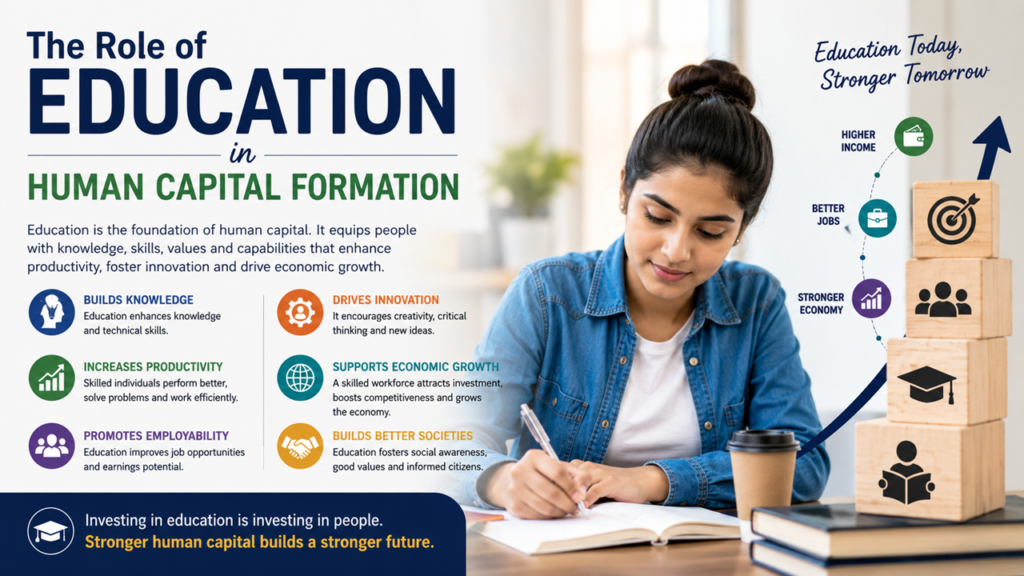
Education is not just about reading books or passing exams. In 2026, education is the most powerful tool a country has to build a strong economy, reduce poverty, and create a better future for its people. This blog will explain the role of education in human capital formation in the simplest way possible — so every student, parent, and teacher can understand it clearly.
Think about this: Why do some countries grow fast while others stay poor? The answer is often not just money or land — it is the skill and knowledge of their people. When people are educated, they become more productive, more creative, and more useful to society. This is the basic idea behind human capital formation.
What Is Human Capital Formation?
Before we understand the role of education in human capital formation, let us first understand what the term means.
Human capital is the collection of skills, knowledge, experience, and health that people carry within themselves. It is different from physical capital like machines or buildings. You cannot see human capital directly, but you can see its effects — in a doctor who saves lives, an engineer who builds bridges, or a teacher who shapes young minds.
Human capital formation is the process of building and improving these skills and abilities in people. It is like investing in a person the way a company invests in its equipment. When a government spends money on schools, colleges, hospitals, and training centres, it is investing in human capital.
| Type of Capital | Examples | Who Owns It |
| Physical Capital | Machines, buildings, roads | Businesses & Governments |
| Financial Capital | Money, stocks, bonds | Individuals & Institutions |
| Human Capital | Skills, knowledge, health | Individuals & Society |
| Social Capital | Networks, trust, relationships | Communities |
Education and Human Capital Development: The Connection
Education and human capital development are closely connected. In fact, education is considered the most important path to building human capital. When a person goes to school or college, they learn new things — how to read, calculate, think, and solve problems. These skills make them more capable workers and better citizens.
Let us look at this connection with a simple example:
A child who completes school is more likely to get a good job. A person with a good job earns more money. With more money, they can live a healthier life, send their own children to school, and contribute to the economy. This cycle of education → income → better life → more education is the engine of human capital development.
In 2026, this connection has become even stronger. With rapid changes in technology — especially artificial intelligence, automation, and digital tools — people need more education and training than ever before. A farmer in 2026 uses apps to predict weather and manage crops. A factory worker uses digital machines. Even a small shop owner uses online payment systems. Education gives people the skills to use these tools effectively.
The Role of Education in Human Capital Formation: 10 Key Ways
Now let us explore the role of education in human capital formation in detail. There are many ways in which education builds human capital. Here are the ten most important ones:
1. Education Builds Knowledge and Skills
The most basic role of education is to give people knowledge and practical skills. When a student learns mathematics, they can become an accountant or an engineer. When a student learns biology, they can become a doctor or a researcher. Education turns raw potential into usable talent.
In 2026, the skills that employers look for include digital literacy, critical thinking, communication, and teamwork. Schools and colleges that teach these skills are directly contributing to human capital formation.
2. Education Increases Worker Productivity
An educated worker can do more work, do it faster, and do it better. A typist who knows a computer can type 10 times more words per minute than someone who writes by hand. A teacher with a proper degree can explain concepts more clearly than an untrained one.
Higher productivity means the economy produces more goods and services with the same number of workers. This is one of the main reasons why education and economic development are so closely linked.
3. Education Improves Health Outcomes
Educated people know more about health, hygiene, and medicine. They are more likely to visit doctors, follow medical advice, and maintain a healthy lifestyle. They know the dangers of smoking, the importance of vaccines, and how to take care of their mental health.
Healthier workers are more productive. They miss fewer days of work. They live longer and contribute to the economy for more years. This is why health and education together form the two pillars of human capital formation.
4. Education Reduces Poverty
Poverty and lack of education go together. When people do not have education, they cannot get good jobs. Without good jobs, they stay poor. Their children often cannot go to school because of financial pressure, and the cycle continues.
Education breaks this cycle. When a first-generation learner gets a college degree and a good job, the whole family’s situation changes. Data from 2024-2025 shows that each additional year of schooling can increase a person’s income by 8-10% in developing countries.
5. Education Promotes Innovation and Technology
New inventions, new medicines, new apps, and new solutions — all of these come from educated people. The importance of education in human capital goes beyond getting a job. Educated people create new jobs, start businesses, and solve problems that benefit everyone.
India’s growing tech industry, for example, is directly built on the foundation of educated engineers and programmers who went through quality education systems. In 2026, countries with higher education and research investment are leading the world in artificial intelligence and green energy technology.
6. Education Builds Social Awareness and Citizenship
Education does not just create workers — it creates citizens. An educated person understands their rights and responsibilities. They can vote wisely, participate in community activities, and contribute to a fair and democratic society.
Social awareness leads to less corruption, better governance, and stronger communities. These are important but often invisible parts of human capital formation.
7. Education Empowers Women and Girls
One of the most powerful impacts of education on human capital development is the empowerment of women. When girls are educated, they get better jobs, marry later, have fewer and healthier children, and invest more in their children’s education.
Research shows that educating girls produces some of the highest returns on any investment a country can make. In 2026, countries with higher female literacy rates consistently show stronger economic growth and lower rates of poverty.
8. Education Develops Soft Skills
Hard skills like coding or accounting are important. But so are soft skills like communication, leadership, teamwork, and problem-solving. Modern education systems around the world are placing more focus on these skills because employers say they are equally important.
When a student learns how to work in a group, present ideas confidently, or handle failure without giving up — they are building human capital that will serve them throughout their life.
9. Education Adapts People to Change
The world in 2026 is changing very fast. Jobs that existed ten years ago may not exist in the next ten years. Education prepares people to adapt — to learn new skills, switch careers if needed, and stay relevant in a changing job market.
This is called lifelong learning, and it is a key idea in modern education and human capital development. When people are taught how to learn, not just what to learn, they become flexible and resilient workers.
10. Education Strengthens the Entire Economy
When more people are educated, the whole economy benefits. Businesses can find skilled workers. Governments collect more tax revenue. Social problems like crime and inequality decrease. Public services become better. This is the big picture of how education and economic development are connected.
Countries like South Korea, Singapore, and Finland have transformed their economies within a few decades primarily through massive investment in education. Their story is one of the clearest proofs of the importance of education in human capital.
Education Investment vs. Economic Growth: A 2026 Snapshot
Let us look at how some countries compare in terms of education spending and economic outcomes:
| Country | Education Spend (% of GDP) | Literacy Rate | HDI Rank (2025) | Key Strength |
| Finland | 6.3% | 99% | Top 5 | Teacher quality & equality |
| Singapore | 3.1% | 97% | Top 10 | Technical & vocational training |
| India | 4.4% | 77% | 132 | STEM graduates & IT sector |
| South Korea | 4.9% | 98% | Top 20 | Research & innovation |
| Nigeria | 1.9% | 62% | 163 | Growing but underfunded |
| Germany | 5.1% | 99% | Top 10 | Dual education system |
This table clearly shows that countries that invest more in education generally perform better on human development indicators. There are exceptions, but the overall trend is strong and consistent.
Education and Economic Development: Why They Cannot Be Separated
Education and economic development are two sides of the same coin. You cannot have strong, sustained economic growth without an educated population. And without economic growth, a country cannot afford to fund good education. They support each other.
How Education Drives Economic Development
Here is a simple chain of events that shows how education leads to economic development:
- Better schools → more educated workers
- More educated workers → higher productivity
- Higher productivity → more goods and services produced
- More production → higher GDP and national income
- Higher national income → more tax revenue for government
- More tax revenue → better roads, hospitals, and schools
- Better infrastructure → more business investment and job creation
This is called the virtuous cycle of education and economic development. Each step feeds the next, and the whole society benefits.
The Cost of Poor Education
On the other side, poor education is very expensive for a country — even if it seems like it saves money. When children drop out of school, they are more likely to be unemployed, earn lower wages, and require social support later in life. Poor education also increases crime rates, reduces innovation, and makes a country less competitive globally.
The World Bank estimates that learning poverty — where children cannot read properly by age 10 — costs countries trillions of dollars in lost economic output over time. This is a powerful reminder of why the importance of education in human capital cannot be ignored by any government or society.
New Trends in Education and Human Capital in 2026
Education in 2026 looks very different from what it was ten years ago. Here are some of the biggest changes and trends that are shaping education and human capital development today:
1. Digital and Online Learning
Millions of students around the world now learn through apps, online courses, and virtual classrooms. Platforms like Coursera, BYJU’S, Khan Academy, and many government e-learning portals have made education accessible to people who live in remote areas or cannot afford traditional schools.
This is a game-changer for human capital formation, especially in developing countries, because it removes many of the barriers that kept people from accessing quality education.
2. AI-Powered Personalized Learning
Artificial intelligence can now analyze how a student learns and create a customized study plan just for them. If a student struggles with algebra, the AI tutor gives them more practice in algebra. If they are strong in science, they get advanced material. This kind of personalized learning can dramatically improve educational outcomes and therefore accelerate human capital development.
3. Vocational and Technical Education
Not everyone needs a traditional college degree to build human capital. In 2026, there is a growing recognition that vocational and technical education — learning trades like plumbing, electrical work, coding, welding, and healthcare support — is equally valuable.
Countries like Germany have long used a dual education system where students spend time both in classrooms and in real workplaces. This approach creates highly skilled workers and is now being adopted by many other countries.
4. Focus on Lifelong Learning
In 2026, learning does not stop when you leave school. Companies train employees regularly. Governments run adult literacy programs. Online platforms offer micro-credentials — short courses that give you a specific, verifiable skill. This culture of lifelong learning is essential for keeping human capital strong in a rapidly changing economy.
5. STEM and Green Skills Education
With the growth of technology and the push toward sustainability, there is a huge demand for skills in Science, Technology, Engineering, and Mathematics (STEM) — as well as new green skills like solar panel installation, waste management, and environmental assessment. Education systems are updating their curricula to produce graduates with these in-demand skills.
| Skill Area | Why It Matters in 2026 | Example Careers |
| Digital Literacy | Almost every job now requires basic tech skills | Data Analyst, Digital Marketer |
| Critical Thinking | AI handles routine tasks; humans must solve complex problems | Manager, Researcher, Strategist |
| Communication | Collaboration across teams and cultures is key | Teacher, HR Manager, Journalist |
| STEM Skills | Drives innovation and technology sectors | Engineer, Scientist, Developer |
| Green/Sustainability Skills | Climate action demands new expertise | Environmental Officer, Solar Technician |
| Healthcare Skills | Aging populations need more healthcare workers | Nurse, Physiotherapist, Pharmacist |
Challenges in Education and Human Capital Formation
Even though we know how important education is, there are still many challenges that prevent education from fully doing its job. Let us look at some of the biggest ones:
1. Inequality in Access to Education
In many countries, children in rural or poor areas do not have access to the same quality of education as children in cities. This creates a two-tier system where some people build strong human capital and others are left behind. Solving this inequality is one of the most urgent tasks in education policy today.
2. Poor Quality of Teaching
Having a school building is not enough. If the teachers are not well-trained or motivated, students do not learn effectively. Many countries suffer from a shortage of qualified teachers, especially in science and mathematics.
3. High Dropout Rates
In many developing countries, a large percentage of students drop out before completing secondary school. Poverty, child marriage, family responsibilities, and lack of interest are common reasons. Keeping students in school — especially girls — is a critical challenge for human capital formation.
4. Mismatch Between Education and Job Market
Sometimes, students graduate with degrees that do not match what employers actually need. This is called the skills gap. Universities may produce too many graduates in some fields and too few in others. Bridging this gap requires constant communication between educational institutions and the industries that hire their graduates.
5. Rapid Technological Change
Technology is changing so fast that educational curricula struggle to keep up. A course designed five years ago may already be outdated. Education systems need to become more flexible and responsive to stay relevant.
What Governments Can Do to Strengthen Education and Human Capital
Governments play a crucial role in education and human capital development. Here are key actions that governments can take:
- Increase public spending on education — especially primary and secondary levels
- Invest in teacher training and pay teachers fairly to attract talented people to the profession
- Build schools in rural and underserved areas to reduce inequality
- Provide scholarships and financial aid to students from poor families
- Update school curricula regularly to match the demands of the modern economy
- Promote girls’ education and tackle cultural barriers that keep girls out of school
- Partner with industries to create vocational training programs
- Invest in early childhood education, which has the highest returns of any education investment
- Use technology to reach students in remote areas through e-learning programs
- Create policies that encourage lifelong learning and adult education
The UNESCO Global Education Monitoring Report (2025) recommends that countries should spend at least 4-6% of their GDP on education to achieve meaningful human capital formation and meet the Sustainable Development Goals by 2030.
Education and Human Capital Formation in India: 2026 Update
India is one of the most important examples to study when it comes to education and human capital development. With over 1.4 billion people, India has both enormous potential and significant challenges.
What India Has Achieved
- Literacy rate has risen to over 77%, up from about 12% at independence in 1947
- India produces the second-largest number of science and engineering graduates in the world
- The National Education Policy (NEP) 2020 has brought major reforms in school and higher education
- Digital India and PM eVidya programs have expanded online learning to millions
- India’s IT and software sector — built on educated engineers — contributes over 8% to GDP
What India Still Needs to Improve
- Reduce learning poverty — many students can complete school but still cannot read properly
- Improve quality and infrastructure of government schools in rural areas
- Increase female participation in higher education and STEM fields
- Better connect vocational education with industry needs
- Increase public education spending closer to the 6% of GDP target
What You Can Do as a Student: Building Your Own Human Capital
Human capital formation is not just a government responsibility. Every individual plays a role in building their own human capital. If you are a student reading this, here is what you can do:
- Take your education seriously — every subject you study adds to your human capital
- Develop both hard skills (like coding or accounting) and soft skills (like communication and teamwork)
- Read beyond your textbooks — books, articles, and online content expand your knowledge
- Learn digital skills — knowing how to use technology effectively is essential in 2026
- Take online courses in subjects that interest you or are in demand
- Find internships or part-time jobs to gain practical experience
- Stay curious — ask questions, explore new ideas, and never stop learning
- Take care of your health — a healthy mind and body are the foundation of all human capital
Remember: Every hour you spend learning is an investment in yourself. The skills and knowledge you build today will pay dividends for the rest of your life. This is the personal dimension of human capital formation — and it starts with you.
Conclusion:
When we look at the world in 2026, one truth stands out clearly: the countries that invest the most in education are the ones that grow the fastest, solve the biggest problems, and offer the best quality of life to their people.
The importance of education in human capital is not just an economic argument — it is a human argument. Education gives people dignity, opportunity, and the power to shape their own futures. It is the greatest equalizer in a world of inequality.
Education and economic development are not separate goals. They are one and the same path. When a child learns to read, a country grows. When a girl gets a college degree, a community transforms. When a worker learns a new skill, an economy adapts and thrives.
Human capital formation is not a one-time project — it is a lifelong journey that involves families, schools, governments, businesses, and individuals working together. And at the heart of it all, always, is education.
Frequently Asked Questions (FAQs)
Q1. What is the role of education in human capital formation?
Education is the primary way through which human capital is built. It gives people skills, knowledge, and abilities that make them more productive and valuable in the economy. Education also improves health, reduces poverty, and promotes innovation — all of which strengthen human capital.
Q2. What is the difference between human capital and physical capital?
Physical capital refers to tools, machines, and buildings used in production. Human capital refers to the knowledge, skills, and health of people. While physical capital depreciates over time, human capital can be continuously improved through education and training.
Q3. How does education contribute to economic development?
Education creates skilled workers who are more productive. Higher productivity leads to more goods and services being produced, which increases national income and GDP. Educated people also innovate, start businesses, and improve governance — all of which drive economic development forward.
Q4. Why is education important for human capital in developing countries?
In developing countries, human capital is often the most underutilized resource. Better education can break cycles of poverty, increase worker productivity, reduce inequality, and help countries climb the development ladder. The returns on education investment are especially high in countries where education levels are currently low.
Q5. What are the barriers to human capital formation through education?
Key barriers include poverty (families cannot afford school fees or need children to work), lack of quality schools, shortage of trained teachers, gender discrimination, geographic isolation, and curricula that do not match job market needs. Addressing these barriers is critical for effective human capital formation.
Q6. How is technology changing education and human capital development in 2026?
Technology is making education more accessible, personalized, and flexible. Online learning platforms, AI tutors, virtual classrooms, and digital tools are helping students learn faster and more effectively. They are also enabling lifelong learning, which is essential for keeping human capital relevant in a rapidly changing world.
Q7. Can vocational education build human capital like a university degree?
Absolutely. Vocational and technical education builds practical skills that are directly useful in the workplace. In many countries, skilled tradespeople like electricians, plumbers, and healthcare workers earn excellent incomes and contribute significantly to the economy. Human capital formation happens through any quality education that builds useful skills — university degree or not.
Q8. What is education in human capital formation for students specifically?
For students, education in human capital formation means using your time in school and college not just to get a certificate, but to genuinely build skills, knowledge, and capabilities that will make you more productive and successful throughout your life. It means learning how to learn, how to think, how to communicate, and how to adapt.

StudentsTalk.in, is an education-focused platform dedicated to helping students stay informed about the latest academic updates, scholarships, entrance exams, career opportunities, government schemes, and study resources. With a passion for education and student success, she creates informative, easy-to-understand content.