
Becoming a pilot is one of the most exhilarating and rewarding journeys a person can undertake. The Student Pilot License (SPL) is the foundational certification that marks your first official step into the world of aviation. Whether you dream of flying commercially across continents, performing aerial acrobatics, or simply enjoying the breathtaking freedom of weekend flights, the SPL is your gateway. But before you can take the controls, you must demonstrate theoretical knowledge and pass a structured written examination.
This comprehensive guide is designed specifically for aspiring pilots preparing for the SPL written exam. We cover every major subject area that appears in the examination — from meteorology and navigation to air law, aircraft systems, and human performance. Each section includes explanations of core concepts, common exam question formats, and insider tips that will help you walk into your examination room fully confident.
The SPL written examination is administered by civil aviation authorities worldwide — the Directorate General of Civil Aviation (DGCA) in India, the Federal Aviation Administration (FAA) in the United States, the Civil Aviation Safety Authority (CASA) in Australia, and equivalent bodies in other countries. While specific question sets vary by country, the core subject matter is largely standardized through International Civil Aviation Organization (ICAO) guidelines. This guide covers the universally tested knowledge areas that all student pilot exams share.
Tip: Begin your study at least 3 months before your scheduled exam. Use this guide in combination with your Ground School materials and official AIP (Aeronautical Information Publication) documents.
Section 1: Air Law and ATC Procedures
1.1 Understanding Air Law
Air law governs all aspects of civil aviation — from the registration of aircraft to the behavior of pilots and air traffic controllers. It is one of the heaviest-weighted subjects on the SPL written exam and requires careful study. Air law is derived from international conventions (primarily the Chicago Convention of 1944, which established ICAO), national civil aviation acts, and local regulations published in the AIP.
Key Topics in Air Law
- The Chicago Convention: Establishes the rules of international air navigation and the framework for national civil aviation authorities.
- ICAO Annexes: Understand Annexes 1 (Personnel Licensing), 2 (Rules of the Air), 6 (Operation of Aircraft), and 11 (Air Traffic Services).
- Right of Way Rules: Aircraft in distress have right of way over all others. Among aircraft of equal priority, specific geometric rules apply.
- Visual Flight Rules (VFR) vs Instrument Flight Rules (IFR): Know when each applies and the minimum weather conditions required.
- Airspace Classification: Class A through G, with associated rules for entry, separation, and services provided.
- Aircraft Nationality and Registration Marks: Every aircraft must display its nationality mark and registration mark in a visible location.
- Certificate of Airworthiness: An aircraft must hold a valid CofA to operate. Understand the requirements for issue and renewal.
1.2 Common Exam Questions — Air Law
| Exam Question | Correct Answer / Key Concept |
| Which ICAO Annex deals with Rules of the Air? | Annex 2 — Rules of the Air |
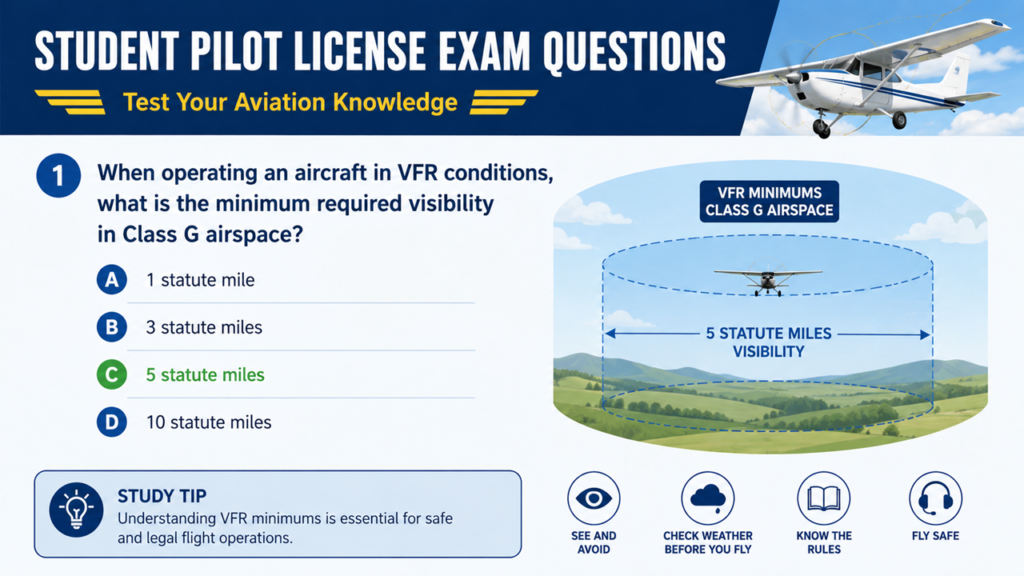
| What is the minimum flight visibility for VFR flight below 3000 ft AMSL? | Generally 5 km (varies by jurisdiction; check your local AIP) |
| An aircraft in distress has right of way over: | All other aircraft |
| What document authorizes an aircraft to fly? | Certificate of Airworthiness (CofA) |
| Class G airspace is: | Uncontrolled airspace — no ATC clearance required |
1.3 ATC Communications and Phraseology
Clear, unambiguous radio communication is a critical safety skill. Student pilots must learn standard ICAO phraseology and the phonetic alphabet. Every transmission follows a pattern: who you’re calling, who you are, where you are, and what you want.
The Phonetic Alphabet (ICAO)
Alpha, Bravo, Charlie, Delta, Echo, Foxtrot, Golf, Hotel, India, Juliet, Kilo, Lima, Mike, November, Oscar, Papa, Quebec, Romeo, Sierra, Tango, Uniform, Victor, Whiskey, X-ray, Yankee, Zulu.
Standard Call-out Structure
- Station being called (e.g., ‘Delhi Approach’)
- Your callsign (e.g., ‘VT-XYZ’)
- Your position (e.g., ‘Ten miles south of Delhi’)
- Your request (e.g., ‘Request traffic information’)
Exam Tip: Questions on ATC phraseology often test knowledge of readback requirements. Always read back clearances involving altitudes, headings, runway numbers, and transponder codes.
Section 2: Meteorology for Pilots
2.1 The Atmosphere
The atmosphere is the invisible medium through which all flight takes place. A pilot’s understanding of atmospheric science directly affects decision-making and safety. The atmosphere is divided into several layers, but pilots primarily operate in the troposphere — the lowest layer, extending from the surface to approximately 36,000 feet (11 km) at mid-latitudes.
Atmospheric Layers
- Troposphere: Surface to ~36,000 ft. Contains all weather. Temperature decreases at the standard lapse rate of approximately 2°C per 1000 ft (3°C per 1000 m).
- Stratosphere: 36,000 ft to ~160,000 ft. Temperature is roughly constant in the lower portion, then increases.
- Tropopause: The boundary between the troposphere and stratosphere. Temperature inversion occurs here.
2.2 Pressure, Temperature, and Density
Atmospheric pressure decreases with altitude at approximately 1 hPa per 30 feet in the lower atmosphere. Temperature and pressure together determine air density, which is critical for aircraft performance. High density altitude (hot, high, humid conditions) significantly reduces lift and engine performance.
Density Altitude — Why It Matters
Density altitude is pressure altitude corrected for non-standard temperature. On a hot day at a high-elevation airport, density altitude can be thousands of feet above actual airport elevation. This means the aircraft ‘thinks’ it is at a much higher altitude, requiring longer takeoff rolls, reduced climb rates, and higher true airspeeds at the same indicated airspeed.
Density Altitude = Pressure Altitude + [120 × (OAT − ISA Temperature)]
2.3 Wind and Its Effects on Flight
Wind is air in motion relative to the Earth’s surface. For pilots, understanding wind at all levels — surface, low level, and upper level — is essential for navigation, fuel planning, and safety.
- Surface Wind: Reported in magnetic degrees at major aerodromes, true degrees for en-route forecasts.
- Wind Shear: A sudden change in wind speed or direction over a short distance. Especially hazardous near thunderstorms and during approach/departure.
- Microbursts: Intense, localized downdrafts from convective activity. A leading cause of aviation accidents during approach and landing.
- Jet Streams: Fast-moving ribbons of air at high altitudes (above FL250). Affect fuel burn and flight times significantly.
2.4 Clouds and Precipitation
Cloud classification is a fundamental meteorology topic on the SPL exam. Clouds are classified by altitude and form. The four basic forms are cumulus (heaped), stratus (layered), cirrus (wispy, high-level ice crystals), and nimbus (rain-producing).
| Cloud Family | Altitude (Approx.) | Cloud Types |
| High | Above 20,000 ft | Cirrus, Cirrocumulus, Cirrostratus |
| Middle | 6,500 – 20,000 ft | Altocumulus, Altostratus |
| Low | Surface – 6,500 ft | Stratus, Stratocumulus, Nimbostratus |
| Vertical | Surface to 60,000+ ft | Cumulus, Cumulonimbus |
2.5 Aviation Weather Reports and Forecasts
Pilots must be proficient in reading and interpreting aviation weather products. These are standardized globally by ICAO and are critical for pre-flight planning.
METAR — Meteorological Aerodrome Report
A METAR is a routine weather observation issued hourly (or half-hourly at major airports). It reports actual conditions at the time of observation, including wind, visibility, weather phenomena, cloud cover, temperature, dew point, and altimeter setting.
Sample METAR: VIDP 021630Z 22015KT 6000 HZ FEW030 SCT100 32/18 Q1008 NOSIG — This METAR for Delhi (VIDP) at 1630Z shows wind from 220° at 15 knots, visibility 6 km in haze, few clouds at 3000 ft, scattered at 10,000 ft, temperature 32°C, dew point 18°C, QNH 1008 hPa, no significant change expected.
TAF — Terminal Area Forecast
A TAF is a forecast of conditions at an aerodrome, typically valid for 24 or 30 hours. It uses the same code format as METAR and is essential for planning arrivals and departures.
SIGMET and AIRMET
- SIGMET (Significant Meteorological Information): Warns of hazardous weather significant to all aircraft — severe turbulence, severe icing, volcanic ash, tropical cyclones.
- AIRMET: Similar but for lighter aircraft; covers moderate turbulence, moderate icing, mountain obscuration.
Section 3: Navigation Principles
3.1 Basic Navigation Concepts
Navigation is the art and science of determining the position of an aircraft and guiding it from one point to another safely and efficiently. For student pilots operating under VFR (Visual Flight Rules), navigation primarily relies on visual references, charts, and basic instruments.
Core Navigation Terms
- True North vs Magnetic North: True North is the geographic north pole. Magnetic North is where the Earth’s magnetic field points. The difference between them is called variation (or declination).
- Magnetic Variation: Must be applied to convert True headings to Magnetic headings. West is Best, East is Least — when variation is West, add it to True to get Magnetic; when East, subtract.
- Deviation: Compass error caused by the aircraft’s own magnetic fields. Corrected using a compass deviation card.
- Track: The intended path over the ground.
- Heading: The direction the aircraft’s nose is pointing.
- Course: The intended route from departure to destination.
3.2 The Triangle of Velocities
Wind affects the actual path of the aircraft over the ground. The Triangle of Velocities is a graphical or mathematical method used to calculate the effect of wind on an aircraft’s track and groundspeed. It involves three vectors: Heading/True Airspeed (the direction and speed through the air), Wind Velocity (wind direction and speed), and Track/Groundspeed (the actual path and speed over the ground).
Wind Correction Angle (WCA)
When wind is blowing, the pilot must point the aircraft into the wind slightly (upwind) to maintain the desired track over the ground. The angle between the heading and the track is the Wind Correction Angle. It is calculated using the navigation computer (whiz wheel) or electronic flight computers.
3.3 Aviation Charts
Aeronautical charts are specially designed maps that provide pilots with information relevant to flight. The most commonly used chart for VFR navigation is the Visual Navigation Chart (VNC) or Sectional Chart, which depicts terrain, airspace boundaries, aerodromes, navigation aids, and obstacles.
- Scale: Charts are produced at various scales. 1:500,000 is common for VFR en-route charts.
- Topographic Information: Contour lines, spot elevations, and colour shading indicate terrain height.
- Aerodrome Symbols: Different symbols denote certified aerodromes, heliports, and water aerodromes.
- Navigation Aids (NAVAIDs): VORs, NDBs, and DMEs are depicted with compass roses or frequency boxes.
- Airspace Depictions: Different boundary types indicate various classes of airspace.
3.4 Dead Reckoning Navigation
Dead Reckoning (DR) is the process of calculating your current position based on a known past position, then advancing that position using speed, time, and heading. It is the most fundamental form of navigation and forms the basis of VFR flight planning.
Distance = Groundspeed × Time | Time = Distance ÷ Groundspeed
Exam Tip: Be very comfortable with the navigation computer (E6B or equivalent). Many exam questions require time-distance-speed calculations, fuel planning, and wind correction angle computations.
Section 4: Aircraft General Knowledge
4.1 The Four Forces of Flight
Every pilot must have a thorough understanding of the four forces that act on an aircraft in flight. These forces — Lift, Weight, Thrust, and Drag — determine whether an aircraft climbs, descends, accelerates, or maintains level flight.
| Force | Direction | Generated By |
| Lift | Upward (perpendicular to relative airflow) | Wings (aerofoil action) |
| Weight | Downward (toward Earth’s center) | Gravity acting on aircraft mass |
| Thrust | Forward (direction of travel) | Engine/propeller |
| Drag | Rearward (opposing motion) | Air resistance on the aircraft |
4.2 How a Wing Generates Lift
The wing (aerofoil) is shaped so that air flowing over the curved upper surface must travel faster than air flowing under the flatter lower surface. According to Bernoulli’s Principle, faster-moving air exerts lower pressure. This pressure differential — lower pressure above, higher pressure below — creates an upward force called lift.
Additionally, the wing is set at a small angle to the oncoming airflow (angle of attack), which deflects air downward. By Newton’s Third Law (action-reaction), the wing is pushed upward.
Factors Affecting Lift
- Airspeed: Lift increases as the square of airspeed. Doubling speed quadruples lift.
- Angle of Attack (AoA): Increasing AoA increases lift — up to the critical angle.
- Wing Area: Greater area produces more lift at the same speed and AoA.
- Air Density: Denser air produces more lift. High altitude and hot temperatures reduce density and thus reduce lift.
- Wing Shape (Camber): More curved wings generate more lift at lower speeds.
4.3 Aircraft Control Surfaces
Three primary control surfaces govern the movement of an aircraft around its three axes of rotation. Understanding these surfaces and the axes they control is fundamental to all aspects of pilot training.
- Ailerons (Longitudinal Axis — Roll): Located on the outer trailing edge of each wing. Moving the control wheel/stick left causes the left aileron to rise and the right aileron to lower, rolling the aircraft to the left.
- Elevator (Lateral Axis — Pitch): Located on the horizontal tail. Pulling back raises the elevator, increases AoA, and pitches the nose up. Pushing forward lowers the nose.
- Rudder (Vertical Axis — Yaw): Located on the vertical tail fin. Pressing the left rudder pedal deflects the rudder left, yawing the nose left.
Secondary / Auxiliary Controls
- Flaps: Increase lift and drag. Used to allow slower approach speeds and steeper descent angles.
- Trim Tabs: Small surfaces on primary control surfaces that relieve control pressure at a given flight condition.
- Spoilers/Airbrakes: Increase drag and reduce lift for speed control.
4.4 Powerplant Fundamentals
Most training aircraft use a reciprocating (piston) engine. Understanding the four-stroke cycle is essential for the SPL examination. The four strokes are: Intake (fuel-air mixture drawn in), Compression (mixture compressed by the piston), Power (ignition causes explosion, driving piston down), and Exhaust (burnt gases expelled).
Engine Systems
- Carburetor: Mixes air and fuel in the correct ratio. Subject to carburetor icing in certain temperature and humidity conditions. The carburetor heat control vaporizes ice by drawing warm air from around the exhaust.
- Fuel System: Aircraft typically use AVGAS 100LL (low lead). Know the colour coding: blue for 100LL. Always check for water contamination during pre-flight by draining fuel from sumps.
- Oil System: Engine oil lubricates and cools the engine. Monitor oil pressure and temperature gauges continuously in flight.
- Ignition System: Aircraft engines use dual magneto ignition — two independent systems providing a safety backup and better combustion.
Section 5: Flight Performance and Planning
5.1 Weight and Balance
Weight and Balance (W&B) is arguably the most safety-critical calculation a pilot performs before every flight. An aircraft that is overloaded or loaded outside its center of gravity (CG) limits can be impossible to control and may not be airworthy even if technically within weight limits.
Key Weight Definitions
- Maximum Takeoff Weight (MTOW): The maximum permitted weight for takeoff.
- Maximum Landing Weight (MLW): May be less than MTOW due to structural considerations.
- Empty Weight (EW): Weight of the aircraft as manufactured, with unusable fuel and standard fluids.
- Useful Load: MTOW minus Empty Weight. Includes pilot, passengers, baggage, and usable fuel.
- Zero Fuel Weight (ZFW): Total weight minus usable fuel.
Center of Gravity (CG)
The CG is the point at which the total weight of the aircraft acts. It must fall within defined forward and aft limits for the aircraft to be controllable. The W&B calculation uses moments (weight × arm distance from the datum) to determine the CG location.
Exam Formula: Moment = Weight × Arm. Total CG = Total Moment ÷ Total Weight. Always check this falls within the CG envelope shown in the Pilot Operating Handbook (POH) or Aircraft Flight Manual (AFM).
5.2 Takeoff and Landing Performance
Performance charts in the Pilot’s Operating Handbook (POH) allow pilots to calculate takeoff and landing distances under various conditions. Factors affecting performance include pressure altitude, temperature, wind, runway slope, and surface condition.
- Headwind: Reduces required takeoff and landing distance (favorable).
- Tailwind: Increases required distance significantly. A 10-knot tailwind may add 20–25% to the takeoff roll.
- Upslope Runway: Increases takeoff distance, decreases landing distance.
- High Density Altitude: Requires longer takeoff and landing rolls. Engine and wing produce less performance.
- Wet or Contaminated Runway: Increases landing distance considerably due to reduced braking effectiveness.
5.3 Fuel Planning
A student pilot must plan fuel requirements for every flight. Regulatory minimums typically require VFR day flights to carry enough fuel to reach the destination plus a reserve (commonly 30 minutes, or 45 minutes in some jurisdictions). Good practice is to carry significantly more.
Fuel Required = (Trip Fuel) + (Alternate Fuel) + (Reserve Fuel) + (Contingency)
Section 6: Human Performance and Limitations
6.1 Hypoxia — The Silent Killer
Hypoxia is a deficiency of oxygen reaching the body’s tissues. It is particularly dangerous because the impaired brain cannot recognize its own impairment — the pilot may feel euphoric and confident while actually becoming incapacitated. Hypoxia can occur at cabin altitudes above 10,000 ft in unpressurized aircraft.
Types of Hypoxia
- Hypoxic Hypoxia: Insufficient oxygen in the inspired air (altitude).
- Hypemic (Anemic) Hypoxia: Blood cannot carry sufficient oxygen — caused by carbon monoxide poisoning or anemia.
- Stagnant Hypoxia: Circulation is too slow — caused by high G-forces or heart disease.
- Histotoxic Hypoxia: Cells cannot use oxygen — caused by alcohol or drugs.
Symptoms of Hypoxia
Early signs include increased rate of breathing, euphoria, headache, fatigue, and impaired judgment. Advanced hypoxia causes cyanosis (blue lips/fingertips), loss of muscular control, and unconsciousness. The time of useful consciousness (TUC) at 25,000 ft is only 3–5 minutes.
6.2 Spatial Disorientation and Vestibular Illusions
The human body is not designed to fly. Without external visual references (such as in cloud or at night), a pilot’s vestibular system (inner ear) can generate profoundly misleading sensations of aircraft attitude.
- The Leans: After a gradual, undetected roll, the pilot may feel upright. When the bank is corrected, the pilot feels banked in the opposite direction and may re-bank the aircraft.
- Graveyard Spiral: A prolonged coordinated turn leads the pilot to perceive level flight. Attempting to pull back only tightens the spiral.
- Somatogravic Illusion: Rapid acceleration creates the sensation of nose-high pitch attitude, causing the pilot to push the nose down.
- Coriolis Illusion: Moving the head during a prolonged turn generates tumbling sensations.
Key Rule: Trust your instruments over your senses when flying in IMC or low visibility. Spatial disorientation is a leading cause of fatal general aviation accidents.
6.3 Fatigue and Sleep Deprivation
Fatigue significantly impairs decision-making, reaction time, and vigilance — all critical pilot skills. Aviation regulations impose duty time limitations and rest requirements to prevent fatigue-related accidents. Student pilots should never fly when fatigued, after working a full shift, or with less than 8 hours of quality sleep.
6.4 Alcohol and Medications
Aviation regulations are strict regarding alcohol and drug use. The FAA, for example, prohibits flight within 8 hours of consuming alcohol (‘8 hours bottle to throttle’) and requires a blood alcohol level below 0.04%. However, the ‘hangovers’ of alcohol — impaired judgment, dehydration, increased susceptibility to hypoxia — can persist well beyond 8 hours. The prudent standard is 24 hours.
Many common over-the-counter medications have significant effects on pilot performance — antihistamines cause drowsiness, decongestants can cause nervousness, and some antibiotics cause photosensitivity or dizziness. Always consult an Aviation Medical Officer (AMO) before flying while taking any medication.
6.5 Decision Making — The DECIDE Model
Good aeronautical decision making (ADM) is a structured mental process that enables pilots to make consistently sound choices in all circumstances, including emergencies. One widely taught model is DECIDE:
- Detect: Recognize that a change has occurred and a decision must be made.
- Estimate: Estimate the significance of the change to flight safety.
- Choose: Choose a desired outcome from the available options.
- Identify: Identify actions needed to achieve the chosen outcome.
- Do: Take the necessary action.
- Evaluate: Evaluate the effect of the action.
Section 7: Flight Instruments
7.1 Pitot-Static System
The pitot-static system provides the pressure inputs needed to operate the three primary performance instruments: the Airspeed Indicator (ASI), the Altimeter, and the Vertical Speed Indicator (VSI). The pitot tube measures total (ram) pressure from forward motion. Static ports measure ambient static pressure.
Airspeed Indicator (ASI)
The ASI measures the pressure difference between total pressure (pitot) and static pressure. This gives Indicated Airspeed (IAS). Key speed definitions (marked on the ASI with colored arcs) include:
- Vso (White arc bottom): Stall speed in landing configuration.
- Vs1 (Green arc bottom): Stall speed in clean configuration.
- Vno (Green arc top / Yellow arc bottom): Maximum structural cruising speed.
- Vne (Red line): Never-exceed speed — beyond this, structural failure is possible.
- Vfe (White arc top): Maximum flap-extended speed.
Altimeter
The altimeter measures static pressure and converts it to altitude. It must be set to the correct local pressure setting (QNH — sea-level equivalent pressure) for accurate altitude indication above mean sea level. Before takeoff, setting QNH and confirming the altimeter reads airport elevation is standard procedure.
- QNH: Local mean sea level pressure. Sets altimeter to read AMSL altitude.
- QFE: Pressure at aerodrome level. Altimeter reads height above aerodrome (reads zero on ground).
- QNE: Standard atmosphere pressure (1013.25 hPa). Used above the transition altitude (Flight Levels).
7.2 The Gyroscopic Instruments
Three key instruments use gyroscopes to provide attitude and heading information: the Attitude Indicator (AI), the Heading Indicator (HI/DI), and the Turn Coordinator (TC).
- Attitude Indicator (AI): Shows the aircraft’s pitch and bank attitude relative to the horizon. Powered by vacuum/suction or electrically. Critical for flight in IMC.
- Heading Indicator (DI/HI): Shows magnetic heading. Must be periodically aligned with the magnetic compass (every 10–15 minutes) because gyroscopic precession causes it to drift.
- Turn Coordinator: Shows rate of turn and indicates whether the turn is coordinated (no sideslip). The ball in the inclinometer should be centered during all turns.
7.3 The Magnetic Compass
The magnetic compass is the only self-contained magnetic heading instrument — it requires no electrical or vacuum power. However, it is subject to several errors that pilots must understand:
- Variation: Angle between True North and Magnetic North. Applied as East is Least, West is Best (for TN to MN conversion).
- Deviation: Caused by the aircraft’s magnetic fields. Shown on the compass deviation card.
- Dip Error (Northerly Turning Error): In the northern hemisphere, the compass lags behind when turning from North and leads when turning from South.
- Acceleration Error (ANDS): Accelerating on an East or West heading shows a North indication; Decelerating shows South.
Section 8: Airfield Operations and Emergency Procedures
8.1 Aerodrome Information
Student pilots must be familiar with aerodrome markings, signs, and lighting systems. These are standardized by ICAO and provide essential information for safe ground and air operations.
Runway Markings
- Runway Designation: Numbers indicate the magnetic heading in tens of degrees (e.g., Runway 27 = 270°).
- Threshold Markings: White stripes across the width of the runway mark the usable beginning.
- Aiming Point Markings: Large white rectangles approximately 1000 ft from the threshold.
- Touchdown Zone Markings: Series of white bars indicating distance from the threshold.
- Displaced Threshold: A threshold marking that is not at the physical end of the paved surface. The area behind it may be used for taxi and takeoff but not landing.
Taxiway Markings and Signs
- Yellow centerline markings guide the aircraft along the taxiway.
- Runway Hold Short Lines: Double solid and dashed yellow lines — always stop before crossing without ATC clearance.
- Mandatory Signs: Red background — runway designations, critical areas, NO ENTRY.
- Location Signs: Black background — shows current position (which taxiway you are on).
- Direction Signs: Yellow background — shows intersecting taxiways.
8.2 Circuit Pattern (Traffic Pattern)
The aerodrome traffic circuit is a standardized path flown by all aircraft to join, operate within, and depart from an aerodrome’s airspace in an orderly fashion. The standard circuit is flown at approximately 1000 ft AGL (Above Ground Level) and consists of five legs:
- Upwind Leg: Straight out from the takeoff end of the runway, climbing to circuit height.
- Crosswind Leg: Turn 90° (usually to the left) at circuit height.
- Downwind Leg: Parallel to the runway, in the opposite direction to landing. Complete pre-landing checks here.
- Base Leg: Turn 90° toward the runway, begin descent.
- Final Leg: Aligned with the runway, full flap, stabilized approach to landing.
8.3 Emergency Procedures
The SPL exam will test knowledge of both procedural emergencies (those requiring specific checklist actions) and judgement emergencies (requiring decision-making skills). Key emergency procedures all student pilots must know include:
Engine Failure After Takeoff
This is one of the most time-critical emergencies. The memory drill is: Lower nose immediately to maintain flying speed. Do not attempt to turn back to the runway (below 500 ft AGL — impossible safely). Select a field straight ahead or within a narrow angle. Attempt restart only if time permits. Declare Mayday on current frequency.
Engine Failure in Cruise
In cruise, the pilot has more time. The ‘FORCED LANDING’ or ‘EFATO’ checklist applies: maintain best glide speed to maximize range, select a suitable field, attempt restart using the checklist (fuel on, fuel pump on, mixture rich, carb heat, ignition check), declare emergency, squawk 7700, and prepare for landing.
Memory Aid: In any emergency — Aviate, Navigate, Communicate. Fly the aircraft first, always.
Section 9: Practice Exam Questions
Full Mock Exam — 30 Questions
The following 30 questions represent the format and difficulty level typical of the SPL written examination. Study each question, cover the answer, attempt it, then review the explanation.
Air Law
- Q1: Which ICAO Annex covers Rules of the Air? — Answer: Annex 2.
- Q2: The minimum age to fly solo in most countries is? — Answer: 16 years.
- Q3: A student pilot may act as PIC only when? — Answer: On a solo flight specifically authorized by the flight instructor.
- Q4: Class D airspace requires which of the following to enter? — Answer: Two-way radio contact with ATC (no clearance required, but contact must be established).
- Q5: Aircraft registration marks are defined in which ICAO Annex? — Answer: Annex 7.
Meteorology
- Q6: What phenomenon is associated with the tropopause? — Answer: Temperature inversion; jet streams; clear air turbulence.
- Q7: A METAR observation code ‘SCT018’ means? — Answer: Scattered clouds at 1800 ft AGL.
- Q8: Carburetor icing is most likely in temperatures of? — Answer: Between -10°C and +30°C with high relative humidity, especially at around 0°C to +10°C.
- Q9: Wind shear on approach is most hazardous because? — Answer: It causes sudden, unexpected changes in airspeed, potentially causing the aircraft to undershoot the runway.
- Q10: A QNH setting of 1013 hPa is significant because? — Answer: It is the ICAO Standard Atmosphere sea level pressure. Altimeter set to 1013 reads Flight Level (FL) not AMSL altitude.
Navigation
- Q11: Magnetic variation ‘West’ means? — Answer: Magnetic North is west of True North. To convert TN to MN, add westerly variation.
- Q12: A VOR bearing of 090° from the station means the aircraft is? — Answer: Due East of the station (the 090 radial runs East from the VOR).
- Q13: Time = 45 minutes, Groundspeed = 120 knots. What is the distance? — Answer: 90 NM (120 × 45/60 = 90).
- Q14: The 1 in 60 rule states that at 60 NM, 1° of track error equals how many NM off track? — Answer: 1 NM off track.
- Q15: Dead Reckoning is defined as? — Answer: Estimating current position based on known position, heading, speed, and time elapsed.
Aircraft General Knowledge
- Q16: The left aileron goes up when the pilot? — Answer: Turns the control wheel/stick to the left.
- Q17: Bernoulli’s Principle explains lift because? — Answer: Faster-moving air over the wing has lower pressure than slower-moving air below, creating upward lift.
- Q18: AVGAS 100LL is identified by its colour: — Answer: Blue.
- Q19: The purpose of carburetor heat is? — Answer: To melt ice that forms in the carburetor by warming incoming air using exhaust heat.
- Q20: Vno is: — Answer: Maximum structural cruising speed — not to be exceeded in turbulence (top of green arc).
Performance and Planning
- Q21: A tailwind during takeoff: — Answer: Increases takeoff distance significantly.
- Q22: CG forward of the forward limit causes? — Answer: Nose-heavy handling; may make pulling back on the elevator impossible at low speeds.
- Q23: Density altitude is high when? — Answer: Temperature is high AND pressure altitude is high (hot, high, humid conditions).
- Q24: Required VFR day fuel reserve is typically? — Answer: 30 minutes (varies by jurisdiction — know your local regulation).
- Q25: Stall speed increases when? — Answer: Weight increases, bank angle increases, or CG moves aft (generally speaking weight is the primary factor).
Human Performance
- Q26: The first symptom of hypoxia is usually? — Answer: Impaired judgment and euphoria — insidious because the pilot feels fine.
- Q27: The DECIDE model step after ‘Choose’ is? — Answer: Identify — identify the actions needed to achieve the chosen outcome.
- Q28: ‘The Leans’ is a type of? — Answer: Vestibular (spatial) disorientation.
- Q29: Minimum time after alcohol before flying (FAA standard)? — Answer: 8 hours, with BAC below 0.04%.
- Q30: Fatigue impairs pilots primarily by affecting? — Answer: Decision-making, reaction time, situational awareness, and communication.
Section 10: Study Strategy and Exam Tips
10.1 Building Your Study Plan
Passing the SPL written exam requires consistent, structured study. A well-organized 12-week study plan is recommended, allocating time proportionally to each subject’s weight in the examination. Air Law, Meteorology, and Navigation typically carry the most marks and deserve the most study time.
Recommended Weekly Study Schedule
- Weeks 1–2: Air Law — Complete the national aviation regulations and ICAO annexes. Read your country’s AIP General and Enroute sections.
- Weeks 3–4: Meteorology — Study the atmosphere, weather patterns, and aviation weather products. Practice decoding METARs and TAFs daily.
- Weeks 5–6: Navigation — Master chart reading, the E6B computer, and flight planning. Complete at least 10 full navigation problems.
- Weeks 7–8: Aircraft General Knowledge — Work through your training aircraft’s POH/AFM. Understand every system and limitation.
- Weeks 9–10: Human Performance, Instruments, and Emergency Procedures.
- Weeks 11–12: Revision and Mock Exams — Sit full mock exams under timed conditions. Review every wrong answer and understand why the correct answer is correct.
10.2 Exam-Day Tips
- Read each question carefully — many questions contain ‘not’, ‘except’, or ‘least likely’ which completely change the correct answer.
- Answer every question — there is no penalty for guessing in most SPL exams.
- Flag uncertain questions and return to them after completing the rest.
- Use the process of elimination — even if you are unsure, eliminating obviously wrong answers improves your odds.
- Manage your time — most exams allow approximately 1–2 minutes per question.
- Check units carefully in calculation questions — ensure you are working in knots vs km/h, ft vs m, and so on.
- Know your national exam format — how many questions, what passing score (usually 70–75%), and time allowed.
10.3 Recommended Resources
- Pilot’s Operating Handbook (POH) for your training aircraft — the primary technical reference.
- ICAO Document 8168 (PANS-OPS) for approach and departure procedures.
- Your National AIP (Aeronautical Information Publication) — available free online from your civil aviation authority.
- Jeppesen Private Pilot Manual — an internationally used textbook covering all ground school subjects.
- Rod Machado’s Private Pilot Handbook — highly readable with excellent diagrams.
- CAA / DGCA / FAA sample question banks — official practice questions are the most representative.
- Aviation Weather Services (AC 00-45 for FAA; equivalent for other authorities) for meteorology.
Conclusion:
The journey to becoming a licensed pilot is demanding, intellectually stimulating, and deeply rewarding. The Student Pilot License written examination is your first significant academic hurdle — and with the right preparation, it is absolutely achievable.
This guide has covered all major examination subjects: Air Law and ATC procedures, Meteorology, Navigation, Aircraft General Knowledge and Systems, Flight Performance and Planning, Human Performance and Limitations, Flight Instruments, and Aerodrome Operations. Each of these topics is not just an exam subject — it is a pillar of real-world flight safety.
Remember that the purpose of this examination is not just to issue a license — it is to ensure that every person who takes the controls of an aircraft has the foundational knowledge to do so safely. Every question you study, every formula you memorize, and every weather chart you learn to read contributes directly to your safety and the safety of everyone who will ever fly with you.

StudentsTalk.in, is an education-focused platform dedicated to helping students stay informed about the latest academic updates, scholarships, entrance exams, career opportunities, government schemes, and study resources. With a passion for education and student success, she creates informative, easy-to-understand content.