If you have ever thought about becoming a teacher, chances are someone told you to do a B.Ed. But what exactly is B.Ed? What does it stand for? Who can do it? And most importantly, is it still worth doing in 2026? These are fair questions, and you deserve clear, honest answers — not just recycled information from five years ago.
This guide covers everything you need to know about B.Ed in 2026, including the latest eligibility rules, updated course structure, admission process, top colleges, job opportunities, and salary expectations. Whether you are a fresh graduate deciding your next step or someone looking to switch careers into teaching, this article is written for you.
What is B.Ed? Full Form and Basic Meaning
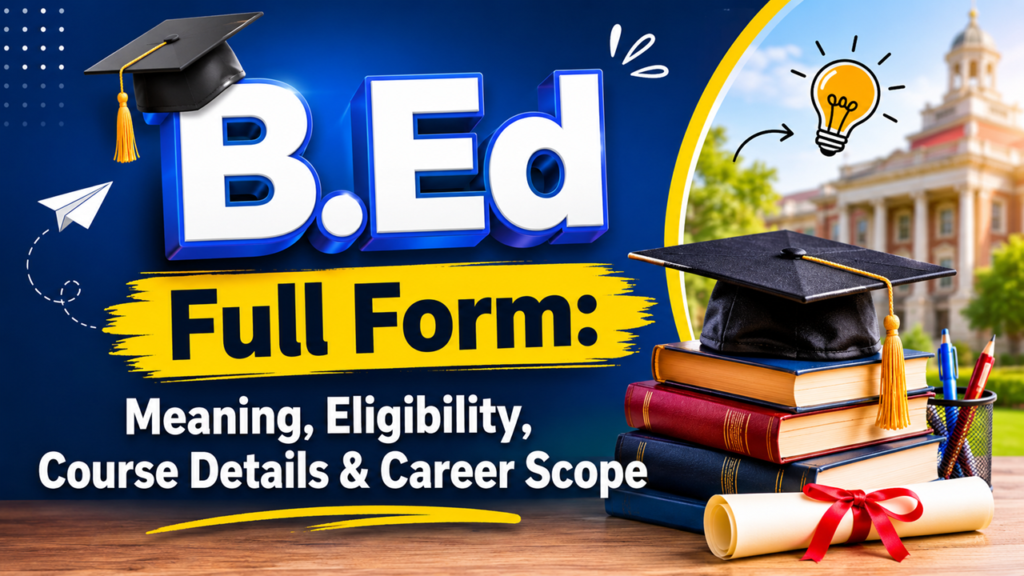
B.Ed stands for Bachelor of Education. It is a professional undergraduate degree programme designed to train individuals to become qualified school teachers. The course focuses on both the theory of education and the practical skills needed to teach students effectively in classroom settings.
In India, B.Ed is governed and regulated by the National Council for Teacher Education (NCTE), which sets the standards, curriculum guidelines, and eligibility norms for the course across the country. Without a valid B.Ed degree from an NCTE-recognized institution, a person cannot legally teach in government or most private schools in India.
The programme is not just about learning subject matter. It is about learning how to teach, how to manage a classroom, how to understand child psychology, how to design lessons, and how to assess student performance. In short, it turns subject knowledge into teaching ability.
B.Ed vs BEd — Is There a Difference?
No, there is no difference. B.Ed and BEd are simply two different ways of writing the same thing. Some universities write it as B.Ed (with a full stop after B), while others write BEd or B.Ed. They all mean Bachelor of Education. Do not let the spelling variations confuse you.
Duration of the B.Ed Course in 2026
As of 2026, the standard B.Ed programme is a 2-year full-time course divided into four semesters. This has been the norm since the NCTE revised its regulations back in 2014, replacing the earlier 1-year B.Ed format.
| Mode | Duration | Semesters | Availability |
| Full-Time (Regular) | 2 Years | 4 Semesters | Most universities |
| Integrated B.Ed (4-Year) | 4 Years | 8 Semesters | Select central universities |
| Distance / ODL Mode | 2-3 Years | Varies | IGNOU, select state universities |
The 4-year integrated B.Ed programme is becoming more popular, especially after the National Education Policy 2020 (NEP 2020) recommended it as the ideal teacher preparation pathway. Several central universities and reputed state universities now offer this integrated format, which combines a subject-specific degree (like B.Sc or B.A) with B.Ed training simultaneously.
| Important Update (2026): As per NEP 2020 implementation timelines, the 4-year integrated B.Ed programme is being scaled up across India. Some universities have already shifted to this model, and it is expected to become the standard over the coming years. Students joining B.Ed now should check if their preferred university offers the integrated route. |
B.Ed Eligibility Criteria in 2026
Before you apply, make sure you meet the eligibility requirements. These are set by the NCTE at the national level, but individual universities may have additional conditions.
For the 2-Year B.Ed Programme
- You must have completed a Bachelor’s degree (like B.A, B.Sc, B.Com, or equivalent) from a recognized university.
- The minimum marks required are generally 50% aggregate. Reserved category candidates (SC/ST/OBC/PwD) typically get a 5% relaxation, bringing their minimum to 45%.
- There is no upper age limit specified by NCTE for B.Ed admission, though some state governments or universities may set their own age limits.
- Your undergraduate subject should ideally be relevant to the school subjects you want to teach, though this is not always a strict bar.
For the 4-Year Integrated B.Ed Programme
- You must have passed Class 12 (10+2) from a recognized board.
- Minimum marks in Class 12 are usually 50% aggregate (45% for reserved categories).
- Admission is through entrance examinations conducted at the national or state level.
Subject Combinations — What You Can Teach
In B.Ed, you choose school teaching subjects based on your graduation subjects. Common teaching subject combinations include:
- Science (Physics, Chemistry, Biology, Mathematics)
- Social Science (History, Geography, Political Science, Economics)
- Languages (Hindi, English, Sanskrit, Urdu, etc.)
- Commerce (Accountancy, Business Studies, Economics)
- Computer Science / Information Technology
Your teaching subjects in B.Ed should match the subjects you studied at the undergraduate level. For example, if you have a B.Sc with Physics and Mathematics, you would typically choose those as your teaching subjects in B.Ed.
B.Ed Admission Process in 2026
Admission to B.Ed courses in India happens through a combination of state-level entrance exams, national entrance exams, and merit-based processes. Here is how the system works:
National Level Entrance
Central Universities Common Entrance Test (CUET-PG): Many central universities admit students to B.Ed through CUET-PG scores. If you are aiming for a central university, this is likely your primary route.
State Level Entrances
Almost every state conducts its own B.Ed entrance examination. Some major ones include:
| State | Exam Name |
| Uttar Pradesh | UP B.Ed JEE |
| Rajasthan | Pre B.Ed Examination (Raj Pre B.Ed) |
| Delhi | IP University CET |
| Maharashtra | MHT B.Ed CET |
| Bihar | Bihar B.Ed CET |
| Madhya Pradesh | MP Pre B.Ed |
| Haryana | CRSU B.Ed Entrance |
| Karnataka | Karnataka B.Ed Entrance |
Some private universities also conduct their own entrance tests or offer direct merit-based admission. Always check the specific admission schedule for the year you plan to apply, as dates and formats can change annually.
Documents Required for Admission
- Class 10 marksheet and certificate
- Class 12 marksheet and certificate
- Bachelor’s degree marksheets (all semesters/years)
- Bachelor’s degree certificate or provisional certificate
- Category certificate (if applicable — SC/ST/OBC/PwD)
- Migration certificate
- Character certificate
- Passport-size photographs
- Entrance exam scorecard
- Domicile/residence certificate (for state quota seats)
B.Ed Course Structure and Syllabus
The B.Ed curriculum is designed to give you both theoretical knowledge and practical classroom exposure. While exact syllabi vary from university to university, the NCTE framework ensures a common structure. Here is what a typical 2-year B.Ed programme looks like:
Year 1 — Semester 1 & 2
| Paper / Subject | Type |
| Childhood and Growing Up | Theory — Core |
| Contemporary India and Education | Theory — Core |
| Language Across the Curriculum | Theory — Core |
| Understanding Disciplines & Subjects | Theory — Core |
| Pedagogy of School Subject 1 (Part I) | Pedagogy — Elective |
| Pedagogy of School Subject 2 (Part I) | Pedagogy — Elective |
| Reading and Reflecting on Texts | Practice |
| EPC 1 — Drama and Art in Education | EPC — Compulsory |
| School Internship — Observation | Practicum |
Year 2 — Semester 3 & 4
| Paper / Subject | Type |
| Learning and Teaching | Theory — Core |
| Assessment for Learning | Theory — Core |
| Creating an Inclusive School | Theory — Core |
| Gender, School and Society | Theory — Core |
| Pedagogy of School Subject 1 (Part II) | Pedagogy — Elective |
| Pedagogy of School Subject 2 (Part II) | Pedagogy — Elective |
| Optional Course (Health / Peace / Guidance) | Elective |
| EPC 2 — Understanding the Self | EPC — Compulsory |
| EPC 3 — Critical Understanding of ICT | EPC — Compulsory |
| School Internship — Practice Teaching (16–20 weeks) | Practicum |
| Dissertation / Action Research Project | Research |
Practical Components — The Heart of B.Ed
Many students underestimate how important the practical components of B.Ed are. These are not just formalities. They are where real teacher training happens.
School Internship (Practice Teaching): You will spend 16 to 20 weeks inside a real school, planning lessons, teaching students, and getting feedback from experienced teachers. This is the most valuable part of the entire programme.
Micro-Teaching: You practise individual teaching skills (like questioning, explaining, or using the blackboard) in short sessions in front of your peers, and then discuss and improve.
Action Research: You identify a real classroom problem, research it, try solutions, and write up your findings. This develops your ability to think critically and solve teaching challenges.
Community Work: B.Ed also involves engagement with the community around the school, helping you understand the social context of education.
Top B.Ed Colleges in India (2026)
Here is a list of some of the most well-regarded institutions for B.Ed in India. These colleges are known for quality faculty, good infrastructure, and strong placement records:
Central Universities and Institutes
- Jamia Millia Islamia, New Delhi
- Banaras Hindu University (BHU), Varanasi
- Aligarh Muslim University (AMU), Aligarh
- University of Delhi (DU), New Delhi
- Hyderabad Central University, Hyderabad
- Pondicherry University, Puducherry
- NCERT Regional Institutes of Education (Ajmer, Bhopal, Bhubaneswar, Mysore, Shillong)
State Universities
- Rajasthan University (UNIRAJ), Jaipur
- Lucknow University, Lucknow
- Panjab University, Chandigarh
- Osmania University, Hyderabad
- Mumbai University, Mumbai
- Calcutta University, Kolkata
- Bangalore University, Bengaluru
Private / Deemed Universities
- Lovely Professional University (LPU), Phagwara
- Amity University, Noida
- Manipal University, Manipal
- Symbiosis International University, Pune
- Christ University, Bengaluru
When choosing a college, always verify that the institution is recognized by NCTE and affiliated with a recognized university. An unrecognized B.Ed degree has no legal value for teaching in government schools.
B.Ed Fees in 2026
The fees for B.Ed vary significantly depending on whether you are attending a government college, a state university, or a private institution.
| Type of Institution | Approximate Annual Fee (INR) |
| Government College / State University | ₹5,000 – ₹25,000 |
| Central University | ₹10,000 – ₹40,000 |
| Private University (Non-Aided) | ₹40,000 – ₹1,20,000 |
| Reputed Private / Deemed University | ₹80,000 – ₹2,00,000 |
| Distance / ODL Mode (IGNOU, etc.) | ₹15,000 – ₹35,000 (total) |
Government colleges and state universities are significantly more affordable. If cost is a concern, prioritize these over private institutions. Also explore scholarships — many states offer fee reimbursement for SC/ST/OBC students, and national scholarships like the Post-Matric Scholarship and the Central Sector Scholarship are also available.
Career Scope After B.Ed in 2026
This is the section most people are really here for. Let us be honest — the career scope after B.Ed depends significantly on what you do next, which subjects you taught during your B.Ed, and which state or sector you aim for. But the opportunities are real and, in many cases, growing.
1. Government School Teacher (The Most Sought After Path)
This is what most B.Ed graduates aspire to, and for good reason. Government teaching jobs offer job security, good salaries, pension benefits, and social respect. But getting here requires clearing additional eligibility tests.
CTET (Central Teacher Eligibility Test): Conducted by CBSE for teaching in Kendriya Vidyalayas, Jawahar Navodaya Vidyalayas, and central government schools. CTET has two papers — Paper 1 for Class 1–5 teachers (but B.Ed graduates primarily appear for Paper 2, which is for Class 6–8).
State TET: Every state has its own Teacher Eligibility Test. For example, REET in Rajasthan, UPTET in UP, HTET in Haryana, MPTET in MP, and so on. You must pass the TET of the state where you wish to teach.
State Teacher Recruitment Exam: After clearing TET, you apply for actual teaching positions through state recruitment boards. Examples include RPSC (Rajasthan), UPPSC, DSSSB (Delhi), and so on.
| Important Note: Passing the TET is not the same as getting a job. TET gives you eligibility, but the actual government teaching job comes through a separate state recruitment process. Many states have a significant backlog of TET-qualified candidates waiting for vacancies to open up. |
2. Private School Teacher
Private schools — especially CBSE and ICSE affiliated schools — actively recruit B.Ed graduates throughout the year. Good private schools, especially in cities, offer competitive salaries and often better working conditions than government schools in some states.
The path here is simpler — you apply directly to the school with your B.Ed certificate and relevant subject background. Some schools also value CTET qualification even for private school positions, as it signals a certain level of competence.
3. Special Education Teacher
After B.Ed, you can pursue a B.Ed in Special Education or a Diploma in Special Education, which qualifies you to teach students with disabilities. This is a growing field with increasing government focus on inclusive education under initiatives like NIPUN Bharat and Samagra Shiksha.
4. Higher Education — M.Ed and Beyond
M.Ed (Master of Education): After B.Ed, pursuing an M.Ed opens doors to teaching at the college level (in education departments), working as a teacher trainer, or entering educational administration and curriculum design roles.
To teach in a college or university, you will also need a NET/SET qualification (National Eligibility Test / State Eligibility Test) in Education. This is conducted by UGC (University Grants Commission).
5. Educational Administration and Policy
With experience and additional qualifications, B.Ed graduates can move into roles like:
- Block Education Officer (BEO)
- District Education Officer (DEO)
- Educational Inspector
- Curriculum Developer at NCERT, SCERT, or state boards
- Teacher Trainer / Mentor at DIETs (District Institutes of Education and Training)
6. EdTech and Online Education
The education technology sector in India has grown enormously and continues to offer opportunities for B.Ed graduates. Roles in edtech include:
- Content Developer / Curriculum Designer
- Online Tutor / Subject Expert
- Instructional Designer
- Academic Coordinator
Companies like BYJU’s, Vedantu, Unacademy, Physics Wallah, and dozens of smaller edtech firms regularly hire B.Ed graduates for both teaching and non-teaching roles. This is an excellent option for those who want to teach but prefer a corporate environment or want to reach a national audience.
7. NGO and Development Sector
Many non-governmental organizations working in education — like Pratham, Teach For India, Aga Khan Foundation, and Room to Read — value B.Ed graduates for their teacher training, community education, and education programme management roles. If you care deeply about education equity, this sector can be incredibly fulfilling.
B.Ed Salary in India — 2026 Reality Check
Salaries after B.Ed vary widely based on the type of employer, location, years of experience, and additional qualifications. Here is a realistic picture:
| Job Role / Sector | Approximate Monthly Salary (INR) |
| Government School Teacher (TGT) | ₹35,000 – ₹65,000 |
| Government School Teacher (PGT) | ₹45,000 – ₹80,000 |
| Private School Teacher (City) | ₹18,000 – ₹50,000 |
| Private School Teacher (Small Town) | ₹8,000 – ₹20,000 |
| Kendriya Vidyalaya Teacher (TGT) | ₹44,900 – ₹1,42,400 (7th Pay Scale) |
| EdTech Content Developer / Tutor | ₹20,000 – ₹60,000 |
| M.Ed + NET — College Lecturer (Assistant Professor) | ₹57,700 – ₹1,82,400 (UGC Scale) |
| NGO / Development Sector | ₹15,000 – ₹40,000 |
Government school salaries have improved significantly after successive Pay Commission revisions. A Kendriya Vidyalaya teacher, for example, gets a solid salary with HRA, DA, and other benefits. State government school salaries vary by state but have generally seen upward revisions in recent years.
Private school salaries are unfortunately still inconsistent. Top schools in metros pay well, but many private schools, especially in smaller towns and rural areas, pay below minimum wage. This is a real issue in the sector.
Is B.Ed Still Worth It in 2026?
This is the honest question that many people are afraid to ask. Let us address it directly.
Reasons B.Ed Is Worth It
- It is legally mandatory to teach in government schools (NCTE mandate). Without it, you simply cannot apply.
- Government teaching jobs remain among the most stable career options in India, particularly for people in smaller cities and towns.
- The course itself genuinely makes you a better teacher, if you engage with it seriously rather than just going through the motions.
- NEP 2020 has given education a higher priority, which is likely to lead to more school investments and potentially more teaching positions.
- The 4-year integrated B.Ed (once scaled up) will be a stronger degree, combining subject expertise with pedagogical training from the start.
Honest Challenges to Consider
- Government teaching job competition is intense. Thousands of candidates compete for limited seats. You may wait years between clearing TET and actually getting a government job.
- Private school salaries at smaller institutions can be quite low, and job security is not always guaranteed.
- The course quality varies enormously. A B.Ed from a reputed university is very different from one done at a low-quality private college just to get a certificate.
- If you are looking for high-paying corporate careers, B.Ed is not designed for that path. It is a professional degree for educators.
| Bottom Line: B.Ed is absolutely worth it if teaching is genuinely your calling — especially if you are targeting a government teaching position. It is less worth it if you are pursuing it just as a backup or without a clear plan for what comes after. Be intentional about your choice. |
B.Ed vs D.El.Ed — What Is the Difference?
A common source of confusion is the difference between B.Ed and D.El.Ed. Here is a clear comparison:
| Feature | B.Ed | D.El.Ed |
| Full Form | Bachelor of Education | Diploma in Elementary Education |
| Level | Undergraduate Degree | Diploma |
| Duration | 2 Years | 2 Years |
| Teaching Target | Secondary / Senior Secondary (Class 6–12) | Primary / Upper Primary (Class 1–8) |
| Minimum Qualification to Enter | Bachelor’s Degree (Graduation) | Class 12 (Intermediate) |
| Conducted Through | Universities | SCERTs, DIETs, Polytechnics |
| Admission Test | State B.Ed Entrance / CUET | DELED Entrance (State-wise) |
| Eligible for CTET/TET Paper | Paper 2 (Class 6–8) | Paper 1 (Class 1–5) |
If you want to teach primary school children (Class 1 to 5), D.El.Ed is the relevant qualification. If you want to teach at the middle or secondary school level (Class 6 to 12), B.Ed is what you need. Some B.Ed graduates are also now eligible for Paper 1 of CTET, depending on NCTE notifications, so always check the latest guidelines.
B.Ed Through Distance Education — IGNOU and Others
Not everyone can attend a full-time B.Ed programme. For working professionals, IGNOU (Indira Gandhi National Open University) offers a B.Ed programme through the Open and Distance Learning (ODL) mode. This allows you to study at your own pace while continuing to work.
IGNOU B.Ed Key Details (2026)
- Duration: 2 to 3 years (flexibility built in)
- Eligibility: Same as regular B.Ed — graduation with 50% marks
- Admission: Through IGNOU’s own entrance exam (BEd entrance), conducted annually
- Total Fee: Approximately ₹55,000 – ₹70,000 for the full programme
- Recognition: NCTE recognized; valid for government teaching jobs
- Study Mode: Self-study materials, online resources, contact sessions, and school internship in a local school
IGNOU B.Ed is a legitimate, recognized qualification. Many in-service teachers use this route to formalize their qualifications. However, it requires significant self-discipline, as you do not have the daily structure of a regular classroom.
NEP 2020 and the Future of B.Ed
The National Education Policy 2020 has significant implications for B.Ed and teacher education in India. Understanding these changes is important for anyone entering or planning to enter the field.
Key NEP 2020 Recommendations for Teacher Education
- The 2-year B.Ed is expected to be phased out and replaced by a 4-year integrated B.Ed, which combines subject study with teaching practice from Year 1.
- Short-duration 2-year B.Ed programmes will still be available for those who already have a subject degree, but the 4-year route will be the preferred path.
- There is a renewed emphasis on multilingual education and foundational literacy and numeracy (FLN) — areas where teachers need specific training.
- Teacher Professional Development will be ongoing, not a one-time qualification. Teachers will be expected to engage in continuous learning throughout their careers.
- The role of DIETs (District Institutes of Education and Training) and SCERTs (State Councils of Educational Research and Training) is being strengthened as local hubs for teacher training and support.
What this means for you: If you are starting your B.Ed journey in 2026, you are doing so at a time of significant change. The 4-year integrated B.Ed, when fully implemented, will likely be a stronger qualification. If your university offers it, seriously consider it. If not, your 2-year B.Ed remains fully valid for the foreseeable future.
Tips for Making the Most of Your B.Ed
Getting a B.Ed degree is one thing. Becoming a truly effective teacher is another. Here are some honest suggestions for students who want to make the most of their two years:
- Take your school internship seriously. This is where real learning happens. Observe experienced teachers carefully, ask questions, reflect on your lessons, and be open to feedback.
- Build your subject knowledge beyond the textbook. Your students will ask questions you did not expect. Read widely in your subject area and stay curious.
- Start preparing for CTET and State TET from the second semester itself. The exam preparation takes time, and an early start gives you a major advantage.
- Engage genuinely with the education theory courses. Subjects like Child Psychology, Sociology of Education, and Philosophy of Education might seem abstract, but they give you the conceptual tools to understand what you are doing in the classroom.
- Practice lesson planning. Good teaching is prepared teaching. Get comfortable with writing detailed lesson plans, unit plans, and assessment strategies.
- Network with other education students and teachers. Teaching can be an isolating profession. Building a community of fellow educators early will serve you throughout your career.
- Explore the digital classroom. ICT in Education is part of the B.Ed curriculum, but go beyond the textbook — explore platforms, tools, and approaches that real teachers are using today.
Conclusion
B.Ed, at its core, is not just a degree. It is a commitment to the idea that teaching is a profession that deserves serious preparation, ongoing learning, and deep respect. If you are entering B.Ed with a genuine desire to make a difference in students’ lives, you are on the right path.
The landscape of education in India is changing — NEP 2020 is reshaping teacher education, EdTech is creating new opportunities, and the demand for qualified, capable teachers continues to be real. A well-earned B.Ed, followed by a CTET/TET qualification and genuine classroom experience, gives you a strong foundation to build a meaningful career in education.
Whether you end up in a government school in rural Rajasthan, a private school in Bengaluru, an EdTech company in Delhi, or an NGO working in tribal communities — the skills you build during B.Ed will serve you and, more importantly, the students you teach.
Frequently Asked Questions About B.Ed (2026)
Q1: Can I do B.Ed after B.Com or B.Sc?
Yes, absolutely. B.Ed is open to graduates from any recognized discipline — B.A, B.Sc, B.Com, BCA, BBA, and others. Your graduation subject determines which teaching subjects you can choose in B.Ed.
Q2: Is there an age limit for B.Ed?
The NCTE does not prescribe a maximum age limit for B.Ed admission. However, some state governments and universities set their own upper age limits for government-funded courses. Always check the specific notification of the university or state exam you are applying to.
Q3: Can I teach in a private school without CTET?
Yes, in many cases. Private schools are not legally bound by CTET requirements the way government schools are. Many private schools hire B.Ed graduates based on their subject knowledge, interview performance, and teaching demonstration, without requiring CTET. However, having CTET gives you a competitive edge even in private schools.
Q4: What is the validity of CTET?
As of the latest CBSE guidelines, CTET qualification is valid for lifetime. Earlier it had a 7-year validity, but this was changed. So once you clear CTET, you remain eligible permanently (though actual government job appointments still depend on state recruitment processes).
Q5: Can I do a PhD after B.Ed?
Not directly. To pursue a PhD, you generally need a postgraduate degree. After B.Ed, you would typically do M.Ed (Master of Education), clear NET/SET in Education, and then pursue a PhD in Education. Some universities may also consider M.A or M.Sc + B.Ed as a pathway to PhD in specific disciplines.
Q6: How is B.Ed different from B.P.Ed?
B.P.Ed stands for Bachelor of Physical Education. It specifically trains teachers to teach Physical Education (PE/Sports) in schools. B.Ed is for academic subjects (Science, Social Science, Languages, Commerce), while B.P.Ed is exclusively for physical education. They are two entirely separate programmes.
Q7: Is B.Ed from IGNOU valid for government jobs?
Yes. IGNOU’s B.Ed programme is recognized by NCTE, which means it is valid for all teaching posts that require an NCTE-recognized B.Ed. Many government school teachers have obtained their B.Ed qualification through IGNOU while serving as contractual teachers.

StudentsTalk.in, is an education-focused platform dedicated to helping students stay informed about the latest academic updates, scholarships, entrance exams, career opportunities, government schemes, and study resources. With a passion for education and student success, she creates informative, easy-to-understand content.